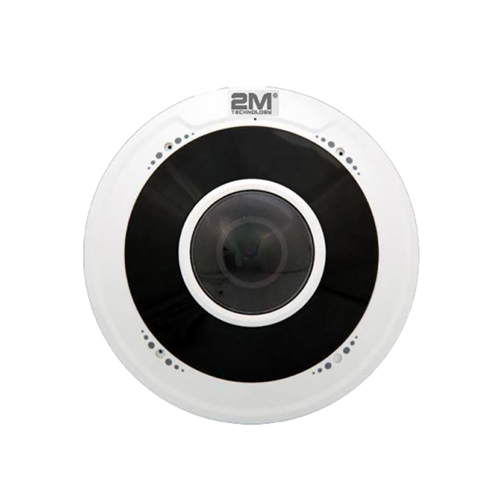
Ideal for expansive areas, our network fisheye cameras eliminate blind spots, capturing a 360-degree view of your surroundings in a single device with unparalleled clarity. These cameras also offer remote monitoring capabilities, allowing you to keep watch over your property at all times.
Network fisheye cameras, are specialized, ultra-wide-angle security cameras that provide a complete 360-degree panoramic view of an area. Because a single fisheye camera can eliminate blind spots and cover an entire room, they are an incredibly cost-effective addition to commercial security systems.
A network fisheye camera is an IP surveillance device equipped with a highly specialized, ultra-wide lens. When mounted to a ceiling, this lens captures a massive 360-degree circular image of the environment below. This panoramic capability means a single fisheye camera can often replace three or four standard fixed-lens cameras. This drastically reduces your hardware and installation costs in open environments like retail showrooms, warehouses, and large corporate lobbies.
| Type | Lens | Best For | Tradeoff |
|---|---|---|---|
| Fixed-lens fisheye | Single fixed focal length, set at install | Budget installs where the field of view won't change | Field of view can't be adjusted remotely later |
| Vandal-resistant fisheye | Fixed lens, in an impact-rated housing | Publicly accessible areas — lobbies, retail floors, parking structures | Bulkier housing than a standard indoor fisheye |
| Low-light fisheye | Fixed lens, low-light optimized sensor | Areas with poor or inconsistent lighting | Higher price tier than standard sensors |
By nature, the raw video captured by a fisheye lens is circular and heavily distorted. To make this footage useful, the video must go through a process called dewarping. Dewarping software takes that circular image and digitally flattens it out into standard, easy-to-view video panels. Many modern fisheye cameras feature edge dewarping, meaning the camera itself processes the image before sending it to your recorder. This allows you to digitally pan, tilt, and zoom through the 360-degree footage exactly as if you had multiple cameras installed.
Indoor fisheye cameras typically use a lighter plastic or basic metal housing since they aren’t exposed to weather or casual impact — a good fit for offices, hallways, and retail sales floors. Outdoor and public-area fisheye cameras need an IP66-rated weatherproof housing to keep out dust and water, and an IK10 vandal-resistant rating to withstand impact from tools, thrown objects, or deliberate tampering. Before ordering, confirm the housing rating matches where the camera will actually be mounted — an indoor-rated fisheye in an exterior soffit will fail faster from moisture exposure regardless of its image quality.
| Resolution | Pixels | Best For |
|---|---|---|
| 2MP | 1920 × 1080 | General area monitoring, budget-conscious indoor installs |
| 4MP | 2560 × 1440 | Standard commercial coverage with room to digitally zoom on playback |
| 5MP | 2560 × 1920 | Facial identification at medium distances |
| 4K (8MP) | 3840 × 2160 | License plate detail at longer distances |
Rule of thumb: 4MP is the practical minimum if you need to identify a face after the fact rather than just confirm someone was present. Starlight and WDR (Wide Dynamic Range) sensor variants are worth the added cost for entrances that face bright exterior light or need usable footage after dark.
Placement is everything when it comes to fisheye cameras. If mounted too high, you will only capture the tops of people’s heads. If mounted too low, your overall coverage area shrinks significantly. Mounting it between 12 and 15 feet is usually the sweet spot for the camera to see outward in all directions. To get a true 360-degree view without obstructions, the camera must be mounted dead center on a flat ceiling. However, you can also mount a fisheye camera flat against a wall. This cuts the field of view in half, providing a 180-degree panoramic view that is perfect for long hallways or narrow retail aisles.
Network-connected fisheye cameras are endpoints that can be targeted by attackers if not properly hardened.
Key risks:
Best practices per the NIST Cybersecurity Framework:
Yes, for general surveillance. A fisheye camera is phenomenal for situational awareness and tracking movement across a massive area. However, because the camera is stretching its pixels across a 360-degree field of view, it will not provide the same ultra-fine detail at a distance as a targeted, fixed-lens bullet or dome camera.
A fisheye uses a single, ultra-wide lens to capture a circular 360-degree image that must be digitally flattened. A multi-sensor camera literally houses three or four separate traditional camera lenses inside a single dome enclosure. Multi-sensor cameras typically offer better overall image quality and less distortion, but they are significantly larger and much more expensive than a single fisheye camera.
Neither camera style is objectively better; they simply serve different security purposes. Fisheye cameras are unmatched for broad situational awareness. Because they capture a massive 360-degree footprint, a single fisheye camera can eliminate blind spots across an entire retail floor or warehouse. However, because their pixels are stretched over such a wide area, they cannot provide the fine, zoomed-in detail needed to identify specific faces. Dome cameras, conversely, offer highly targeted, high-resolution coverage. They are the clear winner for monitoring specific choke points like entry vestibules, cash registers, or tight hallways where capturing exact details is critical. In fact, the most effective security systems often use fisheye cameras for general tracking and dome cameras for detailed identification.
They are excellent for general tracking, but they are not the best choice for identifying specific faces unless the subject walks directly underneath or very close to the camera. If strict facial identification is your primary goal, you should pair your fisheye overview camera with a targeted 5MP or 8MP bullet or dome camera positioned near your entrance doors.
The right resolution comes down to what you need to do with the video footage after an incident. If you simply want to monitor general foot traffic, see if a room is occupied, or get a broad overview of a lobby, a 2MP or 4MP camera is usually more than enough. However, if your goal is to capture clear, actionable evidence like specific facial details or license plate numbers, you should step up to a 5MP or 8MP (4K) model. Just keep in mind that higher resolutions capture more detail but will also require more network bandwidth and hard drive storage space.

Texas Security License B15309


Texas Security License B15309
2M TECHNOLOGY Inc. © 2026 | Company based in TEXAS USA – All Rights Reserved