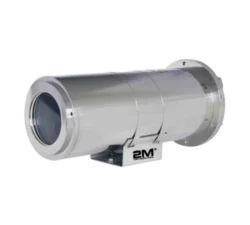
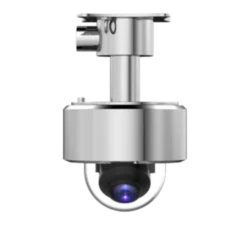
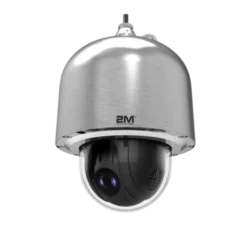
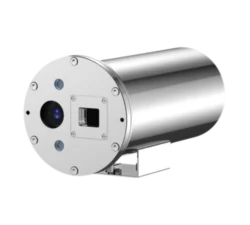
Explosion proof camera housings from 2M Technology protect surveillance cameras deployed in hazardous locations where flammable gases, vapors, combustible dust, or ignitable fibers are present. Every housing in our catalog is independently tested and certified to ATEX and IECEx standards, meeting Class I Division 1 & 2 and Class II Division 1 & 2 requirements for oil & gas, petrochemical, mining, chemical processing, and refinery environments.
Explosion-proof camera housings are ATEX & IECEx certified stainless steel enclosures that allow standard IP cameras — including Verkada, UniFi, and Cisco Meraki — to operate safely in Class I/II hazardous areas where flammable gases, vapors, or combustible dust are present. Required for oil & gas, chemical plants, refineries, grain elevators, and pharmaceutical facilities.
Our explosion proof camera housing lineup covers every camera form factor:
All standard housings use 304 stainless steel construction with optional 316L stainless steel for marine or offshore deployments. Sealing meets IP66/IP68 ingress protection ratings. Certifications include:
Our housings are compatible with major IP camera platforms including Verkada, UniFi Protect, Cisco Meraki MV, Axis, Hanwha, and Hikvision. Universal mounting brackets and lens port options accommodate most standard box, bullet, and PTZ camera bodies. Custom adapters are available for non-standard configurations.
2M Technology offers custom explosion proof housing design and fabrication for projects requiring non-standard dimensions, special alloys, unique mounting geometry, or integration with existing equipment. Our engineering team works directly with end users, EPCs, and OEM partners to deliver housings that meet exact project specifications and certification requirements. Lead times for custom fabricated units are typically 4–8 weeks depending on complexity.
Our catalog of explosion proof camera housings includes stainless steel, polycarbonate, and aluminum enclosures tested and certified for Class I Division 1, Class II Division 1, ATEX Zone 1, and IECEx environments. All explosion proof camera housings ship with mounting hardware. NEC Article 500 provides the area classification standards that determine which housing rating your installation requires.
Our explosion proof camera housings are deployed globally across:
Explosion proof camera housings are engineered enclosures that protect a camera and its electronics in classified hazardous locations — areas where flammable gases, vapors, combustible dust, or ignitable fibers may be present. The housing eliminates any ignition pathway between the camera’s internal components and the hazardous atmosphere outside. All 40 explosion proof camera housings in 2M Technology’s catalog are independently certified to ATEX and/or IECEx standards.
| Housing Type | Camera Form Factor | FOV Coverage | Best Application |
|---|---|---|---|
| Dome housing | Turret or mini-dome | Wide area | Indoor process areas, refineries, storage tanks |
| Bullet/tube housing | Box camera or module | Fixed focal or zoom | Perimeter, fence lines, loading areas |
| Box camera housing | Full-size box camera | Interchangeable lens | Long-range applications, gate inspection, yard monitoring |
| PTZ housing | PTZ camera module | 360° patrol/preset | Tank farms, large process areas, port terminals |
| Custom/retrofit housing | Any camera (Meraki, Verkada, etc.) | Varies by camera | Integrating specific brand cameras into Zone 1 areas |
The three main certification standards for explosion proof camera housings differ by geographic applicability and testing body:
For facilities in the U.S. that export to or operate in Europe or international markets, dual ATEX/IECEx + NEC rated explosion proof camera housings are the most project-portable specification.
An offshore drilling company operating in the Gulf of Mexico required explosion proof camera housing solutions for a Cisco Meraki MV surveillance deployment on a drilling platform classified as Zone 1 (ExdIIB T6 Gb). The challenge: the Cisco Meraki MV12 cameras the platform had standardized on were not rated for hazardous area use, but the IT team was committed to the Meraki platform for its cloud management and AI video analytics capabilities.
2M Technology engineered and manufactured custom 316L stainless steel explosion proof camera housings for the Meraki MV12 cameras — preserving the cloud connectivity and AI analytics while meeting the Zone 1 ExdIIB T6 Gb certification requirement. IP68 ingress protection was specified to handle the marine environment. The installation included 6 housings across two drilling decks, with window heaters to prevent condensation in the Gulf of Mexico humidity cycle. The completed installation passed the facility’s explosion protection inspection under ATEX protocols.
Material selection affects both long-term corrosion performance and facility compliance requirements:
Not sure which certification you need? Our free ATEX compliance checker identifies the exact certification required for your facility.
An explosion-proof camera housing is a certified enclosure that allows a standard or IP security camera to operate safely in hazardous areas where flammable gases, vapors, or combustible dust are present. The housing contains any internal sparks or ignition sources that could trigger an explosion in the surrounding atmosphere. Certified housings meet ATEX, IECEx, and NEC Class I/II Division standards.
Explosion-proof camera housings require ATEX certification for European and international hazardous areas, IECEx certification for global recognition, and NEC Class I Division 1 or 2 (for gas/vapor hazards) or Class II Division 1 or 2 (for combustible dust) certification for North American installations. 2M Technology supplies housings certified to all applicable standards.
Yes. 2M Technology manufactures custom explosion-proof housings designed to fit specific camera models including Verkada, Ubiquiti UniFi, Cisco Meraki, Axis, and others. The camera is installed inside the certified housing, allowing it to operate in Class I/II hazardous environments while maintaining full functionality and remote management.
Industries that require explosion-proof camera housings include oil and gas production and refining, petrochemical plants, chemical manufacturing, grain elevators, pharmaceutical manufacturing, paint and coatings facilities, wastewater treatment plants, mining operations, and any facility classified as a hazardous area under OSHA or NEC standards.
2M Technology explosion-proof camera housings are manufactured from 304 stainless steel and 316L stainless steel. 316L stainless steel provides superior corrosion resistance for marine, offshore, and highly corrosive chemical environments. Both grades meet ATEX and IECEx certification requirements.
Class I Division 1 areas have flammable gases or vapors present continuously or intermittently during normal operations — the most hazardous classification. Class I Division 2 areas have flammable gases or vapors present only during abnormal conditions such as equipment failure. Division 1 requires more stringent explosion-proof enclosures; Division 2 allows some purged or pressurized equipment.
Yes, with engineering review. 2M Technology designs and builds custom explosion proof camera housings for specific camera models — including Cisco Meraki, Verkada, Axis, Hikvision, and others. The housing is certified for the hazardous area; the camera inside does not need to be individually hazardous-location rated. The window aperture, ventilation, and thermal management are engineered to match the specific camera model’s heat output and lens geometry. Contact 2M Technology to discuss a custom housing build for your camera model.
The T-class rating specifies the maximum surface temperature of the explosion proof housing under worst-case operating conditions. T4 = maximum 135°C; T6 = maximum 85°C. A lower T-class (higher temperature rating) restricts which gas groups the housing can be used with — for hydrogen service (gas group IIC), T6 is typically required because hydrogen’s auto-ignition temperature is lower than most hydrocarbons. When specifying explosion proof camera housings, match the T-class to the lowest auto-ignition temperature of the gases present in your classified area.
Stocked standard models: 1-2 week delivery from 2M Technology’s warehouse. Custom-built housings for specific camera models: 3-6 weeks depending on housing design, material, and certification review. For large-quantity orders or frames-and-bundles project procurement, contact 2M Technology for project-specific lead time commitments. Texas Security License B15309.
Texas Security License B15309
2M TECHNOLOGY Inc. © 2026 | Company based in TEXAS USA – All Rights Reserved