
References: NICB Construction Theft Report · OSHA Construction Safety Standards
Security Infrastructure › Construction Sites
Modular container checkpoints, solar surveillance trailers, and cloud LPR built for active construction sites. Deploy in hours — no wired infrastructure, no construction delays.
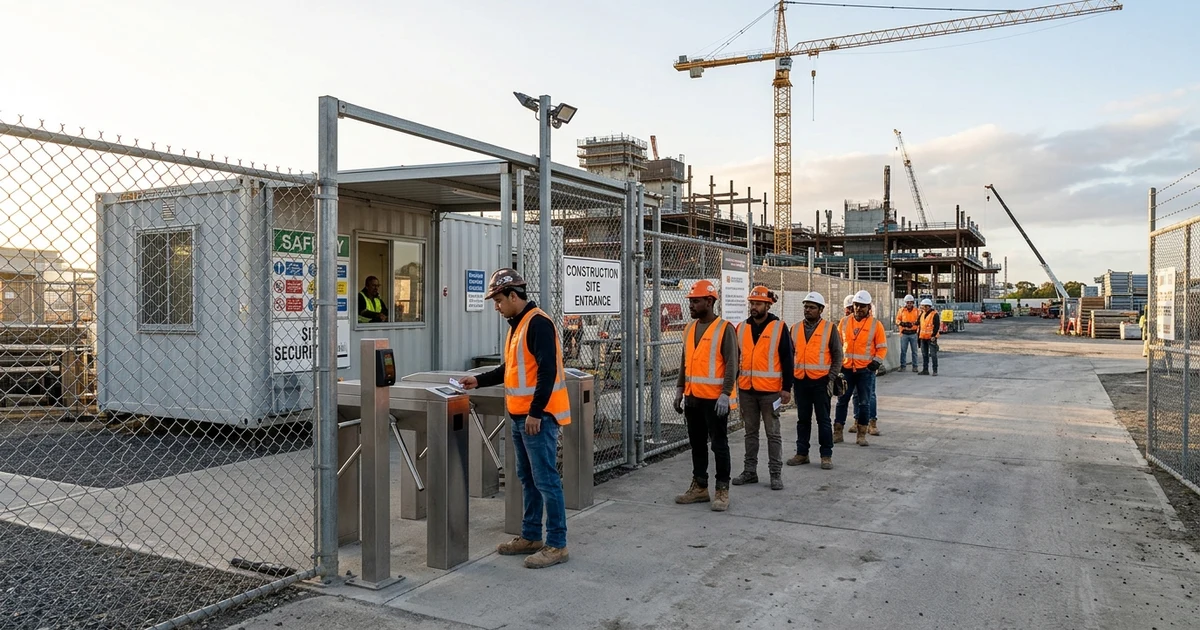
Definition: A construction site workforce checkpoint system is dedicated security infrastructure deployed at job site entry and exit points to credential workers, log vehicle access, and maintain perimeter surveillance during the active construction phase. It combines a modular container checkpoint with turnstiles, Placa.ai LPR cameras, solar CCTV surveillance trailers, and cloud-based VMS — all operational without wired power or permanent installation.
Why Construction Sites Need Dedicated Checkpoint Infrastructure
Construction sites present a uniquely complex security problem. The workforce changes daily — general contractors, subcontractors, inspectors, delivery drivers, and equipment operators cycle in and out across shifting perimeters. A hospital with a permanent guard desk and keyfob system cannot simply be transplanted to a job site. The infrastructure doesn’t exist.
Yet the security requirements are real. Theft, unauthorized access, liability exposure, and OSHA compliance all demand that site owners know exactly who is on the property at any time. Construction site workforce checkpoint systems answer this need with deployable infrastructure that arrives ready to operate and leaves no permanent footprint when the project is complete.
2M Technology designs these systems for construction sites of all sizes — from 40-worker commercial renovations to megaprojects with 200 or more workers per shift across multiple active gates.
The Construction Site Access Challenge
The scale of the problem on large construction sites is significant. Industry data points to persistent, measurable losses:
Construction theft annually in the U.S., per the National Insurance Crime Bureau (NICB)
Workers per shift on midsize to megaprojects, often from 10+ subcontractor companies
Of construction theft occurs after hours, when perimeter surveillance is most critical
Beyond theft, site owners face liability when unauthorized individuals access active construction zones. An untracked visitor in a hard-hat area creates workers’ compensation exposure even if that person is not a site employee. A contractor credential system with logged entries eliminates ambiguity about who was on site, when, and under what authorization.
Workforce Entry Management
The core function of a construction site checkpoint is managing the daily flow of workers across three categories: direct employees, credentialed subcontractors, and visitors.
Employees receive HID or MIFARE credential badges or mobile credentials tied to their employment record. Their access window is defined by shift schedule. Anti-passback rules prevent badge sharing. Entries and exits are logged automatically, providing accurate headcounts for muster in the event of a site emergency.
Subcontractors are enrolled by company. Each subcontractor firm receives a batch of credentials tied to their contract period. When the contract window ends, all credentials in that batch are automatically deactivated. Site superintendents can extend, suspend, or revoke any credential from a browser or mobile device without touching the checkpoint hardware.
Visitors are handled at a dedicated visitor management station at the container. Visitors present a government ID, which is scanned and logged. A temporary credential is issued for the duration of the visit. The visitor record links to the employee or site manager who authorized the visit, creating a clear accountability chain.
Access control panels in the 2M Technology container checkpoints are Mercury-compatible, allowing integration with Brivo cloud access control or Genetec on-premise platforms depending on the site owner’s existing infrastructure.
Vehicle and Equipment Control
Construction site vehicle management is as important as personnel control. Concrete trucks, equipment haulers, delivery vehicles, and subcontractor pickups must be logged, and unauthorized vehicles must be flagged before they reach the active work zone.
Placa.ai cloud LPR is mounted at vehicle entry and exit lanes of the container checkpoint. When any vehicle approaches the gate, Placa.ai reads the plate and cross-references it against the site’s approved vehicle list in real time. The gate control response takes under one second:
- Approved vehicle: Gate opens automatically. Entry is logged with timestamp, plate image, and driver credential if available.
- Expected delivery vehicle (scheduled): Gate opens automatically within the delivery window. Outside the window, an alert is sent to the site logistics coordinator.
- Unregistered or flagged vehicle: Gate holds. Alert is pushed to the site superintendent’s mobile device. The officer at the checkpoint receives the alert on the operator console.
Equipment tracking is extended through RFID tags on high-value assets (generators, compressors, lifts). When tagged equipment leaves through the vehicle lane, the departure is logged. Unauthorized removal triggers an immediate alert.
Perimeter Surveillance Without Wired Infrastructure
Construction site perimeters are defined by temporary fencing and change as the project progresses. Running conduit for fixed cameras to every perimeter segment would require trenching, permits, and re-runs every time the perimeter shifts — an impractical approach for any active site.
2M Technology solar surveillance trailers solve this by providing autonomous camera nodes that can be repositioned in minutes by any site vehicle with a trailer hitch. Each trailer includes:
- Solar panels and deep-cycle battery storage for 24/7 operation including overnight and cloudy-day periods
- LTE/5G cellular modem for live streaming to Ifovea cloud VMS without any site network connection
- Pan-tilt-zoom (PTZ) camera and fixed wide-angle cameras for overlapping coverage
- Onboard motion detection with alert triggering on configurable zones
- Floodlights for after-hours deterrence and illumination in alert conditions
A typical mid-size construction site uses 2–4 trailers positioned at the highest-risk perimeter segments: material storage yards, equipment staging areas, and sections of fence away from the active crew. Trailers are repositioned weekly or as the construction footprint evolves. Because they connect to Ifovea via LTE/5G, repositioning requires only moving the trailer to the new location — no reconfiguration, no IT work.
X-Ray Screening for High-Security Construction Sites
A subset of construction sites require package and bag inspection at workforce entry: government facilities under construction, military installations, secure data center builds, and projects with heightened theft-prevention requirements. For these sites, 2M Technology integrates conveyor-fed x-ray baggage screening directly into the container checkpoint.
The x-ray unit is positioned inside the container on a conveyor run that terminates at the turnstile exit. Workers place bags on the conveyor before swiping their credential. The x-ray operator inside the container can clear or hold the bag. Threat alarms trigger an audible alert and log the event with the bag scan image, worker credential, and timestamp.
X-ray screening in a container checkpoint serves dual purposes: theft prevention (preventing high-value materials from leaving the site in worker bags) and contraband control (preventing prohibited items from entering sensitive sites).
Cloud Visibility for Project Managers
Construction project managers rarely sit at the gate. They’re in site trailers, in meetings, or traveling between projects. Ifovea cloud VMS provides the remote visibility they need without requiring VPN access, dedicated client software, or on-site IT support.
From any browser or the Ifovea mobile app, a project manager can:
- View live camera feeds from the checkpoint and all solar trailers simultaneously
- Review recorded footage with timeline scrubbing — useful for investigating incidents or verifying delivery times
- Receive motion alerts from any camera zone — a material yard alert at 2 AM goes directly to a mobile device
- Export video clips for insurance claims, OSHA documentation, or law enforcement
- Access headcount and vehicle entry logs that sync with contractor payroll systems via API
Multi-project visibility is a particular advantage for general contractors managing several active sites simultaneously. All sites appear in a single Ifovea dashboard, with alerts aggregated across the portfolio.
Construction-Specific Deployment Configurations
2M Technology sizes checkpoint deployments based on project scale, workforce density, and site layout.
| Project Size | Workers/Shift | Container Configuration | Solar Trailers | LPR Lanes |
|---|---|---|---|---|
| Small Commercial | 40–75 | 20 ft, 2 turnstiles, basic access control | 1–2 | 1 entry lane |
| Mid-Size Project | 75–150 | 40 ft, 2MFHT-4C, 4 turnstiles, intercom | 2–4 | 1 in / 1 out |
| Large Project | 150–200+ | 40 ft, 2MFHT-5C, 5 turnstiles, x-ray, full LPR | 4–6 | 2 in / 2 out |
| Megaproject / Multi-Gate | 200+ / multiple gates | Multiple containers, command center, x-ray, HVAC | 6+ | Dedicated vehicle lanes per gate |
Configurations are starting points. 2M Technology engineers final layouts based on site survey, workforce shift structure, and site owner security requirements.
Related Security Infrastructure
- Distributed Operational Security Infrastructure Hub — Complete overview of all deployable systems
- Solar CCTV Surveillance Trailers — Autonomous perimeter coverage that moves with the site
- Placa.ai License Plate Recognition — Cloud LPR for construction vehicle control
- Container Turnstile Systems — Full-height and waist-height options for worker credentialing
- Ifovea Cloud VMS — Remote video management for project managers and security directors
Is Construction site workforce checkpoint Right for Your Site?
Construction site workforce checkpoint is the right approach for any site where workforce scale, vehicle volume, or perimeter size makes traditional guard booths and fixed cameras inadequate. 2M Technology engineers construction site workforce checkpoint solutions that deploy in hours, not weeks, and scale incrementally as operational requirements grow.
The core advantage of construction site workforce checkpoint from 2M Technology is open architecture: every component integrates with existing credentialing systems, VMS platforms, and access control software. There is no proprietary lock-in. Clients who already operate HID, Mercury, Brivo, or Genetec systems can connect to 2M construction site workforce checkpoint infrastructure without replacing their existing investment.
How to Evaluate a Construction site workforce checkpoint Provider
- Confirm construction site workforce checkpoint deployment timeline: pre-wired units should be operational in 4-8 hours
- Verify open-architecture credential support (HID, MIFARE, Mercury, Brivo, Ubiquiti)
- Confirm LTE/5G wireless backhaul so no site fiber is required
- Require cloud VMS and cloud LPR integration as standard, not add-on
- Validate that the construction site workforce checkpoint system can be relocated as site requirements evolve
Is Construction site workforce checkpoint the Right Approach for Your Operation?
Construction site workforce checkpoint from 2M Technology is appropriate when standard security measures cannot address the scale, throughput, or detection requirements of the operation. 2M Technology engineers construction site workforce checkpoint solutions that are calibrated to your specific site, threat profile, and operational workflow — not generic off-the-shelf configurations.
The core advantage of construction site workforce checkpoint from 2M Technology is open architecture and interoperability. Every component integrates with existing credentialing, video management, and access control platforms already in use — there is no proprietary lock-in and no requirement to replace functioning systems.
Key Questions When Evaluating Construction site workforce checkpoint Options
- Does the construction site workforce checkpoint solution deploy without permanent structural changes?
- Can the construction site workforce checkpoint system scale incrementally as operational requirements grow?
- Is the solution cloud-connected for remote oversight and event review?
- Does the construction site workforce checkpoint provider offer site assessment and ongoing support?
- Can the system integrate with your existing access control and VMS platforms?
Contact 2M Technology at (214) 988-4302 for a site-specific construction site workforce checkpoint assessment.
Frequently Asked Questions
Content reviewed and updated: May 2026. System specifications and project pricing subject to change. Contact 2M Technology for current availability and site assessment.
Secure Your Construction Site Before Mobilization Day
2M Technology designs construction site checkpoint systems for your workforce size, site layout, and project timeline. Operational in 4–8 hours. No wired infrastructure required.

