Security Infrastructure › Container Systems
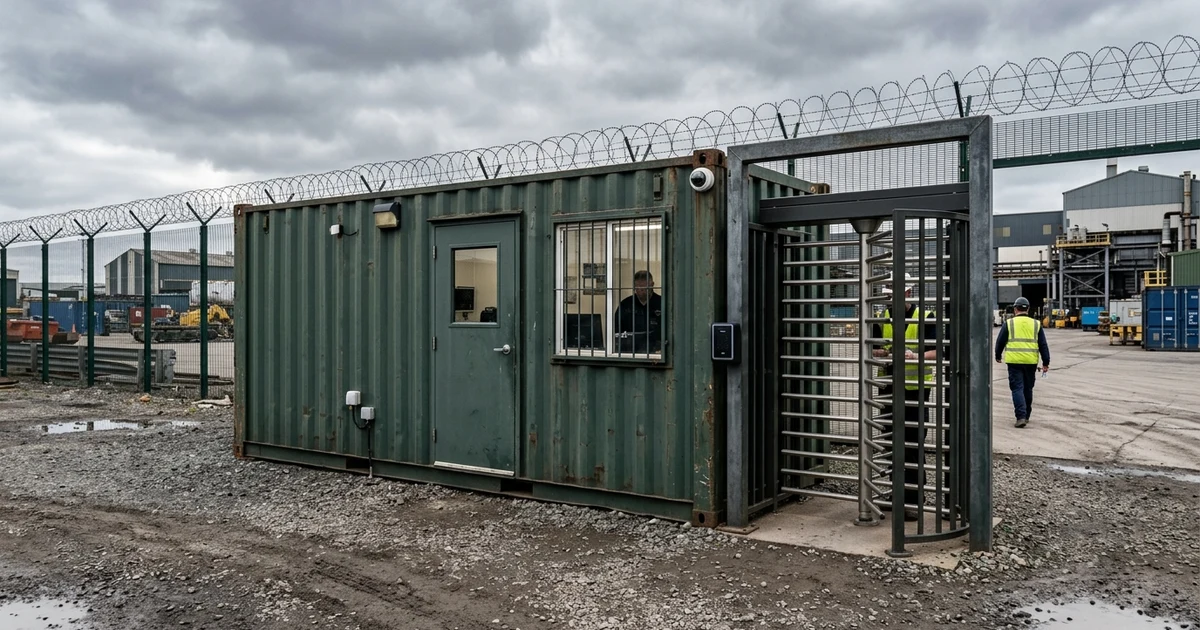
Pre-wired CONEX container checkpoints with turnstiles, access control, x-ray, LPR, and cloud VMS — operational in 4–8 hours after delivery. No foundations, no conduit, no construction delays.
Industry references: ASIS International — Physical Security Standards | DHS Facility Security Standards
Definition: A modular security container system is a standard ISO shipping container (CONEX box) that has been factory-converted into a deployable security checkpoint. The unit arrives pre-wired with turnstiles, credential readers, IP cameras, network rack, LPR, and optionally x-ray screening equipment — all integrated and tested before shipment. On-site setup requires only power connection and network activation, making the checkpoint operational in 4–8 hours.
What Are Modular Security Container Systems?
Modular security container systems solve one of the most persistent problems in temporary and permanent workforce security: the time and cost gap between site mobilization and a functioning checkpoint. Traditional guard booths require construction permits, concrete pads, electrical conduit, and weeks of installation. Modular container checkpoints eliminate all of that. 2M Technology engineers CONEX-based checkpoints under two primary SKUs: the 2MFHT-5C (five-turnstile, high-throughput configuration) and the 2MFHT-4C (four-turnstile, medium-density configuration). Both arrive fully wired and tested. Internal components include HID or MIFARE/DESFire credential readers, Mercury-compatible access control panels, IP cameras, a managed network rack, intercom, and optional HVAC. Larger configurations can incorporate x-ray baggage screening and a dedicated vehicle LPR lane. Because these containers rest on existing grade — asphalt, compacted gravel, concrete — they require no excavation. Power comes from a standard shore-power connection or a generator. An LTE/5G SIM activates cloud connectivity without fiber runs. The result is a fully functional security checkpoint operational within hours, not weeks.Standard Container Configurations
2M Technology offers four primary configuration tiers. Each can be customized with additional technology options.| Configuration | Container Size | Included Technology | Typical Use Case | Price Range |
|---|---|---|---|---|
| Single Office | 20 ft | 1 turnstile, reader, 4 cameras, network rack | Small site, visitor management | $45,000–$60,000 |
| Checkpoint + Turnstile (2MFHT-4C) | 40 ft | 4 turnstiles, HID readers, 8 cameras, intercom, LTE, Ifovea cloud VMS | Construction, energy, logistics | $65,000–$85,000 |
| Checkpoint + X-Ray (2MFHT-5C) | 40 ft | 5 turnstiles, HID readers, x-ray scanner, 10 cameras, Placa.ai LPR, intercom | Critical infrastructure, stadiums, government | $85,000–$110,000 |
| Command Center | 40 ft high-cube | Full operator workstation, multi-lane LPR, x-ray, 5 turnstiles, HVAC, UPS, fiber patch panel | Megaproject hubs, ports, military support | $95,000–$120,000 |
Pricing is approximate and varies by site conditions, customization, and delivery distance. Contact 2M Technology at (214) 988-4302 for a formal quote.
Core Components and Options
Every container checkpoint is engineered around a set of core components. Clients select technology tiers based on throughput, security level, and budget requirements.Turnstiles
Full-height or waist-height. Bi-directional, anti-passback capable. Compatible with HID, MIFARE, and DESFire credentials.
Access Control
Mercury-compatible panels. Integrates with Brivo cloud or Genetec on-premise. Credential enrollment via mobile or kiosk.
X-Ray Screening
Conveyor-fed baggage and package x-ray with dual-view imaging. Operator console inside the container. Threat alarm integration.
IP Cameras
ONVIF-compliant cameras mounted at entry lanes, parking areas, and perimeter. Feeds stream to Ifovea cloud VMS.
LPR — Placa.ai
95–99% read accuracy. Watchlist alerts, audit log, cloud dashboard. Mounted at vehicle entry and exit lanes.
Network Rack
Managed PoE switch, LTE/5G router, UPS battery backup. Ubiquiti UniFi or equivalent. Pre-configured and tested before shipping.
HVAC
Mini-split heating and cooling for operator comfort and equipment protection in Texas summers and winter cold snaps.
Intercom
IP intercom at entry points. Two-way audio with video. Integrates with access control for remote unlock by operators.
How Placa.ai LPR Integrates
Vehicle control is one of the highest-value functions of a container checkpoint. Placa.ai provides cloud-native license plate recognition that works with cameras already installed in the container, requiring no separate on-premise server. When a vehicle approaches the container vehicle lane, overhead LPR cameras capture the plate. Placa.ai processes the image in the cloud and returns a read result in under one second. If the plate matches an approved list, the gate opens automatically. If it matches a watchlist or is unregistered, an alert is pushed to the operator console and optionally to a mobile device. Placa.ai capabilities in a container checkpoint context:- 95–99% read accuracy across daylight, dusk, and low-light conditions
- Real-time cloud audit log of every vehicle entry and exit with timestamp and plate image
- Watchlist alerts delivered via browser, mobile app, or webhook to third-party systems
- No on-premise server required — LTE/5G from the container connects directly to the Placa.ai cloud
- Multi-site visibility: all container deployments across a portfolio appear in a single Placa.ai dashboard
- Integration with Genetec and other VMS platforms via API
How Ifovea Cloud VMS Integrates
Ifovea is the cloud video management system that consolidates all camera feeds from the container checkpoint — turnstile lanes, vehicle entry, perimeter overwatch — into a single browser-accessible interface. Unlike traditional VMS software that requires an on-premise server and VPN for remote access, Ifovea streams camera feeds from the container directly to the cloud. Project managers, security directors, and remote operations centers can monitor any camera in real time from any device without being on site. Ifovea features for container checkpoint deployments:- ONVIF-compatible with all major IP camera brands — works with cameras pre-installed in the container
- Cloud recording with configurable retention (7, 30, 90 days)
- Motion-triggered alerts delivered to email or mobile app
- Multi-site dashboard: all container deployments on one screen
- No dedicated NVR hardware required — reduces cost and failure points
- Role-based access control: site managers see their sites; security directors see all sites
Deployment Timeline
The speed advantage of a modular container checkpoint is most visible in the deployment sequence. What takes 6–12 weeks for a traditional guard booth or gatehouse takes hours with a container checkpoint.- Delivery and positioning: Container arrives on a flatbed. A crane or forklift places it on prepared grade — compacted gravel or asphalt. No concrete pad required.
- Shore power or generator connection: Standard 200–400A electrical connection. A generator can substitute if utility power is unavailable at mobilization.
- LTE/5G activation: The pre-installed LTE/5G router is SIM-activated. The container achieves cloud connectivity without any fiber or DSL infrastructure.
- Cloud platform onboarding: Placa.ai and Ifovea accounts are pre-provisioned. Cameras, LPR zones, and access rules are activated remotely by 2M Technology’s engineering team.
- Credential enrollment: Worker badges or vehicle plates are imported via CSV or mobile enrollment. The system is ready for live access control.
- Operator training: 2M Technology provides on-site or remote training. Most operators reach proficiency within two hours.
Industries Using Modular Container Checkpoints
Modular container security systems serve any sector where workforce or vehicle access must be controlled at a site that lacks permanent infrastructure, has changing perimeter requirements, or operates on compressed timelines.Construction & Infrastructure
Large-scale construction projects, highway and bridge work, utility infrastructure projects requiring workforce tracking and vehicle control across shifting perimeters.
Energy & Upstream Oil and Gas
Drilling pads, pipeline construction corridors, solar and wind farm build-outs, and LNG terminal construction where workforce numbers fluctuate rapidly.
Logistics & Distribution
Temporary distribution hubs, peak-season overflow yards, intermodal staging areas, and bonded warehouse perimeters where vehicle flow must be logged.
Government & Military Support
Forward operating base checkpoints, emergency operations perimeters, FEMA response staging areas, and temporary government facility access control.
Events & Temporary Venues
Large-scale events requiring credentialed staff entry with x-ray screening, vehicle control for production vehicles, and perimeter surveillance.
Critical Infrastructure
Water treatment, power generation, and data center campus perimeters where NERC-CIP or similar compliance requires documented access logs and badge-in/badge-out records.
Related Security Infrastructure
- Case Study: 10-ft Container Turnstile Checkpoint
- Distributed Operational Security Infrastructure Hub — Overview of all deployable security systems
- Container Turnstile Systems — Turnstile configurations for container checkpoints
- Solar CCTV Trailers — Perimeter surveillance beyond the checkpoint footprint
- Placa.ai License Plate Recognition — Cloud LPR for vehicle control
- Ifovea Cloud VMS — Remote video management for all container camera feeds
- Access Control Systems — HID, MIFARE, Mercury panel options
Is Modular security container systems Right for Your Site?
Modular security container systems is the right approach for any site where workforce scale, vehicle volume, or perimeter size makes traditional guard booths and fixed cameras inadequate. 2M Technology engineers modular security container systems solutions that deploy in hours, not weeks, and scale incrementally as operational requirements grow.
The core advantage of modular security container systems from 2M Technology is open architecture: every component integrates with existing credentialing systems, VMS platforms, and access control software. There is no proprietary lock-in. Clients who already operate HID, Mercury, Brivo, or Genetec systems can connect to 2M modular security container systems infrastructure without replacing their existing investment.
How to Evaluate a Modular security container systems Provider
- Confirm modular security container systems deployment timeline: pre-wired units should be operational in 4-8 hours
- Verify open-architecture credential support (HID, MIFARE, Mercury, Brivo, Ubiquiti)
- Confirm LTE/5G wireless backhaul so no site fiber is required
- Require cloud VMS and cloud LPR integration as standard, not add-on
- Validate that the modular security container systems system can be relocated as site requirements evolve
Containerized Security Solutions
Portable container turnstiles for construction and job sites — worker badging, attendance tracking, and theft prevention, deployed in hours.
Workforce, contractor, visitor, and event entry control with full-height turnstiles, badge and biometric readers, cameras, HVAC, and power.
Custom Container Security Checkpoints
Full screening units with turnstiles, X-ray baggage screening, walk-through metal detectors, cameras, access control, guard workstations, and commissioning.
Prefab guard booths and guard shacks built in CONEX containers — turnstile lanes, readers, cameras, HVAC, and solar options integrated.
Not sure which fits your site? Use the container configurator or request a quote.
Frequently Asked Questions
Content reviewed and updated: May 2026. Product specifications and pricing are subject to change. Contact 2M Technology for current availability.
Ready to Deploy a Container Checkpoint?
2M Technology engineers and delivers modular CONEX container checkpoints configured for your site, workforce size, and security requirements. Operational in 4–8 hours after delivery.