Security Infrastructure › Large Properties
Distributed solar surveillance nodes, Placa.ai LPR at gates, and Ifovea cloud VMS — complete perimeter visibility for large acreage properties with no wired infrastructure required.
Definition: Large property perimeter security infrastructure is a distributed network of autonomous surveillance nodes, gate control systems, and cloud management platforms deployed across properties where a single camera or wired system cannot provide complete perimeter coverage. It operates without wired power or communications infrastructure — each node runs on solar power and connects to cloud platforms via LTE/5G — making it the only practical security approach for estates, ranches, remote industrial sites, and large campuses.
What Large Property Perimeter Security Infrastructure Means
Securing a 50-acre ranch, a 200-acre estate, or a remote solar farm presents a fundamentally different engineering problem than securing a building or urban campus. The perimeter is measured in thousands of linear feet. Terrain, vegetation, and varying topography create natural blind spots. Running electrical conduit and fiber to cover the entire fence line would cost more than the security system itself — and would be impractical or impossible on many properties.
Large property perimeter security infrastructure addresses this by distributing autonomous surveillance nodes along the perimeter rather than running infrastructure to fixed camera locations. Each node is self-powered and self-connected. The cloud ties them together into a unified view accessible from any device, anywhere.
2M Technology designs these systems for properties starting at 20 acres and scaling to thousands of acres, with configurations that include solar CCTV trailers at perimeter intervals, Placa.ai cloud LPR at vehicle entry gates, and Ifovea cloud VMS as the monitoring and recording backbone. No on-premise servers. No fiber runs. No utility power at perimeter nodes.
Why Fixed Camera Systems Fail on Large Properties
Traditional wired CCTV systems are designed for buildings and small campuses. When applied to large properties, their assumptions break down at every level.
| Challenge | Wired Fixed Camera System | Distributed Solar Node System |
|---|---|---|
| Power at perimeter | Requires trenching, conduit, electrical work at every camera location | Solar panels + battery. No conduit. Repositionable. |
| Network connectivity | Fiber or Cat6 runs to each location. Expensive, disrupts landscape. | LTE/5G cellular at each node. No cable runs. |
| Coverage gaps | Fixed. Gaps persist unless new conduit is run. | Trailers repositioned in minutes to address discovered blind spots. |
| Installation time | Weeks to months depending on trenching and permitting | Hours. Trailers are towed to position and left running. |
| Remote access | Requires on-premise DVR/NVR and VPN for off-site viewing | Ifovea cloud VMS. Browser or mobile app, no VPN. |
| Scalability | Adding coverage requires new trenching and infrastructure | Add a trailer. Connect it to Ifovea. Done. |
| Power outage | System goes dark. Requires UPS at each node or central UPS. | Battery storage continues operation through outages and cloudy days. |
Distributed Solar Surveillance Node Architecture
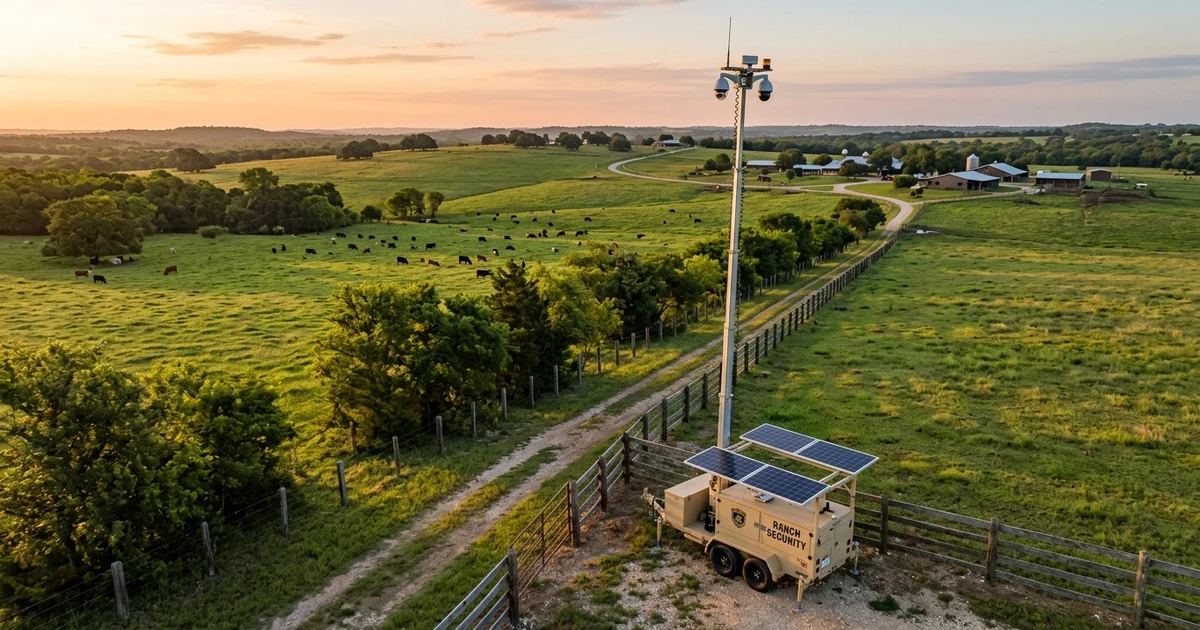
The foundation of a large property perimeter security system from 2M Technology is a network of solar surveillance trailers deployed at intervals along the fence line. Each trailer is an autonomous surveillance node.
Each solar surveillance node includes:
- Solar array: Panels sized for the geographic latitude and expected daily operation duration. Most configurations provide 24/7 coverage with 3–5 days of battery autonomy during extended cloudy periods.
- Deep-cycle battery bank: Onboard storage that continues powering cameras and communications through overnight hours and adverse weather.
- LTE/5G router: Connects to the cellular network using a commercial data SIM. Streams live video to Ifovea cloud VMS continuously. No on-site Wi-Fi or network required.
- PTZ camera: Pan-tilt-zoom for operator-directed investigation of detected motion events. Can sweep a wide perimeter arc remotely.
- Fixed wide-angle cameras: Continuously recording a defined coverage zone. ONVIF-compliant for universal Ifovea compatibility.
- Onboard motion analytics: Configurable zones trigger alerts when motion is detected in defined areas — fence line, gate approach, or interior exclusion zones.
- Integrated floodlights: Activated on motion detection alerts after dark. Deterrence plus illumination for usable night video.
Trailers are towed using any standard truck. Repositioning takes minutes — drive the trailer to the new position, lower the leveling jacks, raise the mast, and the system re-establishes its Ifovea connection automatically. No IT work required.
Gate Security with Placa.ai LPR
The most vulnerable point of any large property is the vehicle gate. A property can have perfect perimeter visibility from solar trailers, but if unrecognized vehicles enter through an unmonitored or manually-operated gate, the perimeter is meaningless.
Placa.ai cloud LPR converts any vehicle gate into an intelligent entry point. LPR cameras are mounted at the gate approach, angled to capture the license plate at vehicle speed. The Placa.ai cloud processes the read in under one second and compares it against the property’s approved vehicle list.
Gate control behaviors based on Placa.ai reads:
- Family and household vehicles (approved list): Gate opens automatically. Entry logged with timestamp, plate image, and matched identity record.
- Scheduled service providers (time-windowed approval): Gate opens only within the approved service window. Outside the window, the gate holds and an alert is sent to the property manager.
- Delivery vehicles (one-time approval): Gate opens once for a specific plate, then the approval expires. Re-entry requires re-authorization.
- Unknown vehicle: Gate holds. Alert is delivered to the property owner’s mobile device with a live photo of the vehicle. Owner can approve or deny entry remotely from the Placa.ai app.
- Watchlist vehicle: Gate holds. Immediate high-priority alert to all authorized contacts. Incident logged with vehicle image and time.
All gate events — opens, holds, alerts, and remote approvals — are logged to the Placa.ai cloud dashboard. The property owner has a complete audit trail of every vehicle entry and exit, accessible from any browser or mobile device, regardless of whether anyone is on site.
Cloud VMS for Remote Monitoring Without On-Site Staff
Most large estate and ranch owners do not have 24/7 on-site security staff. They need monitoring that works even when no one is present — and they need to be able to investigate incidents after the fact without traveling to the property.
Ifovea cloud VMS provides both. All camera feeds from all solar trailer nodes stream continuously to the Ifovea cloud. Recording is continuous with cloud retention. The property owner, their estate manager, or a professional monitoring service can access live and recorded footage from any browser or the Ifovea mobile app.
Ifovea capabilities for large property monitoring:
- Live view of all perimeter nodes simultaneously in a multi-camera grid layout
- Timeline scrubbing for recorded footage — investigate a motion alert by jumping to the exact timestamp
- Motion alert delivery via mobile push notification or email, with a thumbnail image and camera location in the notification
- Video clip export for law enforcement, insurance claims, or dispute resolution
- Role-based access: property owner sees all cameras; estate manager sees operational cameras; professional monitoring service sees all cameras during overnight hours
- No VPN required. No on-premise DVR. No IT maintenance needed at the property.
Coverage Planning for Large Acreage
Coverage planning starts with the perimeter geometry. A 2M Technology engineer reviews aerial imagery, fence line coordinates, terrain, and vegetation to determine trailer positions that minimize gaps and overlap.
| Property Size | Approx. Perimeter | Trailer Positions | Gate LPR Cameras | Notes |
|---|---|---|---|---|
| 20–50 Acres | 2,000–4,000 ft | 4–8 | 2–4 | Flat terrain with standard vegetation |
| 50–200 Acres | 4,000–9,000 ft | 8–20 | 4–8 | Mixed terrain; some trailer overlap recommended |
| 200–500 Acres | 9,000–15,000 ft | 20–35 | 6–12 | Ranch or agricultural; elevated trailer masts increase coverage radius |
| 500+ Acres / Remote Industrial | 15,000+ ft | 35+ | 8–20+ | Solar farm, remote facility; interior coverage nodes may also be required |
Coverage estimates assume open terrain and 300–400 ft effective camera range per trailer. Dense vegetation, rolling terrain, or interior coverage requirements increase node counts. A 2M Technology site assessment provides a precise coverage plan.
Property Types and Use Cases
Private Estates
Large residential properties requiring perimeter monitoring, gate vehicle intelligence, and after-hours intrusion detection without permanent infrastructure that disrupts landscaping.
Working Ranches
Cattle ranches, horse properties, and agricultural land where perimeter breaches mean livestock loss, equipment theft, or trespassing by hunters and off-road vehicle riders.
Solar & Wind Energy Farms
Renewable energy installations spanning hundreds of acres with high-value infrastructure and no on-site staff. Perimeter nodes protect panel fields and substation perimeters without wired infrastructure.
Private Campuses
Corporate retreat centers, educational campuses, and religious properties with acreage that exceeds fixed camera coverage and requires vehicle control at multiple entry gates.
Remote Industrial Sites
Aggregate yards, remote warehousing, pipeline infrastructure, and rural industrial properties where running fiber and conduit is cost-prohibitive and utility power is limited.
Nature Preserves & Conservation Land
Conservation properties where wired infrastructure would damage ecosystems but perimeter monitoring is required to prevent poaching, illegal dumping, and unauthorized access.
No Wired Infrastructure Required
The defining advantage of a distributed solar surveillance system is complete autonomy from wired infrastructure. This is not a minor convenience — it is the fundamental engineering difference that makes large property perimeter security practical.
Consider the alternative: a 100-acre ranch with a perimeter of approximately 6,000 linear feet. Running conduit for wired cameras at 200-foot intervals would require 30 camera runs, each potentially hundreds of feet long, with trenching through established pasture, creek beds, and rocky terrain. The electrical work alone would cost tens of thousands of dollars, take months, and leave permanent trenching scars. And if the camera positions need to change, the process repeats.
With LTE/5G-connected solar nodes:
- No trenching. No conduit. No landscape disruption.
- No fiber runs. No DSL or cable installation. No utility coordination.
- No on-premise network equipment. No server room. No IT infrastructure.
- Trailers repositioned as needed — seasonal coverage changes, responding to discovered blind spots, or relocating after a fence line changes.
- LTE/5G data costs are typically $40–$80 per trailer per month — a fraction of wired infrastructure costs.
- Cloud recording in Ifovea eliminates the need for any on-property storage device that could be stolen or damaged.
This infrastructure-free approach is why 2M Technology solar surveillance systems are deployed on properties where traditional security integrators have told clients that camera coverage is impractical or cost-prohibitive.
Related Security Infrastructure
- Distributed Operational Security Infrastructure Hub — Complete overview of all deployable systems
- Solar CCTV Surveillance Trailers — Autonomous perimeter nodes for large acreage
- Placa.ai License Plate Recognition — Cloud LPR for remote gate control
- Ifovea Cloud VMS — Remote monitoring from any device, no VPN required
- Construction Site Perimeter Blind Spots — Coverage gap analysis for active job sites
- Large Property Security Blind Spots — Identifying and eliminating coverage gaps on large acreage
Is Large property perimeter security the Right Solution for Your Site?
Large property perimeter security from 2M Technology is the right approach for any site where workforce scale, vehicle volume, or perimeter size makes traditional guard booths and fixed cameras inadequate. 2M Technology designs large property perimeter security that deploys in hours, not weeks, and scales incrementally as your operational requirements grow.
The core advantage of large property perimeter security from 2M Technology is open architecture: every component integrates with existing credentialing systems, VMS platforms, and access control software without proprietary lock-in. Organizations already operating HID, Mercury, Brivo, or Genetec systems can connect large property perimeter security without replacing existing investment.
How to Evaluate a Large property perimeter security Provider
- Confirm large property perimeter security deployment timeline — pre-wired units should be operational in 4 to 8 hours
- Verify open-architecture credential support (HID, MIFARE, Mercury, Brivo, Ubiquiti)
- Confirm LTE and 5G wireless backhaul so no site fiber is required
- Require cloud VMS and cloud LPR integration as standard components
- Validate the large property perimeter security system can relocate as site requirements evolve
Frequently Asked Questions
Content reviewed and updated: May 2026. Coverage estimates and system specifications are subject to change based on property conditions. Contact 2M Technology for a site-specific assessment.
Map Your Large-Site Perimeter Coverage
2M Technology engineers distributed perimeter security systems for estates, ranches, energy sites, and remote industrial properties across Texas and the U.S. No wired infrastructure required. Coverage planning starts with your property acreage and fence line.