Updated May 2026 | 2M Technology | Grand Prairie, TX
Contractor badging, high-throughput shift entry, x-ray screening, and cloud oversight — engineered for the demands of industrial entry environments where standard commercial systems fall short.
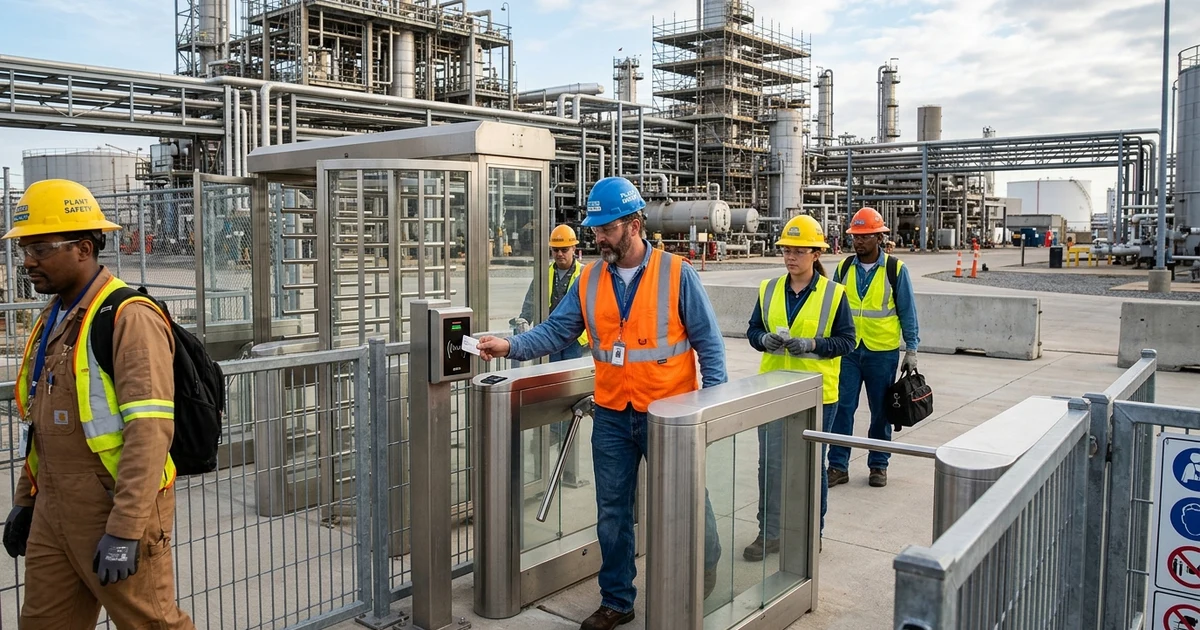
Engineer Industrial Workforce Access →Industrial workforce access control infrastructure is the integrated system of turnstile checkpoints, credential readers, contractor management software, x-ray screening stations, LPR vehicle gates, and cloud video oversight that manages who enters an industrial facility — plant, refinery, or utility — at every shift boundary. Unlike commercial office access control, industrial systems must handle high-density shift changes, hazardous area compliance, contractor certification validation, and tool/equipment accountability simultaneously.
Industrial Workforce Access Control: What It Requires
Industrial access control infrastructure has fundamentally different requirements than commercial building security. A 12-hour shift change at a refinery may move 400 to 600 workers through a single checkpoint in under 30 minutes. Contractors from dozens of different companies arrive simultaneously, each with different zone authorizations, certification requirements, and equipment they are permitted to bring on-site. Standard commercial turnstile and badge systems are not designed for this environment. The critical design factors for industrial workforce access include: throughput rate per lane measured in people per minute, contractor management integration with HR and safety training databases, zone restriction enforcement for hazardous areas, and x-ray or tool screening that does not create a chokepoint. 2M Technology designs and integrates all of these components as a unified system. Plants and refineries we have worked with report that unstructured manual sign-in processes consume an average of 18 minutes of supervisor time per shift change — time that compounds across every shift of the year. Replacing manual processes with RFID-based checkpoint infrastructure reduces this to under 4 minutes while producing an auditable digital record.Contractor Management Workflows
Contractors present the most complex access control problem in industrial environments. Unlike employees, contractors change frequently, carry certifications that expire, are authorized for specific zones only, and may arrive from third-party companies whose HR records the facility does not control directly. Industrial contractor management workflow in a properly designed system:- Pre-authorization: Contractor submits credentials, safety certifications, and training records before arrival. System checks against required certifications for the work order zone. Credential is issued only after all requirements are met.
- Zone restriction: The issued credential is scoped to the specific process units or buildings on the work order. Attempting to access adjacent restricted zones results in denial and an alert to the shift supervisor.
- Certification expiry: The access system monitors certification expiration dates. A contractor whose OSHA-30 or H2S training expires mid-project has their credential automatically suspended until the certification is renewed.
- Mustering: Hard anti-passback ensures that emergency headcount reflects actual facility occupancy rather than badge-in logs that may not account for tailgating.
Shift Entry Management at Scale
High-throughput shift entry is a design problem, not just a technology problem. The number of turnstile lanes, the credential read distance, and the physical lane geometry all determine whether 400 workers can enter safely in 15 minutes or whether crowd compression becomes a safety hazard.| Shift Size | Lanes Required | Throughput per Lane | Clear Time |
|---|---|---|---|
| Up to 150 workers | 2 lanes | 25 people/min | ~3 minutes |
| 150–400 workers | 3–4 lanes | 25–30 people/min | 5–8 minutes |
| 400–800 workers | 5–8 lanes | 30–40 people/min | 10–15 minutes |
| 800+ workers | 8+ lanes, dual checkpoint | 30–40 people/min | 15–20 minutes |
Industrial Security Engineering | (214) 988-4302
How many workers per shift? We will size your checkpoint.
Talk to an Engineer →X-Ray Screening for Tool and Package Control
Many industrial facilities — particularly refineries, petrochemical plants, and power generation sites — require screening of bags, tool bags, and packages at the entry checkpoint. X-ray screening stations are integrated into the checkpoint flow immediately before or after the turnstile lane. The critical design decision is whether x-ray screening applies to all entrants or only to contractors and visitors, with a pre-cleared bypass lane for badged employees. X-ray integration with access control software adds an interlock: the turnstile does not open until the x-ray operator marks the screened individual as cleared in the system. This prevents bypass of the screening station. 2M Technology installs Smiths Detection and Rapiscan systems in industrial checkpoint configurations.Hazardous Area Considerations
Perimeter surveillance in classified hazardous areas requires explosion-proof or intrinsically safe camera housings. Under NEC Article 500, Class I Division 1 areas (where flammable gases are present continuously or intermittently under normal operating conditions) require Group-rated explosion-proof enclosures. Division 2 areas may use intrinsically safe designs or purged/pressurized enclosures. 2M Technology installs explosion-proof cameras on refinery and petrochemical perimeters, rated for Class I Division 1 and Division 2 environments. These cameras integrate with Ifovea cloud VMS for remote monitoring alongside standard perimeter cameras at non-hazardous locations. ATEX-rated cameras are available for international deployments.Vehicle and Equipment Access
Industrial facilities receive significant daily vehicle traffic: delivery trucks, vendor vehicles, contractor equipment transporters, and fuel tankers. Manual vehicle logging at the gate creates queues and produces unreliable records. Placa.ai LPR automates vehicle identification: plates are read by overhead cameras as vehicles approach, cross-referenced against an authorized vehicle list, and the gate operator is triggered automatically for recognized plates. Unrecognized vehicles are flagged for guard verification. The complete vehicle log — plate, timestamp, photo, and authorization decision — is stored in the cloud for audit purposes. Average vehicle processing time with LPR automation: 4 to 8 seconds versus 45 to 90 seconds for manual guard check-in.Cloud Video and Remote Oversight
Ifovea cloud VMS connects all checkpoint cameras, perimeter cameras, and explosion-proof zone cameras into a single remote-accessible interface. Multi-site industrial operators use Ifovea to monitor plant entry points from a central operations center without requiring on-site security staff at every facility. Ifovea supports high-retention cloud storage, motion event alerts, and integration with access control event streams so that a door-forced-open alarm at a remote plant immediately surfaces the corresponding camera view to the central operator.Integration with Existing Safety and HR Systems
Industrial access control systems should not operate as data silos. Contractor management software (such as ISNetworld, Avetta, or Veriforce) maintains certification and compliance records that should drive access authorization decisions in real time. 2M Technology engineers API integrations between access control platforms (Brivo, Genetec) and contractor management databases so that certification status changes are reflected in access permissions within minutes rather than days. HR system integration ensures that terminated employees have credentials suspended at the moment of HR system update. Visitor management integration routes contractor pre-registration through a web portal that feeds directly into the access control enrollment queue, eliminating duplicate data entry at the checkpoint.Industrial Deployment Configurations
| Facility Type | Typical Workforce | Key Components | Access Platform |
|---|---|---|---|
| Small manufacturing plant | 50–150/shift | 2 turnstile lanes, LPR gate, CCTV | Brivo cloud |
| Mid-size refinery | 200–500/shift | 4–6 lanes, x-ray, exp-proof perimeter, LPR | Genetec + Mercury |
| Large utility / power plant | 300–800/shift | CONEX checkpoint, 6–10 lanes, dual vehicle gate | Genetec + Mercury |
| Multi-site enterprise | Variable per site | Standardized CONEX units, federated access control | Genetec Federation or Brivo Multi-Site |
Need a Full Container Security Checkpoint?
For industrial and energy sites requiring complete personnel screening alongside workforce access control, 2M Technology builds custom container security checkpoints — complete units with X-ray screening, walk-through metal detectors, turnstiles, cameras, access control, and commissioning. For workforce entry control only, see our container turnstiles for oil and gas sites.
View Custom Container Security Checkpoints →Industrial Access Control Standards
Industrial workforce screening sits at the intersection of site-security and jobsite-safety rules: OSHA 29 CFR 1926 governs site control on construction and industrial projects, CISA physical security guidance covers critical-infrastructure facility protection, and personnel screening equipment follows NIJ Standard 0601.02 from the National Institute of Justice. 2M’s container-built access points implement these with full-height turnstile lanes rated 20–30 workers per minute per lane and badge/biometric records retained for contractor compliance audits.Is Industrial workforce access control the Right Solution for Your Site?
Industrial workforce access control from 2M Technology is the right approach for any site where workforce scale, vehicle volume, or perimeter size makes traditional guard booths and fixed cameras inadequate. 2M Technology designs industrial workforce access control that deploys in hours, not weeks, and scales incrementally as your operational requirements grow.
The core advantage of industrial workforce access control from 2M Technology is open architecture: every component integrates with existing credentialing systems, VMS platforms, and access control software without proprietary lock-in. Organizations already operating HID, Mercury, Brivo, or Genetec systems can connect industrial workforce access control without replacing existing investment.
How to Evaluate an Industrial workforce access control Provider
- Confirm industrial workforce access control deployment timeline — pre-wired units should be operational in 4 to 8 hours
- Verify open-architecture credential support (HID, MIFARE, Mercury, Brivo, Ubiquiti)
- Confirm LTE and 5G wireless backhaul so no site fiber is required
- Require cloud VMS and cloud LPR integration as standard components
- Validate the industrial workforce access control system can relocate as site requirements evolve
Frequently Asked Questions
Engineer Industrial Workforce Access
Share your shift size, facility type, and current checkpoint setup. 2M Technology will design a turnstile and credentialing system that clears your workforce safely and on time.
Request an Engineering Review Call (214) 988-4302Related Project
See a containerized industrial access control unit we designed, fabricated and delivered for an energy facility: Case Study: 10-ft Container Turnstile Checkpoint (Louisiana Energy Site).