Updated May 2026 — Includes current AI weapons detection options, Texas school safety funding programs, and throughput planning guidance.
School metal detectors are walk-through or handheld electromagnetic screening devices installed at K-12 school entrances to detect firearms, knives, and concealed metal weapons before they enter the building. In the 2020-2021 school year, there were 93 school shootings with casualties in the U.S. — the highest since 2000-2001 (Bureau of Justice Statistics). This guide covers everything school administrators and safety directors need to evaluate, plan, and deploy school metal detectors effectively.
2M Technology designs and installs school metal detector systems for K-12 campuses across Dallas-Fort Worth and Texas — serving public school districts, private schools, and charter campuses from our Grand Prairie headquarters.
Need help planning school entrance screening?
2M Technology designs school metal detector systems based on campus layout, arrival traffic, staff availability, camera coverage, access control, and Texas grant funding options.
Why Schools Are Installing Metal Detectors
Metal detectors serve two distinct security functions in K-12 environments: detection and deterrence. When a student or visitor knows that all entrances are screened, the psychological barrier to bringing a weapon onto campus increases significantly. Beyond deterrence, school metal detectors provide a documented screening record — critical for liability and compliance purposes following safety incidents.
A CDC study found that more than 7% of high school students had been threatened or injured with a weapon on school property. Approximately 5% of students ages 12-18 reported fearing attack or harm at school — higher than the 3% who feared harm away from school (NCES). Schools that implement visible screening measures report improved student perception of safety, which directly affects attendance and learning outcomes.
What School Metal Detectors Can and Cannot Prevent
Understanding the scope of school metal detectors is essential before committing to a deployment. Walk-through and handheld detectors reliably identify:
- Firearms (handguns, rifles if concealed under clothing)
- Knives and edged weapons with metal blades
- Brass knuckles, metal clubs, and improvised metal weapons
- Prohibited items like vapes with metal housings
School metal detectors do not detect non-metallic threats (ceramic blades, plastic components, explosives without metal triggers). They are one layer in a multi-layered security system — most effective when combined with surveillance cameras, access control, and trained security staff. No single technology is 100% effective against a determined threat; school metal detectors work best when paired with staff training and student reporting culture.
Walk-Through Metal Detectors vs. AI Weapons Detection Systems
Schools evaluating screening equipment face a choice between two primary categories:
| Factor | Walk-Through Metal Detector | AI Weapons Detection System |
|---|---|---|
| How it works | Students walk through a gate; alarm triggers on metal detection | Camera-based AI identifies weapon shapes without stopping students |
| Throughput | 60–100 students/minute (multi-zone) | Up to 3,600 students/hour per lane, no stopping required |
| Cost per unit | $3,500–$12,000 | $18,500–$45,000+ |
| False alarm rate | Low with proper zone calibration | Improving — AI training reduces false positives over time |
| Detection scope | Metal objects only | Visible weapons including non-metallic threats |
| Staff required | 1–2 per station | Remote monitoring possible |
| Best for | Standard K-12 budget deployments | High-volume schools, special events, reduced staff environments |
For most K-12 budgets, multi-zone walk-through school metal detectors remain the practical standard. AI weapons detection is the faster-evolving category and may become cost-competitive within 3–5 years.
How Many Metal Detectors Does Your School Need?
The number of school metal detectors required depends on three variables: the number of active student entry points, peak arrival flow (students per 15-minute window), and acceptable queue length. A general planning formula:
- Single main entrance schools: 1–2 walk-through units with a staffed handheld for secondary screening
- Multi-entrance schools (2–4 entrances): 1 walk-through per active entrance, plus a portable handheld unit for overflow and events
- Large campuses (1,500+ students, 5+ entrances): Controlled entry policy funneling students to 2–3 designated screening points with 2 units each
The national average of ~526 students per public school means a single multi-zone school metal detector can process the entire student body in under 10 minutes at maximum throughput — eliminating the “too slow” concern that causes many districts to delay implementation.
Throughput Planning: Students Per Minute
Throughput is the most misunderstood factor in school metal detector planning. Older single-zone detectors process 15–30 students per minute with secondary checks. Modern multi-zone school metal detectors, like 2M Technology’s 2MWT-i24Z with 24 detection zones, process 60–100 students per minute while showing the approximate body zone of a detected item — eliminating full-body pat-downs for most alarms.
Practical throughput calculation: A school with 800 students arriving over 30 minutes requires processing ~27 students/minute. One modern multi-zone school metal detector handles this comfortably. At 1,500 students over 30 minutes (~50 students/minute), two units or two staffed entry lanes are the appropriate design.

Reducing False Alarms: Bag Checks and Sensitivity Calibration
False alarms are the operational challenge that derails poorly planned school metal detector deployments. The fix is zone-based detection and proper sensitivity calibration — not lower sensitivity settings that miss real threats.
- Zone detection — Multi-zone detectors identify the body location of a detected item (left ankle, right hip, torso). Staff direct targeted checks to that zone rather than full-body searches, reducing check time from 45 seconds to 5–10 seconds.
- Sensitivity thresholds — School metal detectors can be calibrated to ignore small non-threatening items (coins, belt buckles, underwire) while remaining sensitive to objects at the mass of a handgun or knife blade. 2M Technology configures sensitivity during installation based on your school’s specific alarm tolerance.
- Staff training — Two to four hours of initial training covers alarm response protocols, secondary screening procedures, and de-escalation for student interactions. Annual refresher training is recommended.
- Bag X-ray integration — For schools with backpack-carry policies, a bag X-ray scanner at the entry point paired with school metal detectors provides comprehensive screening. See our guide on X-ray baggage scanners for schools.
Where to Place School Metal Detectors
Placement determines whether school metal detectors function as a genuine security layer or a security theater installation:
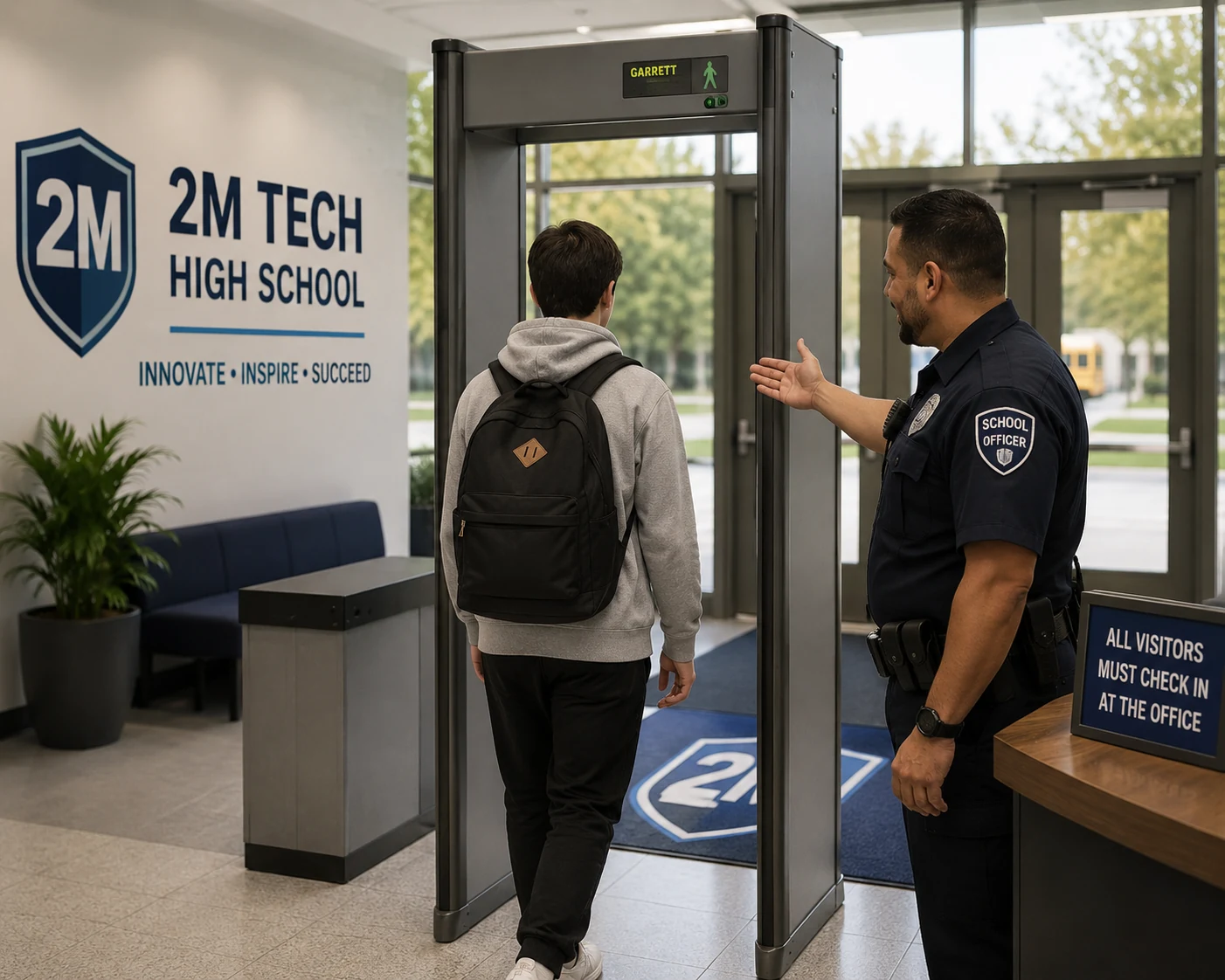
- Main student entrance: The primary deployment point. Position the detector 6–10 feet inside the vestibule so students who trigger the alarm are contained in the entry zone, not spilling back onto the sidewalk.
- Staff/faculty entrances: Often overlooked. Weapons introduced through unscreened staff entrances bypass the entire main screening point. All regular-use entrances require screening or electronic access control with credential verification.
- Gymnasium and auditorium events: Portable walk-through school metal detectors deployed for after-hours events screen community members entering for sports, performances, and parent nights where the general public has access.
- Visitor check-in: A handheld detector at the administrative check-in window provides a secondary screening point for visitors who arrive through access-controlled vestibules.
Integrating School Metal Detectors with Cameras and Access Control
Standalone school metal detectors create an alarm but no documentation trail. Integration with the school’s camera and access control systems creates a complete security record:
- Camera coverage at detector positions — IP cameras positioned to capture detector alarm events create video documentation of every alarm and resolution. 2M Technology installs UniFi Protect cameras at all screening positions with local NVR storage — no cloud subscription required.
- Access control at entry vestibules — Electronic door controls at the vestibule entry and interior door allow staff to remotely lock down the entry zone if a screening alarm indicates a credible threat, preventing the individual from entering the main campus.
- Alarm event logging — When camera, access control, and metal detector events are time-stamped and correlated, administrators have a documented record for law enforcement and district reporting following any incident.
- Intercom and two-way communication — Visitor entry intercoms at controlled vestibule entry points allow administrative staff to visual-verify visitors before remotely releasing the vestibule door lock, creating a second screening layer before visitors reach the metal detector.
Cost Factors for School Metal Detectors
Total cost of a school metal detector deployment includes hardware, installation, training, and any integration with existing camera and access systems:
| Component | Typical Cost Range | Notes |
|---|---|---|
| Walk-through metal detector (single unit) | $3,500–$12,000 | Higher cost = more zones, better pinpointing |
| Handheld metal detector | $150–$600 | Secondary screening; 1–2 per walk-through |
| AI weapons detection camera system | $18,500–$45,000 | Per entry point; includes AI processing hardware |
| X-ray baggage scanner | $18,500–$40,000 | Optional; for schools with backpack-carry policy |
| Installation and configuration | $800–$2,500 | Per entry point; includes sensitivity calibration |
| Staff training | $500–$1,500 | Initial training; plan for annual refresher |
Texas School Metal Detector Grant Funding
Texas schools have multiple funding sources for school metal detectors and security equipment:
- School Safety Allotment — Texas school safety funding changes by fiscal year and program. Eligible funding may include the School Safety Allotment, TEA safety grants, and other state or federal programs. TEA guidance confirms that security cameras, metal detectors, and other security equipment are eligible uses under school safety funding.
- TEA School Safety Grants — Competitive grants through the Texas Education Agency for security infrastructure improvements
- Federal Title IV-A — Student Support and Academic Enrichment grants can fund school safety equipment including metal detectors
- ESSER funds — Some remaining ESSER III funds were directed toward school safety infrastructure
2M Technology works with Texas school districts to identify applicable grant sources and provide documentation required for funding applications.
School Metal Detector Implementation Checklist
- Security assessment — Map all active entry points, traffic patterns, peak arrival windows, and current security gaps
- Select detector type — Walk-through multi-zone vs. AI detection based on budget, throughput requirements, and desired detection scope
- Determine quantity and placement — Calculate throughput requirements per entry point; plan for portable units for events
- Plan entry vestibule layout — Ensure physical space accommodates queue containment and secondary screening area
- Specify camera and access control integration — Identify camera positions at each screening point; plan access control at vestibule doors
- Identify grant funding — Review School Safety Allotment, TEA grants, and Title IV-A eligibility before finalizing purchase
- Install and calibrate — Professional installation with sensitivity calibration for your school’s specific environment and alarm tolerance
Frequently Asked Questions — School Metal Detectors
-
Do school metal detectors actually prevent school shootings?
School metal detectors function primarily as a deterrent and detection layer. Visible screening measures can support deterrence and help schools detect prohibited metal weapons at controlled entry points, especially when combined with cameras, access control, trained staff, and student reporting procedures. The most consistent finding is deterrence — a potential threat encountering a screened entry must either abandon the weapon or choose a different target. Metal detectors are most effective as part of a layered security program that includes cameras, access control, staff training, and student reporting culture.
-
How much do commercial metal detectors for schools cost?
Walk-through school metal detectors cost $3,500–$12,000 per unit. X-ray baggage scanners for school entry points cost $18,500–$45,000. Many Texas schools fund these purchases through the School Safety Allotment, TEA safety grants, or federal Title IV-A funding. Because funding levels and eligibility change by fiscal year, 2M Technology helps districts identify applicable programs and prepare the documentation required for applications.
-
What type of metal detector is best for schools?
For high-throughput K-12 school entrances, multi-zone walk-through detectors (18–45 zones) provide accurate detection with zone-based alarm pinpointing while maintaining student flow. Handheld detectors supplement walk-throughs for secondary screening. The optimal configuration depends on school size, number of entry points, budget, and whether bag screening is also required.
-
Are school metal detectors required in Texas?
Texas law does not mandate metal detectors, but SB 11 (2019) requires school districts to implement multi-layered safety and security programs. TEA School Safety Standards recommend access control and screening measures. Following safety incidents in neighboring districts, many Texas districts implement school metal detectors voluntarily — often funded through the School Safety Allotment.
-
How long does it take to screen students with a school metal detector?
A modern multi-zone walk-through school metal detector processes 60–100 students per minute. A school with 800 students arriving over 30 minutes requires one unit. For 1,500+ students in the same window, two units or two staffed lanes are the appropriate design. Throughput planning is the most important factor in school metal detector deployment — underspecifying units creates the queuing problems that give metal detectors a bad reputation for disrupting school schedules.
Related Security Solutions from 2M Technology
2M Technology is a US-based security systems integrator with 20+ years of experience and 450+ installations across Texas commercial, industrial, and K-12 sectors. Request a free system design or explore our solutions below.
- School Security Solutions — cameras, access control, and metal detectors for K-12 campuses
- Metal Detector Product Catalog — walk-through and handheld detector specifications
- Best X-Ray Baggage Scanners for Schools — companion screening for backpack-carry environments
- Access Control System Installations
Get a Free School Security Assessment
2M Technology installs and services school metal detectors, cameras, and access control systems for K-12 campuses across Texas. No monthly licensing fees.
Real Project: School Metal Detector Deployment, North Texas School District (2024)
A North Texas suburban school district with four high school campuses (combined enrollment 6,200 students) initiated a comprehensive school security upgrade following a district safety audit. The audit identified entrance screening as the primary gap — the four schools shared two portable wand-style detectors from a prior contract, providing inconsistent and labor-intensive screening that created significant arrival bottlenecks.
2M Technology conducted site assessments at all four campuses and designed a standardized entrance screening layout for each: two 33-zone walkthrough metal detector lanes at each main entrance, staffed by one operator per lane during the 25-minute arrival window. The 33-zone selection was based on the district safety team requirement to detect firearms and knives while not alarming on common student items (belt buckles, keys, medical devices).
Installation was completed over two weekends with no impact on school operations. The district now runs consistent multi-lane screening at all campuses. Average throughput per lane during the first semester was 620 students per 25-minute window — clearing the full school population in under 20 minutes at each site. The district safety director reported zero student bypass incidents in the first semester.
Texas School Safety Funding for Metal Detectors
Texas school districts have several funding paths for security equipment purchases including metal detectors:
- Texas School Safety Center (TSSC) grants: The TSSC administers state grant programs for school safety improvements. Metal detectors and screening equipment are eligible expenses under physical security categories. Visit Texas School Safety Center (txssc.txstate.edu) for current grant cycles.
- ESSER III / ARPA funds: Many districts still have unspent ESSER III federal safety allocations. Metal detectors qualify as physical security improvements under allowable uses.
- Local ISD bond funds: Capital safety improvements are common bond line items — metal detectors have been included in multiple DFW-area district bond programs in 2022-2024.
- Texas Chapter 37 compliance: The Texas Education Code Chapter 37 (School Safety) requirements have driven security upgrades across the state. 2M Technology has worked with multiple districts on Chapter 37 compliance reviews.
2M Technology can provide documentation supporting district grant applications for metal detector systems. Contact us to discuss funding options for your district security project.
Metal Detectors for Schools vs. X-Ray Screening: Which Is Right?
| Factor | Walkthrough Metal Detector | X-Ray Baggage Screening |
|---|---|---|
| What it detects | Metallic objects only (weapons, phones, keys) | All contents of bags and backpacks (weapons, drugs, non-metallic threats) |
| Throughput | High (600-1,200 students/hr per lane) | Lower (200-400 bags/hr per lane) |
| Student experience | Walk through, no bag removal required | Bag placed on belt, slower process |
| Threat detection scope | Metal weapons only | All concealed threats in bags |
| Typical K-12 use | Primary screening layer at all schools | Secondary layer at high-security schools, event venues |
| Cost per lane | Lower ($2,000 to $8,000) | Higher ($15,000 to $40,000) |
Most K-12 schools use walkthrough metal detectors as the primary screening layer. X-ray baggage screening is added at facilities with documented drug concerns or at specific high-security events (graduation, athletics).
Evaluating AI screening systems like Evolv against conventional detectors? See our full Evolv alternatives comparison covering costs, throughput, and certification standards.