

Features
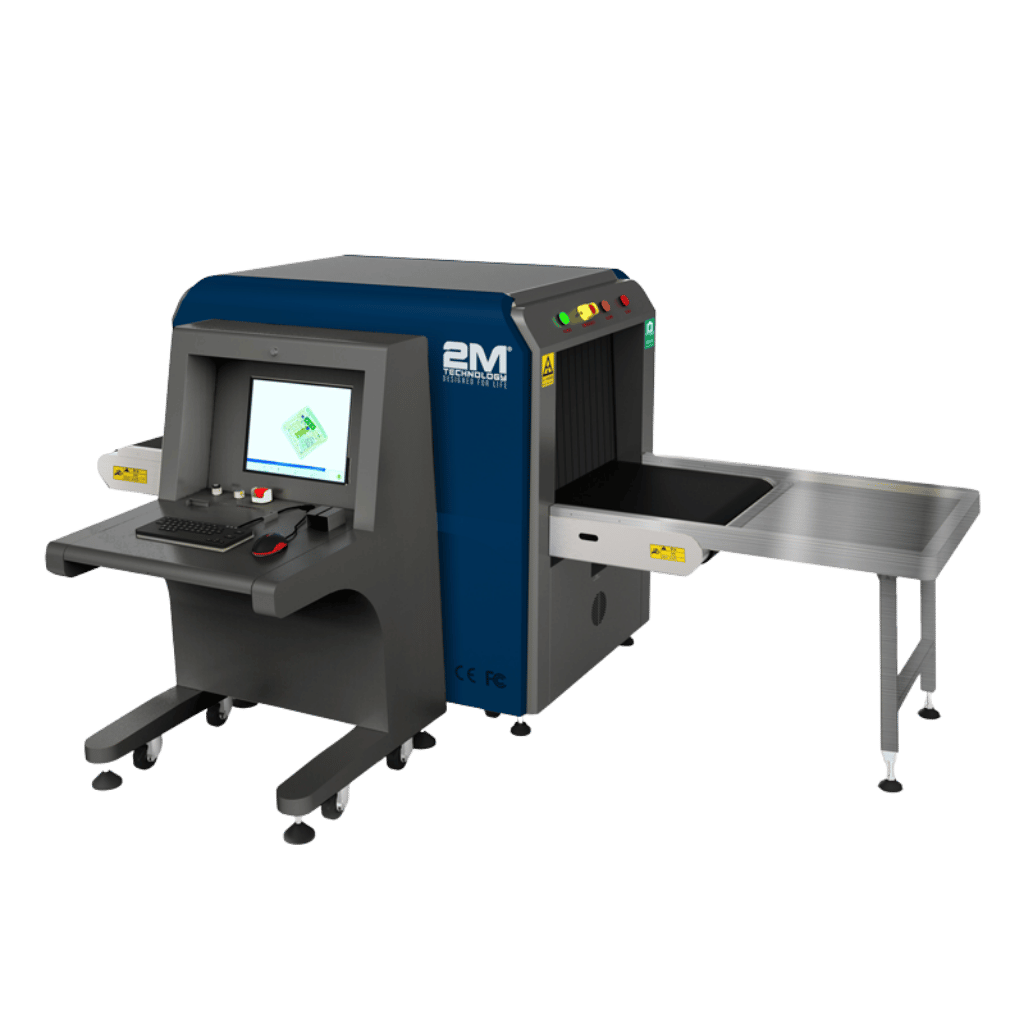
WHAT IS A DUAL-VIEW X-RAY BAGGAGE SCANNER?
A dual-view X-ray baggage scanner simultaneously images baggage from two independent angles — top-down and side-view — using two separate X-ray generators. This dual-perspective approach delivers significantly higher threat detection accuracy than single-view systems and reduces false alarm rates by up to 30%, making it the preferred choice for airports, courthouses, government buildings, and high-security facilities.
Industry Fact: According to the TSA, dual-view X-ray systems are the standard at all U.S. airport checkpoints, processing over 2 million bags daily. The dual-generator design ensures uninterrupted operation — if one generator requires maintenance, screening continues with the second.
Why Dual-View Matters: 2MX-6550 vs. Single-View Scanners
| Feature | 2MX-6550 (Dual-View) | Single-View Scanner |
|---|---|---|
| X-Ray generators | 2 independent | 1 |
| Image perspectives | Top + Side simultaneously | Top only |
| Threat detection accuracy | Higher — dual angle reduces blind spots | Standard |
| Uptime reliability | Redundant — screening continues if 1 generator down | Single point of failure |
| Best for | Airports, courthouses, high-security facilities | Lower-volume checkpoints |
Frequently Asked Questions — 2MX-6550 Dual-View X-Ray Scanner
What tunnel size does the 2MX-6550 accommodate?
The 2MX-6550 features a 658×490mm (25.9″×19.3″) tunnel opening, accommodating standard carry-on luggage, briefcases, backpacks, laptop bags, and parcels. The high load-bearing conveyor handles items up to the tunnel dimensions without operator assistance.
What is the steel penetration capability?
The 2MX-6550 offers two models: 30mm (1.2″) steel penetration at 140kV and 38mm (1.5″) steel penetration at 160kV (2MX-6550H). Higher penetration is recommended for facilities screening dense or packed bags where threats may be shielded by other items.
Where is the 2MX-6550 dual-view scanner typically deployed?
The 2MX-6550 is deployed in airports, courthouses, government buildings, schools, hotels, corporate campuses, and event venues. Its dual-view capability and redundant generator design make it the standard choice for facilities requiring continuous, uninterrupted security screening.
Does the 2MX-6550 detect drugs and explosives?
Yes. The 2MX-6550 includes automatic threat detection with material classification for drugs and explosives. The Hamamatsu detector and Sens-Tech detection board work together to generate high-resolution, high-contrast images that allow operators to distinguish organic, inorganic, and metallic materials by color coding.
How does the 2MX-6550 compare to the 2MX-6550M mobile version?
The 2MX-6550 is a fixed-installation system designed for permanent security checkpoints. The 2MX-6550M is a vehicle-mounted mobile version for temporary deployments, events, or locations without permanent infrastructure. Both use the same dual-generator X-ray technology.
Dual-View Screening Workflow: Why Two Generators Matter
Single-view X-ray systems produce one image — operators must identify threats from a single angle even when objects overlap or are densely packed. The 2MX-6550 produces simultaneous top-down and side-view images using two independent generators, giving operators two perspectives in a single pass. This reduces rescans, cuts queue buildup, and increases operator confidence when identifying layered electronics or concealed organic compounds.
The second generator also provides operational redundancy: if one generator requires maintenance, the lane continues at single-view capacity without shutdown — critical for courthouses, airports, and events where closing a lane during peak hours is not an option.
Checkpoint Throughput Planning with the 2MX-6550
| Planning Factor | Guideline |
|---|---|
| Bags per hour | 180–220 bags/hour per lane at standard flow |
| Operators required | Min. 2 per lane: 1 monitor operator + 1 bag handler. High-volume adds 1 secondary inspection officer. |
| Secondary inspection rate | 3–8% of bags typically flagged — plan a dedicated table adjacent to the exit belt |
| Queue overflow | 8–12 linear feet of queue per 100 visitors/hour. Plan for morning and shift-change peak windows. |
| Tray return | Plan 20–30 trays per lane with return loop or bin diversion table to reduce post-screening congestion |
| Pairing | Pair with walkthrough metal detector or AI weapon detection portal upstream for a complete primary screening lane |
Best Facilities for the 2MX-6550 Dual-View X-Ray Scanner
| Facility Type | Why Dual-View |
|---|---|
| Courthouses | Continuous daily screening of attorneys, defendants, and visitors. Dual-view reduces rescans during busy morning dockets. |
| Schools & Universities | High morning-arrival volume with backpacks full of layered electronics. Dual-view cuts false alarms from laptops and chargers. |
| Stadiums & Event Venues | High-volume arrival windows. Two-generator redundancy prevents single-lane shutdown during peak entry. |
| Religious Facilities | Reduces hands-on bag searches, supporting a dignified screening experience for all demographics. |
| Corporate Campuses | Executive protection and data center environments where speed and detection accuracy are equally required. |
| Hotels & Conference Centers | 658x490mm tunnel accommodates large briefcases, camera bags, and catering supply boxes. |
Screening Lane Architecture — Pairing the 2MX-6550
The 2MX-6550 is the X-ray component of a complete primary screening lane. For maximum detection and throughput, pair with:
- Upstream: Walkthrough metal detector — screens persons while bags move through the X-ray simultaneously
- Adjacent: Tray and roller conveyor for organized bag placement and retrieval
- Downstream: Secondary inspection table for flagged items, positioned at exit belt
- Entry control: Access control turnstile upstream to manage queue flow and prevent tailgating
Request a free checkpoint design consultation from 2M Technology
Why Dual-View X-Ray Screening Improves Checkpoint Throughput
The core operational advantage of the 2MX-6550 is not just better imaging — it is faster, more confident decision-making at the operator station. In a single-view system, ambiguous bag content forces operators to either flag for secondary inspection or re-run the bag — both outcomes reduce lane throughput. Dual-view eliminates most of that ambiguity by giving the operator two simultaneous perspectives before making a decision.
Reduced Rescans
In a typical single-view checkpoint, 12–18% of bags require a rescan due to overlapping objects or operator uncertainty. Each rescan adds 15–30 seconds and creates upstream queue buildup. Dual-view systems reduce rescan rates to 4–8%. Over an 8-hour screening day processing 1,200 bags, that difference is 50–80 fewer rescans — approximately 30–40 minutes of recovered throughput per lane, per day.
Overlapping Object Visibility
The most common cause of operator uncertainty is overlapping dense objects: a laptop on top of a power bank on top of a water bottle creates a stacked material profile that is difficult to interpret from a single top-down view. The 2MX-6550’s side-view generator resolves this in real time — operators see the stacked objects separated in the side view, enabling accurate material classification without removing items from the bag.
Operator Efficiency and Fatigue Reduction
Dual-view imaging reduces cognitive load on the operator. When one view is ambiguous, the second view provides confirmation or elimination. Studies of X-ray screening operations indicate that dual-view systems reduce operator decision time per bag by 18–25%, which translates to higher sustained throughput across a full shift without increased false positive rates.
Reduced Manual Bag Checks
Manual bag checks — where an officer opens and physically inspects the bag — add 2–5 minutes per incident. By providing clearer material classification, the 2MX-6550 reduces manual bag check rates. Facilities report 20–35% fewer manual searches after transitioning from single-view to dual-view systems, directly improving lane capacity and visitor experience.
Peak Entry Period Management
The highest-risk throughput period is the peak arrival window — the 15–30 minutes before a court session, school day, or event. During this window, a single rescan creates a cascade of delays. Dual-view’s lower rescan rate and faster decision time are highest-value precisely at peak — when the cost of a bottleneck is greatest.
Two-Generator Redundancy During Peak Operations
If a generator maintenance alert occurs during a peak period, the 2MX-6550 continues operating at single-view capacity rather than shutting down. For facilities without a backup scanner — courthouses, schools, and small event venues — this prevents a checkpoint with zero X-ray coverage during peak entry.
Extended FAQ — Dual-View X-Ray Screening
What is a dual-view X-ray baggage scanner?
A dual-view X-ray baggage scanner uses two independent X-ray generators positioned at different angles to simultaneously produce two images of the same bag — typically a top-down view and a side view. This gives security operators two independent perspectives for threat identification without requiring the bag to be run through twice, improving both detection accuracy and lane throughput.
Why use two generators in baggage screening instead of one?
Two generators eliminate the ambiguity caused by overlapping objects and provide operational redundancy. If one generator requires service, the lane continues at single-view capacity rather than shutting down. For facilities with continuous screening requirements, this uptime advantage alone justifies the dual-generator design.
Does dual-view X-ray screening reduce rescans?
Yes. Single-view checkpoints typically have rescan rates of 12–18% due to operator uncertainty. Dual-view systems reduce rescan rates to approximately 4–8% by providing a second angle that resolves most ambiguity before the operator makes a decision. Over a full screening day, this saves 30–40 minutes of recovered lane throughput per checkpoint.
How many bags per hour can the 2MX-6550 process?
Under standard operating conditions with trained operators, the 2MX-6550 processes 180–220 bags per hour per lane. This assumes a 2-person station, a 3–8% secondary inspection rate, and a pre-organized tray and conveyor setup.
Can the 2MX-6550 integrate with walkthrough metal detectors?
Yes. The 2MX-6550 pairs with a walkthrough metal detector at the lane entrance — persons walk through the metal detector while their bags simultaneously pass through the X-ray conveyor. 2M Technology designs and installs complete lane configurations with both components.
What industries use dual-view X-ray baggage screening systems?
Dual-view X-ray baggage systems are used in government and judicial facilities, K-12 schools and universities, airports and transit hubs, stadiums and event venues, corporate headquarters, data centers, and hotels hosting high-profile events.
Is the 2MX-6550 suitable for school security screening?
Yes. The 2MX-6550 significantly reduces false alarms triggered by dense student backpacks containing laptops, tablets, chargers, and cables. Lower false alarm rates mean fewer manual searches and a faster morning entry process. See the school security screening architecture guide for full deployment recommendations.
Can the 2MX-6550 be used in courthouse security screening?
Yes. Courthouses are a primary deployment environment for the 2MX-6550. The 658×490mm tunnel screens briefcases, purses, laptop bags, and court exhibit containers. Its dual-generator design ensures the checkpoint remains operational through the full court day including morning docket surge. See the courthouse security checkpoint design guide.
What is the difference between single-view and dual-view X-ray baggage scanners?
Single-view scanners produce one image per bag pass (top-down only). Dual-view scanners produce two simultaneous images from two angles. Dual-view has lower rescan rates (4–8% vs 12–18%), higher operator confidence, lower manual bag check rates, and better threat detection for densely packed bags. See the full single-view vs dual-view comparison.
What is the weight and footprint of the 2MX-6550?
The 2MX-6550 weighs 1,631 lbs (740 kg) with overall dimensions of approximately 100″ L × 53″ W × 54″ H. The system requires a standard 110V/220V electrical connection and includes an integrated uninterruptible power supply (UPS).
Deep Dive: Single-View vs Dual-View X-Ray Scanners — Full Comparison — rescan rates, throughput data, operator efficiency, and when each system is right for your facility.
Product Highlights
- Available in two density penetration capacities of 30mm or 38mm (1.2″ in. or 1.5″ )
- Sens-Tech detection board and Hamamatsu detector
- High resolution, high penetration and good image quality
- High load-bearing capacity
- Multilingual operation
- Automatic built in test and self-diagnosis
- Secure access key
- Threat alert and material classification
- Auto archiving
- One key turn off with patent
- Drugs and explosives inspection
- Indication of the date and time
- Baggage counter
Models Available
| Model | X-Ray Penetration | Anode Voltage |
|---|---|---|
| 2MX-6550 | 30 mm / 1.2″ in | 140 kv |
| 2MX-6550H | 38 mm / 1.5″ in | 160 kv |
**Important Notes**
– This is not a medical device. It is intended for industrial or security purposes only.
