Courthouse Security Checkpoint Design
- Published: May 2026
- By: 2M Technology Engineering Team
- Security Infrastructure Specialists, Grand Prairie TX
- Part of the Screening Infrastructure Engineering Center
What is Courthouse Security Checkpoint Design?
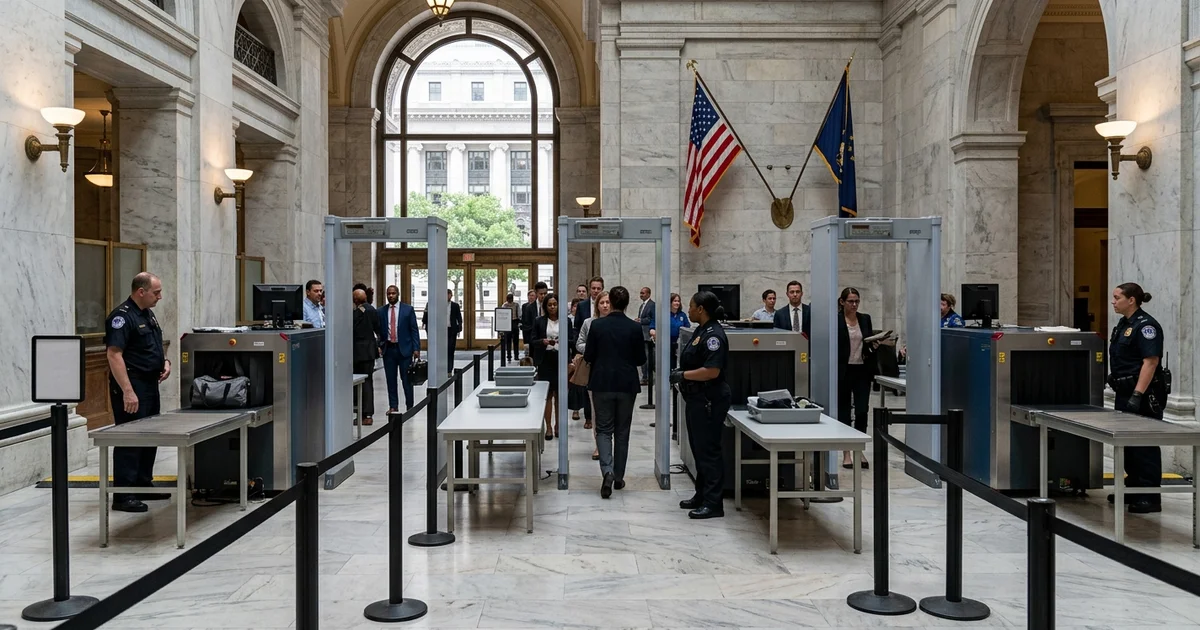
Courthouse security checkpoint design is the engineering of entry screening systems for judicial facilities that simultaneously process three distinct populations — public visitors, credentialed attorneys and court officers, and court staff — through separate, appropriately secured lanes, while maintaining ADA compliance, providing dedicated evidence and package inspection capability, and accommodating the high-variance daily throughput demands created by court dockets, hearing schedules, and jury assembly events. Courthouse checkpoint design is governed by a more complex set of access policy, physical constraint, and operational requirements than any other government facility type.
Minimum screening architecture for courthouses — public, credentialed attorney/officer, and court staff must be separated with distinct access policies and verification requirements
Typical variance in daily visitor volume between a slow court day and a high-profile trial or jury summons day — checkpoint design must handle both without reconfiguration
ADA-required minimum clear width for wheelchair-accessible screening lanes — standard WTMD apertures (24-32 in) do not meet this requirement without dedicated ADA lane design
Recommended minimum for active courthouses — one lane dedicated to public visitors, one lane reserved for evidence, exhibits, and credentialed attorney materials to prevent cross-contamination of the inspection record
Why Courthouse Checkpoint Design Is Different
Courthouses present the most operationally complex checkpoint design challenge in the government facility category. The combination of legal due process requirements, ADA mandates, constitutional protections, attorney-client privilege considerations, and daily throughput variance creates constraints that no other public building type imposes simultaneously.
Attorney and Officer Credential Bypass
Licensed attorneys, law enforcement officers, and court officers require a separate screening lane with credential verification — not elimination of screening, but a faster, modified process appropriate to their known identity and authorization. This lane must physically prevent public visitor access while remaining visible to checkpoint supervisors.
Evidence and Exhibit Inspection
Physical evidence, trial exhibits, and sealed court documents require dedicated X-ray inspection that is documented and chain-of-custody compliant. Inspecting evidence through the same lane as public visitor bags creates documentation gaps and chain-of-custody risks. Dedicated evidence inspection stations require a separate conveyor system with imaging that can be exported for the court record.
Hearing-Day Surge Variance
Daily visitor volume at courthouses is driven by the court docket — a quiet Friday with no trials may bring 40 visitors; a high-profile trial Monday with jury assembly may bring 600. Checkpoint design must function efficiently at both extremes without requiring lane reconfiguration. Staffing models must account for this variance rather than sizing for average daily traffic.
Prohibited Items and Legal Exceptions
Courthouse prohibited item lists must account for jurisdictional legal exceptions — law enforcement weapons, attorney secure communication devices, medical equipment, and press recording equipment all require documented exception handling protocols that are consistent with court policy and local rules. Checkpoint SOPs must be developed in coordination with court administration and the presiding judges.
ADA Full Compliance
Government facilities are subject to ADA Title II requirements with no exception for security checkpoints. This means at minimum one lane must provide 60-inch clear passage width, accessible tray height, WTMD positioning that accommodates mobility devices, and staff-assisted secondary screening without requiring persons to transfer from their mobility device.
Jury Assembly Processing
Jury summons events create burst arrivals of 100-400 community members within a 30-minute window — a throughput demand entirely unlike the courthouse’s typical steady-state daily traffic. Checkpoint design must either accommodate this surge within the permanent system or include a defined temporary expansion protocol with mobile lane augmentation.
The Three-Stream Courthouse Architecture
Every active courthouse checkpoint should be designed around three distinct processing streams. Merging any two of these streams creates operational failures that compromise either security, legal compliance, or throughput.
Stream 1Public Visitor Lane
Full X-ray + WTMD screening for all members of the public. No credential bypass. Secondary inspection area dedicated to this stream. ADA lane within this stream.
Stream 2Attorney and Officer Lane
Credential verification + modified screening protocol for licensed attorneys, law enforcement, and credentialed court officers. Faster processing but documented checkpoint passage. Physically separated from public stream.
Stream 3Evidence and Exhibit Inspection
Dedicated X-ray with image export capability for evidence, trial exhibits, and sealed documents. Chain-of-custody documentation at the point of inspection. Separate conveyor and image archive from public lanes.
Courthouse Checkpoint Throughput Reference
Lane count recommendations by facility size and peak daily visitor volume. Figures assume full three-stream architecture with dedicated attorney bypass and evidence inspection station.
| Facility Type | Peak Daily Visitors | Public Lanes | Attorney Lane | Evidence Station |
|---|---|---|---|---|
| Small County Courthouse | 50–150/day | 1–2 lanes | Combined with public + bypass gate | Shared lane with protocol |
| Mid-Size County Courthouse | 150–400/day | 2–3 lanes | Dedicated bypass lane | Dedicated station |
| Large County / State Courthouse | 400-1,000/day | 3–5 lanes | Dedicated bypass + ADA lane | Dedicated station + archive |
| Federal District Courthouse | 500-2,000/day | 4–6 lanes | Dedicated multi-lane bypass | Secure evidence inspection room |
| Jury Assembly Surge | +100-400 burst | +2-4 temporary lanes | Mobile augmentation | Existing station |
How to Design a Courthouse Security Checkpoint
Court Administration Policy Review
Before any equipment is specified, obtain the court’s written access policy covering attorney bypass procedures, law enforcement weapon carriage, prohibited items list, media equipment policy, ADA accommodation protocols, and evidence inspection chain-of-custody requirements. Checkpoint design is constrained by these policies — equipment selection and lane architecture must implement them, not create conflicts with them.
Docket-Based Throughput Analysis
Analyze 90 days of court docket data to identify peak visitor days — high-profile trials, jury summons dates, and hearing clusters. Design lane count and staffing to the 95th-percentile peak day, not the average. A courthouse that handles 80 visitors on normal days but 500 on jury assembly days needs a checkpoint system that accommodates 500 without warning.
Three-Stream Layout Design
Design separate physical pathways for the public stream, attorney/officer stream, and evidence inspection station. Each stream must have its own entry queue, screening equipment, and exit pathway. Streams should not merge until after checkpoint clearance. Physical barriers — stanchions, glass, or fixed dividers — must prevent population crossover without supervisor authorization.
ADA Compliance Engineering
Designate one lane within the public stream as the ADA-compliant lane. This lane requires 60-inch minimum clear width, accessible tray table at 34-inch maximum height, a WTMD model with 32-inch or wider aperture, and a defined staff-assisted secondary screening protocol that does not require the individual to transfer from their mobility device. Document ADA compliance in the checkpoint design drawings submitted to court administration.
Evidence Inspection Station Configuration
Configure the evidence inspection station with a dedicated X-ray system with image export capability. The system must be able to generate a timestamped, authenticated image record for each inspected item that can be entered into the court record. Chain-of-custody documentation starts at the inspection point — the checkpoint officer logs the evidence item, the inspection result, and signs the custody record before the item proceeds into the courthouse.
Surge Planning and Mobile Augmentation
Document a written surge plan for jury assembly and high-profile trial days. The plan specifies the mobile equipment to be deployed, the lane configuration during surge, the additional staffing required, the outdoor queue management setup, and the coordination protocol with the court administrator and sheriff’s office. 2M Technology provides mobile X-ray and WTMD units for courthouse surge events and can be on-site for scheduled high-volume court dates.
Real Project Example
City of Thornton: Courthouse X-Ray Security Screening Scanners
Courthouse Checkpoint Cost Reference
| Facility Type | Configuration | Installed Cost |
|---|---|---|
| Small County Courthouse | 2x X-ray + 2x WTMD + bypass gate + handhelds | $70,000–$110,000 |
| Mid-Size Courthouse | 3x X-ray + 3x WTMD + dedicated attorney lane + evidence station | $130,000–$210,000 |
| Large / State Courthouse | 4-6x X-ray + WTMD + 3-stream full architecture + access control | $220,000–$380,000 |
| Federal District Courthouse | Full GSA-spec multi-lane with evidence room + surveillance + UPS | $380,000–$750,000+ |
RECOMMENDED X-RAY EQUIPMENT FOR COURTHOUSE CHECKPOINTS
Related Screening Infrastructure Resources
Courthouse Screening Standards & Guidelines
Courthouse entry screening design draws on published guidance from the National Center for State Courts, which maintains court security best-practice resources used by state judiciaries, and on equipment benchmarks from the National Institute of Justice — walk-through metal detectors to NIJ Standard 0601.02 and cabinet X-ray under FDA 21 CFR 1020.40. A typical single-lane courthouse checkpoint processes 300–500 visitors per hour with one X-ray operator, one magnetometer officer, and one divestiture position; peak dockets justify a second lane.
Need a Portable Container Screening Checkpoint?
Frequently Asked Questions: Courthouse Security Checkpoints
What courthouse security screening systems do you install?
2M Technology installs X-ray baggage scanners, walk-through metal detectors, conveyor systems, officer consoles, and checkpoint management systems for courthouses and government facilities. We design checkpoint layout to meet federal and state security standards.
Do you install courthouse security systems that meet government standards?
Yes. 2M Technology has experience with government facility security requirements and installs systems from manufacturers that meet GSA and DHS checkpoint standards. Texas License B15309.
How long does a courthouse security screening installation take?
A typical courthouse checkpoint installation takes 3-5 days for a single entry point, including X-ray scanner, walk-through metal detector, conveyor, and officer console. Multi-entry courthouse projects are scoped per site assessment.
How are attorneys screened differently from the public at courthouses?
Licensed attorneys typically pass through a credentialed bypass lane with verified bar identification and modified screening — their bags and briefcases are X-rayed but they may bypass the WTMD with a handheld wand screening instead. They do not wait in the public visitor queue. The bypass lane must be physically separated from the public lane and staffed by an officer who can verify bar card credentials against a current database. Local court rules govern the specific attorney bypass protocol, and checkpoint design must implement whatever the court’s policy requires.
How is evidence and trial exhibits inspected at courthouse checkpoints?
Evidence and trial exhibits should pass through a dedicated X-ray station separate from the public visitor lane. This station generates a timestamped image record of each inspected item that can be used for chain-of-custody documentation. Sealed evidence must be handled according to the court’s evidence integrity protocols — typically the attorney presenting the evidence must be present during inspection and countersign the custody log. 2M Technology configures evidence inspection stations with image export capability for court record integration.
How many X-ray lanes does a courthouse need?
A small county courthouse processing 50-150 visitors per day needs a minimum of 2 X-ray lanes — one primary public lane and one that can function as attorney bypass or evidence inspection. A mid-size courthouse processing 150-400 daily visitors needs 3 dedicated lanes. Large state and federal courthouses with 400-2,000 daily visitors typically require 4-6 public lanes plus dedicated attorney bypass and evidence inspection stations. All lane counts must be validated against peak jury summons and high-profile trial day volumes, not daily averages.
What ADA requirements apply to courthouse security checkpoints?
Under ADA Title II, government courthouses must provide accessible entry screening. Requirements include: minimum 60-inch clear lane width for wheelchair passage, tray tables at maximum 34-inch height, WTMD aperture wide enough to accommodate mobility devices without physical contact, and an alternative screening protocol (handheld wand) for individuals who cannot pass through the WTMD due to implanted medical devices or mobility equipment. The accessible lane must provide equivalent security screening — not a bypass of screening — and must not require the individual to request special accommodation in a manner that singles them out.
Design Your Courthouse Security Checkpoint
- 2M Technology
- 802 Greenview Drive, Suite 100, Grand Prairie, TX 75050
- •
- (214) 988-4302
- •
- sales@2mtechnology.net
- •
- Monday-Friday 8:00 AM – 5:00 PM CST
- •
- Texas Private Security License B15309