School Security Screening Architecture
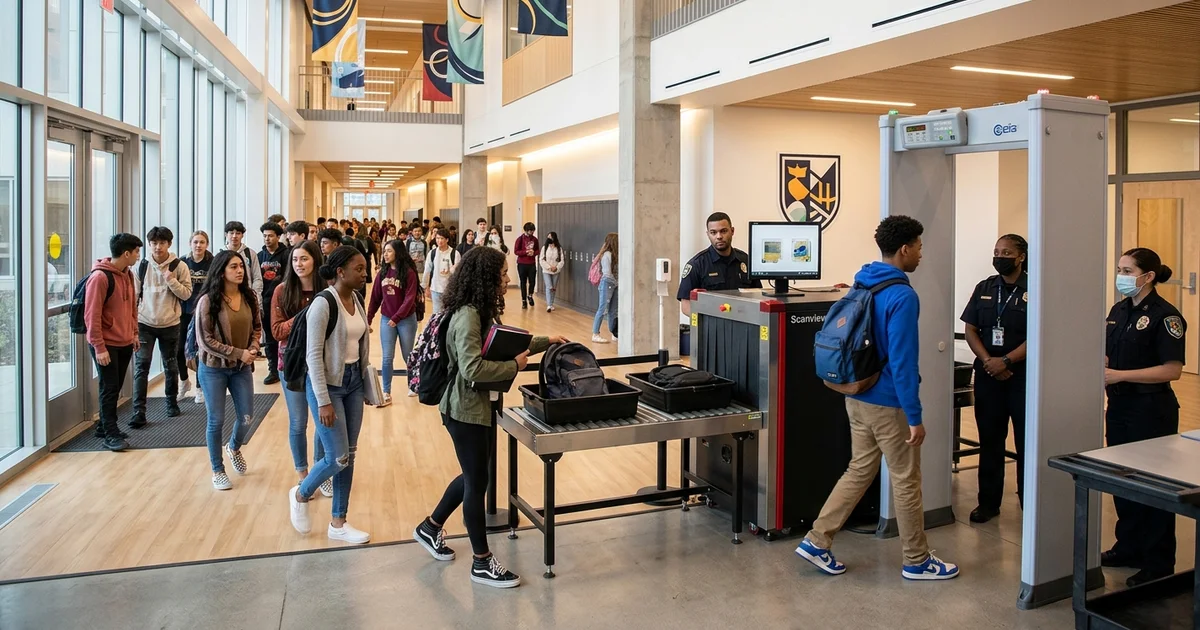
- Published: May 2026
- By: 2M Technology Engineering Team
- Security Infrastructure Specialists, Grand Prairie TX
- Part of the Screening Infrastructure Engineering Center
What is School Security Screening Architecture?
School security screening architecture is the engineering design of entry checkpoint systems for educational facilities — including X-ray inspection equipment, walkthrough metal detectors, access control, and staff workflow — sized and configured to process the school’s full student population through a single entry window without creating queue buildup that compromises safety or disrupts the school day. It is distinct from general security screening in that it must account for burst-arrival traffic patterns unique to school entry, age-appropriate interaction protocols, and the operational realities of school security staff.
The fastest-growing segment for security screening deployments in the United States, driven by state legislative mandates following high-profile school incidents
Typical morning entry window in which 80-90% of students must pass through screening before the first bell — the most compressed throughput demand in the security industry
2M Technology minimum lane planning ratio for schools: one X-ray lane per 250 students in peak enrollment, sized for the burst arrival window not daily average
Installed cost range for a complete single-lane school entry checkpoint — X-ray system, walkthrough metal detector, and handhelds — qualifying for state and federal safety grants
Why School Screening Is the Hardest Throughput Problem in Security
No other facility type compresses as many people through a screening checkpoint in as short a time as a school. A mid-size high school with 1,500 students expects 1,200 students to arrive in a 15-minute window before first period. That is 80 students per minute — a throughput demand that rivals small-stadium event screening.
Most school screening deployments fail not because the equipment is wrong, but because the lane count is calculated against enrollment, not against the arrival rate during the entry window. A single X-ray lane processing 150-200 persons per hour means roughly 2.5-3.3 students per minute. One lane for a 1,500-student school produces a 24-minute queue — the school day has already started before the last student clears the checkpoint.
The Most Common School Screening Mistake
Specifying lane count based on enrollment divided by hours in the school day (steady-state thinking), rather than enrollment divided by the morning entry window (burst-arrival thinking). These produce dramatically different lane requirements — and the wrong calculation is used in the majority of single-vendor proposals 2M Technology encounters when replacing failed deployments.
Engineering Challenges Unique to School Entry Screening
Backpack Volume and Density
Student backpacks average 15-25 lbs and are densely packed with electronics, textbooks, and lunch containers — creating high-density X-ray images that require more operator interpretation time than carry-on luggage. Conveyor speeds must be reduced relative to airport settings to maintain detection quality, which directly impacts throughput calculations.
Separate Visitor and Staff Processing
Schools require distinct entry workflows for students, staff with credential bypass, and visitors requiring check-in and escort. Running these three populations through the same lane creates bottlenecks when staff arrive concurrently with morning rush. Lane architecture must provide a credentialed staff bypass that does not require entering the student queue.
Age-Appropriate Interaction Protocols
Screening protocols appropriate for adult facilities are not appropriate for elementary and middle school students. Secondary inspection of minors requires specific SOP language, same-gender screening where possible for older students, and trauma-informed communication training for security staff. These protocols affect alarm resolution time and must be factored into throughput models.
Weather and Outdoor Queue Management
In Texas and southern states, outdoor queue buildup during summer months creates health and safety risks. In northern climates, cold weather queues create pressure to rush screening. Checkpoint design must include covered staging areas, defined queue lanes with barriers, and throughput buffers that prevent outdoor queues from forming during normal operating conditions.
After-School and Event Screening
School campuses host evening events — sporting events, concerts, graduations — that draw community members who have not been through morning screening. Game-day and event screening requires a separate operational plan with mobile or temporary equipment augmentation, additional staffing, and a distinct visitor processing workflow from the student morning entry system.
Integration with School Access Control
School screening checkpoints must integrate with existing access control infrastructure — visitor management systems, student ID card systems, door access controllers — without creating a single point of failure. A screening system shutdown must not lock students out of the building or grant unsecured access while equipment is offline.
School Entry Throughput Planning Reference
Lane count recommendations by enrollment and entry window. Assumes 80% of enrollment arrives in the morning window, standard backpack-density conveyor settings, and one secondary inspection officer per lane pair.
| Enrollment | Entry Window | Peak Arrival Rate | Minimum Lanes | Recommended Lanes |
|---|---|---|---|---|
| Under 300 | 20 minutes | 12 students/min | 1 lane | 1-2 lanes |
| 300-600 | 20 minutes | 12-24 students/min | 2 lanes | 2-3 lanes |
| 600-1,200 | 15-20 minutes | 24-64 students/min | 3 lanes | 3-5 lanes |
| 1,200-2,000 | 15 minutes | 64-107 students/min | 5 lanes | 5-7 lanes |
| 2,000-3,500 | 15-20 minutes | 80-187 students/min | 7 lanes | 7-10 lanes |
| 3,500+ (Large HS / Campus) | 20 minutes | 140-187+ students/min | Multi-entry required | Multi-entry + 4-6 lanes per gate |
How to Design a School Security Screening System
A six-step engineering process from enrollment data to operational checkpoint, validated by 2M Technology school deployments across Texas.
Arrival Pattern Analysis
Collect actual arrival data for your school -- not enrollment, but the number of students arriving per 5-minute interval during a normal morning. Most districts have bell schedule data and parking lot camera footage that provides this. If data is unavailable, use 80% of enrollment arriving in a 15-minute window as a conservative planning assumption. This is the most important input in the entire design process.
Entry Point Consolidation
Identify which entry points will be active during screening hours. For most schools, this means consolidating to one or two primary screening entries with all other doors locked from outside and monitored by camera. Access control on secondary doors must be integrated with the morning screening schedule. A school that screens at the front door but leaves the gym entrance and cafeteria entrance unlocked has not improved security.
Lane Count and Equipment Specification
Calculate required lanes using the burst-arrival formula: (peak students per minute) divided by (lane throughput per minute at school-appropriate conveyor speed). For backpack-density screening, plan on 1.5-2 students per minute per lane at accurate detection settings. Round up and add 20% buffer. Specify equipment -- X-ray tunnel size, WTMD model, secondary inspection station dimensions, tray count -- against this lane model, not against a generic school security spec.
Physical Layout and Space Design
Each lane requires 18-26 linear feet inside the building, plus outdoor queue staging of at least 20-30 feet per lane. Secondary inspection areas need 6 by 8 feet per lane pair, positioned so that an alarmed bag does not block the primary conveyor exit. Staff bypass lanes require credential readers and a physical gate that prevents tailgating. 2M Technology provides CAD layouts for every school deployment before equipment is ordered.
Staffing Model and SOP Development
Each active lane requires a minimum of two trained operators: one on the X-ray monitor and one managing the WTMD and secondary inspection. Schools with high alarm rates (common with dense student backpacks) should staff three per lane during the peak morning window. SOPs must specifically address prohibited item discovery, escalation to school administration, student communication protocols, and emergency lockdown integration with the checkpoint system.
Testing, Training, and Go-Live
Run a full dress rehearsal before the operational go-live date -- ideally on a non-school day with staff and administrator participation. Identify queue bottlenecks, conveyor speed issues, and secondary inspection gaps under simulated peak conditions. 2M Technology conducts on-site commissioning and training for all school deployments, including a live throughput test against the enrollment-based model to confirm the system will clear the student population within the entry window.
School Security Screening System Cost Reference
Installed costs for complete school entry screening deployments. State safety grant programs in Texas (ESSER, School Safety Allotment) and federal funding (STOP School Violence Act) may offset significant portions of equipment and installation cost.
| School Size | Configuration | Equipment | Installed Cost |
|---|---|---|---|
| Small (under 300) | Single-lane | 1x X-ray + 1x WTMD + handhelds | $35,000-$55,000 |
| Medium (300-800) | Dual-lane | 2x X-ray + 2x WTMD + secondary area + access control | $70,000-$110,000 |
| Large HS (800-1,500) | 3-4 lanes | 3-4x X-ray + WTMD + secondary + camera integration | $130,000-$220,000 |
| Large HS (1,500-2,500) | 5-7 lanes | 5-7x X-ray + WTMD + access control + surveillance + UPS | $220,000-$420,000 |
| Multi-building Campus (2,500+) | Multi-entry | Multiple checkpoint stations with centralized monitoring | Custom scope |
2M Technology School Screening Deployments
Large High School — DFW
Middle School Retrofit
Elementary Campus Multi-Entry
Related Screening Infrastructure Resources
Frequently Asked Questions: School Security Screening
How many X-ray lanes does a school need?
The lane count depends on enrollment and the morning entry window. A school of 600 students needs 2-3 lanes. A school of 1,500 students needs 5-7 lanes. The key calculation is burst-arrival rate (students per minute during peak entry) divided by lane throughput per minute at backpack-appropriate conveyor settings. 2M Technology recommends using the Throughput Calculator with your actual enrollment data to determine the correct lane count for your specific school.
Why is the morning entry window more important than enrollment?
Enrollment tells you how many students you will screen per day. The entry window tells you how many students you must screen per minute. A school with 1,000 students and a 20-minute entry window needs to process 40-50 students per minute at peak. A school with the same enrollment and a 45-minute window needs to process only 18-22 students per minute. The entry window is the variable that determines whether a 2-lane or 5-lane system is appropriate.
Can school security screening be funded by state or federal grants?
Yes. Multiple funding sources are available for school security screening equipment. Texas schools have access to the Texas School Safety Allotment, which funds security equipment. Federal programs include the STOP School Violence Act grants administered by the Bureau of Justice Assistance. ESSER funds (Elementary and Secondary School Emergency Relief) have been used for security infrastructure in many districts. 2M Technology assists Texas school districts in identifying applicable funding sources and preparing equipment specifications aligned with grant requirements.
How do you handle students with medical devices like insulin pumps?
Students with insulin pumps, cochlear implants, or other implanted medical devices should not pass through walkthrough metal detectors, as the electromagnetic field may interfere with device operation. The standard protocol is a staff-assisted bypass with visual inspection and handheld wand screening that avoids the device area. School SOPs should include a documented medical accommodation process, and staff should be trained to handle these situations without drawing undue attention to the student.
What is the right X-ray tunnel size for school backpacks?
Standard school backpacks fit through a 600 x 400 mm (23.6 x 15.7 inch) tunnel aperture, which is the most common size for carry-on baggage X-ray systems. Large athletic bags, musical instrument cases, and sports equipment may require a larger 800 x 600 mm tunnel. 2M Technology recommends a 600 x 400 mm primary screening tunnel with a procedure for oversized items that require manual inspection or a secondary tunnel.
Design Your School Entry Screening System
- 2M Technology
- 802 Greenview Drive, Suite 100, Grand Prairie, TX 75050
- •
- (214) 988-4302
- •
- sales@2mtechnology.net
- •
- Monday-Friday 8:00 AM – 5:00 PM CST
- •
- Texas Private Security License B15309