AI-Powered Industrial Inspection Infrastructure
- Published: May 2026
- By: 2M Technology Engineering Team
- Security Infrastructure Specialists, Grand Prairie TX
- Part of the Screening Infrastructure Engineering Center
What is AI-Powered Industrial Inspection Infrastructure?
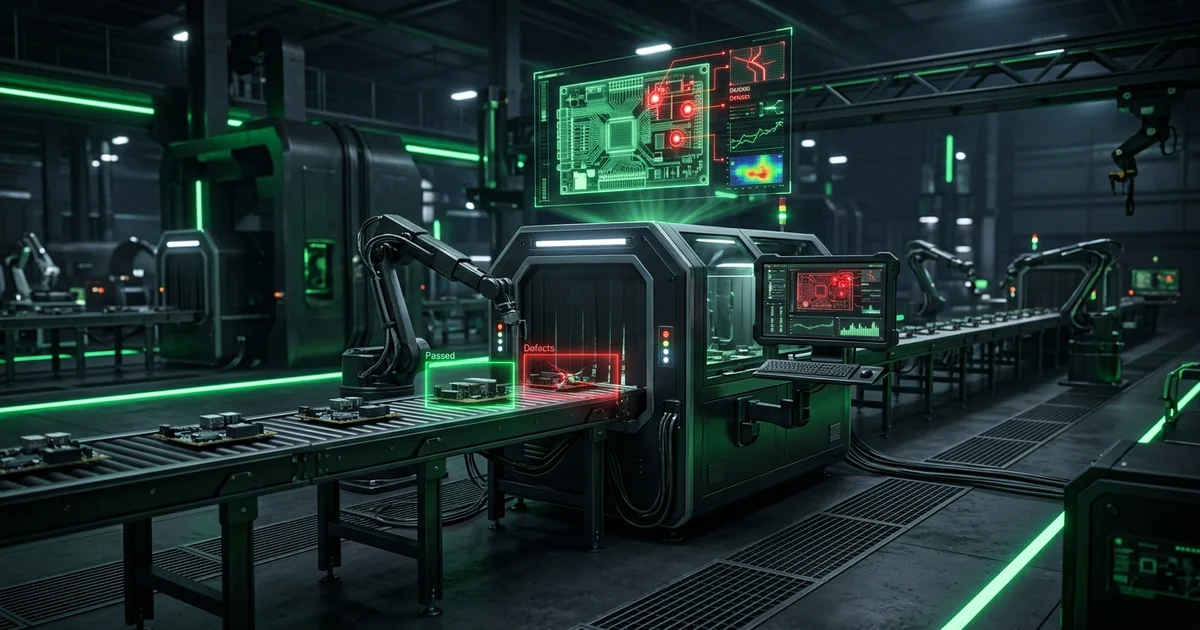
AI-powered industrial inspection infrastructure is the integration of X-ray imaging systems, machine vision cameras, conveyor-integrated sensors, and AI anomaly detection algorithms into production-line quality assurance workflows. Unlike manual inspection or basic automated detection, AI-powered systems learn from production data to identify defects, contaminants, dimensional deviations, and packaging anomalies in real time at full production line speed — reducing false rejection rates, eliminating human fatigue errors, and generating operational QA data that drives continuous process improvement.
Global machine vision market size (2024), growing at 7.8% CAGR through 2030 as manufacturers adopt AI-driven quality inspection to replace manual QA
Inspection accuracy achievable with calibrated AI vision systems on production lines — versus 85-95% for trained human inspectors under fatigue conditions
Reduction in false rejection rates when AI anomaly detection replaces threshold-based rule systems on food and pharmaceutical X-ray lines
Federal regulation driving X-ray inspection deployment in food and pharmaceutical manufacturing — AI systems provide the audit trail and statistical process control data required for compliance
Industrial Inspection Subclusters
2M Technology engineers inspection infrastructure across six production environments. Each sector carries distinct regulatory requirements, throughput parameters, and AI model training needs.
Food Manufacturing X-Ray Inspection
Food X-ray inspection systems detect bone fragments, metal, glass, stone, rubber, and high-density plastic contaminants in raw ingredients, processed products, and packaged goods. AI-powered systems reduce false reject rates on products like poultry (bone detection), canned goods (fill level), and fresh produce (foreign material) while maintaining HACCP and FDA 21 CFR Part 117 compliance documentation.
Detectable Contaminants:
- Metal fragments (ferrous and non-ferrous)
- Bone and calcified tissue
- Glass and ceramic fragments
- Dense plastic and rubber
- Stone and aggregate material
Food Inspection Engineering Guide — Coming Soon
Electronics Manufacturing Inspection
Electronics X-ray and machine vision inspection verifies PCB solder joint quality, component placement, wire bond integrity, BGA ball count and voiding, and package seal quality at production line speed. AI models trained on defect libraries identify void patterns, cold solder joints, and component misalignment that conventional automated optical inspection (AOI) systems miss.
Inspection Applications:
- BGA solder void analysis
- PCB component placement verification
- Wire bond and flip-chip inspection
- Connector and terminal integrity
- Conformal coating coverage
Electronics Inspection Guide — Coming Soon
Pharmaceutical Inspection Systems
Pharmaceutical X-ray inspection systems verify tablet count, capsule integrity, fill level, foreign particle detection, and container seal quality under FDA 21 CFR Part 211 (GMP) requirements. AI-powered inspection generates the statistical process control data and electronic batch records required for regulatory audit trails without adding inspection cycle time to high-speed packaging lines.
Regulatory Compliance:
- FDA 21 CFR Part 211 (GMP)
- FDA 21 CFR Part 11 (electronic records)
- USP Chapter 1 (injection quality)
- EU GMP Annex 11 (computerized systems)
- ICH Q10 (pharmaceutical quality system)
Pharma Inspection Guide — Coming Soon
AI Anomaly Detection Frontier
AI anomaly detection moves inspection beyond rule-based thresholds by training neural networks on production data to recognize what a good product looks like — then flagging deviations from that learned baseline. This approach outperforms fixed-threshold systems on products with natural variation (food, castings, textiles) where rule-based systems produce unacceptable false rejection rates.
AI Inspection Capabilities:
- Unsupervised anomaly detection (no defect library required)
- Continuous model improvement from production data
- Multi-class defect classification
- Real-time SPC and Cpk reporting
- Integration with MES and ERP systems
AI Detection Systems Guide — Coming Soon
Production-Line and Conveyor Inspection
Inline production inspection integrates X-ray and vision systems directly into conveyor lines without creating inspection bottlenecks. System design must match conveyor speed, product spacing, and reject mechanism timing to achieve 100% product coverage at full production rate. 2M Technology engineers conveyor-integrated inspection that does not reduce line throughput.
Engineering Parameters:
- Conveyor speed matching (up to 100 m/min)
- Product spacing and gap optimization
- Reject mechanism timing and validation
- Upstream and downstream integration
- False reject rate and good product loss metrics
Machine Vision Integration
Machine vision systems complement X-ray inspection by detecting surface defects, color anomalies, label placement, barcode readability, fill level through transparent packaging, and dimensional conformance — capabilities that X-ray alone cannot provide. 2M Technology integrates machine vision and X-ray into unified inspection stations with shared data capture, single rejection logic, and consolidated QA reporting.
Vision Inspection Capabilities:
- Surface defect and cosmetic inspection
- Label print quality and placement
- Barcode and 2D code verification
- Fill level through transparent containers
- Dimensional measurement and conformance
Industrial Inspection System Specifications Reference
| Parameter | Food X-Ray | Electronics X-Ray | Pharma X-Ray |
|---|---|---|---|
| Typical line speed | 20-80 m/min | 0.5-10 m/min | 40-120 m/min |
| X-ray energy range | 20-160 kV | 20-225 kV | 20-100 kV |
| Min detectable metal | 0.8-1.5 mm Fe sphere | 0.1-0.5 mm feature | 0.4-0.8 mm particle |
| Regulatory standard | HACCP, FDA 21 CFR 117 | IPC-A-610, J-STD-001 | FDA 21 CFR 211, GMP |
| Typical false reject rate | 0.1-0.5% (AI-tuned) | Under 0.1% | Under 0.05% |
| Data output | SPC, HACCP logs, images | AOI comparison reports | 21 CFR Part 11 records |
Why AI Changes Industrial Inspection
Detects only pre-defined defect types. Requires manual threshold tuning. High false reject rates on variable products. Does not improve over time.
Detects novel defect types automatically. Self-calibrates from production data. 60-80% lower false reject rates. Continuously improves with more data.
Rule-based hard limits for safety-critical contaminants (metal in food) combined with AI detection for quality defects. Best of both approaches.
Operational QA Workflow Integration
An inspection system that does not integrate with production operations is an island. 2M Technology designs inspection infrastructure that connects into manufacturing execution systems (MES), enterprise resource planning (ERP), and statistical process control (SPC) platforms to close the loop between inspection data and production decisions.
Real-Time SPC and Cpk
Inspection systems stream defect rate, reject count, and process capability data to SPC dashboards in real time, enabling production supervisors to identify process drift before it creates a batch failure event.
MES Integration
Inspection results tie to work order and batch records in the MES, enabling traceability from individual rejected unit back to the production run, shift, operator, and upstream process parameters.
Regulatory Audit Trails
FDA 21 CFR Part 11-compliant electronic records capture inspection results, operator actions, system calibration events, and configuration changes with time-stamped, authenticated audit trails.
Remote Monitoring
2M Technology configures remote monitoring for all deployed inspection systems, enabling engineering teams to review inspection images, alarm events, and system health data without being physically on the production floor.
Related Screening Infrastructure Resources
Frequently Asked Questions: Industrial Inspection Infrastructure
What is the difference between X-ray inspection and metal detection in food manufacturing?
Metal detectors identify ferrous, non-ferrous, and stainless steel contaminants using electromagnetic induction. X-ray inspection detects a broader range of contaminants including bone, glass, stone, dense plastic, and rubber — materials that metal detectors cannot identify. X-ray systems also verify fill level, count, and container integrity in the same pass. For food manufacturers seeking HACCP compliance and comprehensive CCP coverage, X-ray inspection provides a significantly wider detection envelope than metal detection alone.
Does AI inspection replace manual quality control inspectors?
AI-powered inspection systems replace the manual inspection function on high-speed production lines where human visual inspection cannot maintain accuracy at production speed. Human QA professionals remain essential for system calibration, exception handling, regulatory documentation, process engineering, and continuous improvement analysis. The operational model shifts from inspector-as-detector to inspector-as-system-manager — a higher-value, more analytically demanding role that AI inspection data makes possible.
What ROI does industrial X-ray inspection deliver?
Industrial X-ray inspection ROI comes from four sources: (1) reduced product recall risk — a single food recall event averages $10 million in direct costs plus brand damage; (2) reduced false reject rates with AI systems — recovering 60-80% of previously wasted good product; (3) eliminated manual inspection labor cost on high-speed lines where 100% coverage is required; and (4) regulatory compliance — avoiding FDA warning letters, consent decrees, and facility shutdowns that carry costs far exceeding inspection system investment.
How long does it take to train an AI inspection model for a new product?
Initial AI model training for a new product typically requires 500 to 5,000 confirmed good-product images for unsupervised anomaly detection models, and an additional 200 to 1,000 labeled defect images for supervised defect classification models. In practice, this means 1 to 4 weeks of production data collection before a model is production-ready. 2M Technology engineers manage the model training process and set precision and recall thresholds based on the customer’s specific quality requirements and false reject rate tolerance.
Engineer Your Industrial Inspection Infrastructure
- 2M Technology
- 802 Greenview Drive, Suite 100, Grand Prairie, TX 75050
- •
- (214) 988-4302
- •
- sales@2mtechnology.net
- •
- Monday-Friday 8:00 AM – 5:00 PM CST
- •
- Texas Private Security License B15309