Religious Facility Security Screening Systems
- Published: May 2026
- By: 2M Technology Engineering Team
- Security Infrastructure Specialists, Grand Prairie TX
- Part of the Screening Infrastructure Engineering Center
What is Religious Facility Security Screening?
Religious facility security screening is the deployment of checkpoint systems — including X-ray inspection equipment, walkthrough metal detectors, and trained security personnel — at the entry points of houses of worship to detect and deter weapons, prohibited items, and threats before they enter the congregation area. Unlike corporate or government checkpoints, religious facility screening must balance rigorous threat mitigation with cultural sensitivity, congregant dignity, and the welcoming atmosphere essential to houses of worship.
Why Religious Facilities Are Deploying Security Screening
Attacks on religious institutions documented in the U.S. between 2018 and 2024, including mass shooting events at houses of worship across multiple denominations and faith traditions.
Of megachurches (2,000+ weekly attendance) report implementing some form of active security program since 2017, up from approximately 28% in 2012 (Barna Group / Church Law & Tax).
In Nonprofit Security Grant Program (NSGP) funding authorized by DHS for houses of worship and nonprofit organizations since 2016 — covering security equipment, training, and hardening measures including screening infrastructure.
The religious facility security screening market remains among the least-served in the security industry. Most equipment vendors offer no faith-specific deployment guidance, culturally sensitive protocols, or worship-environment design expertise.
Why Religious Facility Screening Is Different
Religious facilities present a security screening engineering challenge unlike any other venue type. The physical environment, congregation dynamics, cultural context, and spiritual atmosphere all impose constraints that standard checkpoint designs do not account for.
Burst-Arrival Congregation Patterns
Religious congregations arrive in concentrated bursts — 80% of Sunday or Sabbath attendance may arrive within a 15-minute window before service. This creates peak entry demands up to 10x the steady-state rate, requiring lane counts sized for arrival bursts, not average attendance.
Cultural and Faith-Specific Protocols
Screening protocol design must account for faith-specific considerations: head covering and religious garments that affect WTMD readings; gender-separated screening areas required by some traditions; prohibition on removing religious items in some contexts. Standard airport-style screening directly conflicts with these requirements.
Welcoming Environment Requirement
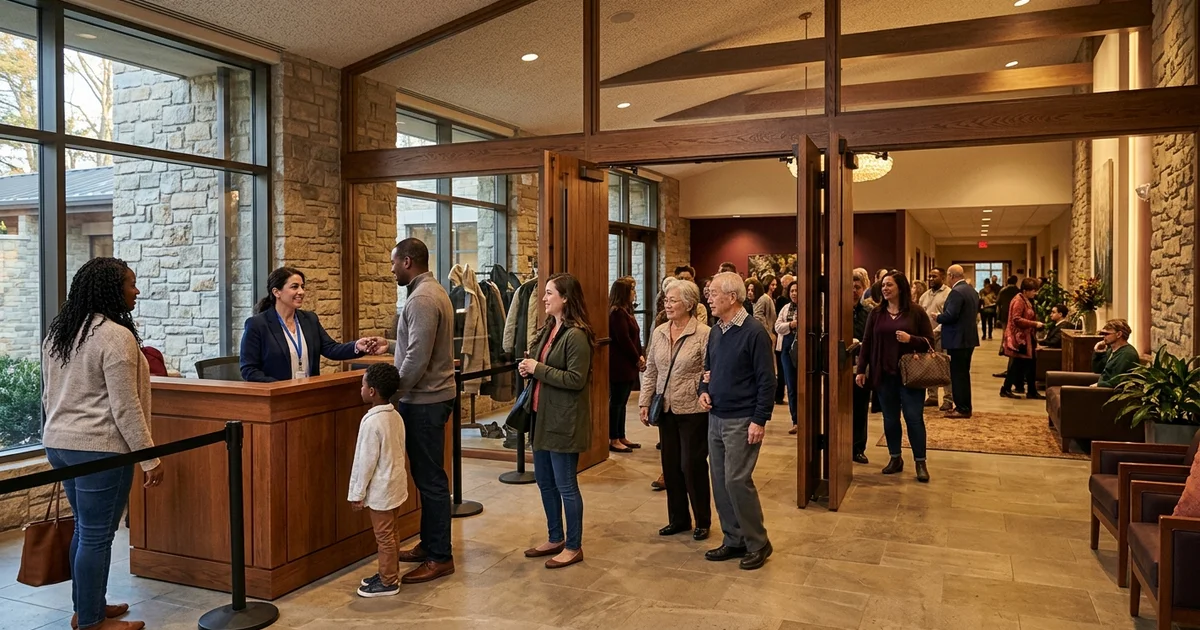
Security screening at a house of worship must not replicate the adversarial or transactional feel of an airport checkpoint. Equipment placement, signage, lighting, and staff demeanor all contribute to whether security feels protective or intrusive. Poor checkpoint design drives away first-time visitors and new members.
Holiday and High-Attendance Surge Events
Christmas Eve, Easter, Eid al-Fitr, High Holy Days (Rosh Hashanah, Yom Kippur), and Diwali create attendance surges 200-400% above typical weekly attendance. Permanent screening infrastructure must either accommodate these surges or integrate with temporary/mobile screening augmentation.
Multiple Entry Points and Informal Access
Religious facilities typically have multiple sanctuary entries, fellowship hall entrances, and administrative access points. Perimeter hardening — controlling which entries are active during services — is a prerequisite to effective screening. Screening one door while leaving three others unsecured provides no real protection.
Volunteer and Non-Professional Security Staff
Many smaller and mid-size congregations rely on volunteer security teams rather than trained professionals. Checkpoint design must account for operator training gaps — simpler workflows, clear signage, and equipment with intuitive alarm resolution reduce the impact of staff skill variance on screening effectiveness.
Faith-Specific Screening Deployment Guidance
How 2M Technology applies screening infrastructure engineering discipline to real facilities across Texas and nationwide. Every deployment begins with throughput modeling, not equipment selection.
Church Security Screening Systems
Christian churches — from small community congregations to megachurches with 5,000+ weekly attendance — represent the largest single segment of the religious facility security market. Screening deployments must accommodate Sunday morning burst arrivals, children’s ministry separate entry flows, and multi-service scheduling with partial crowd overlap between services.
Typical Deployment Parameters:
- Entry window: 10-20 minutes pre-service
- Lane count: 1 per 300-500 weekly attendees
- Children’s ministry: separate screening lane or waiver protocol
- Surge planning: Christmas Eve, Easter (2-4x normal attendance)
- Staff/volunteer lane: credentialed bypass with visual confirmation
Mosque Security Checkpoint Architecture
Mosque security screening presents unique design requirements: gender-separated screening areas aligned with Islamic protocols, accommodation of religious garments that may affect WTMD sensitivity settings, and planning for Friday Jumu’ah prayer surges where attendance can reach 3-5x weekday levels. Eid al-Fitr and Eid al-Adha create the highest attendance events of the year.
Key Design Requirements:
- Gender-separated screening lanes or areas
- Adjustable WTMD sensitivity for religious garments
- Female security staff for female congregant screening
- Eid surge: mobile screening augmentation planning
- Shoe-removal accommodation at security-to-entry transition
Synagogue Security Screening Design
Jewish congregations have been disproportionately targeted in recent years, making synagogue security one of the most urgent segments of the religious facility screening market. Synagogue checkpoint design must accommodate Shabbat entry patterns (Friday evening and Saturday morning services), High Holy Day surges (Rosh Hashanah and Yom Kippur), and considerations around technology use during Jewish holidays that affect electronic access control integration.
Key Design Requirements:
- High Holy Day surge: 3-5x regular Shabbat attendance
- Shabbat-compatible access control (no electronic key fobs)
- NSGP grant-eligible equipment specification
- Perimeter hardening as primary layer, screening as secondary
- Coordination with local law enforcement protocols
Temple and Multi-Faith Facility Screening
Hindu temples, Sikh gurdwaras, Buddhist temples, and multi-faith community centers each carry specific cultural and physical considerations. Common threads include large community gathering events (Diwali, Vaisakhi, Lunar New Year), multi-building campuses that require coordinated entry control, and community expectations of hospitality that must be preserved in checkpoint design.
Key Design Requirements:
- Festival event planning: Diwali, Vaisakhi, Lunar New Year
- Shoe removal areas at sanctuary entry integration
- Langar/community kitchen entry screening coordination
- Multi-building campus perimeter management
- Cultural liaison during checkpoint design process
Religious Facility Throughput Planning Reference
Lane count recommendations based on congregation size and entry window. All figures assume one X-ray system plus one walkthrough metal detector per lane, well-trained operators, and standard secondary inspection protocol.
| Congregation Size | Entry Window | Peak Arrival Rate | Recommended Lanes | Holiday Surge Lanes |
|---|---|---|---|---|
| 200-500 | 15 minutes | 27-33 persons/min | 1-2 lanes | 2-3 lanes (mobile augmentation) |
| 500-1,000 | 15-20 minutes | 25-67 persons/min | 2-3 lanes | 3-5 lanes (mobile augmentation) |
| 1,000-2,500 | 20-30 minutes | 33-125 persons/min | 3-5 lanes | 5-8 lanes (mobile or temp) |
| 2,500-5,000 | 20-30 minutes | 83-250 persons/min | 5-8 lanes | 8-14 lanes (mobile staging) |
| 5,000+ (Megachurch) | 30-45 minutes | 111-167+ persons/min | 8-14 lanes | Multi-gate deployment required |
DHS Nonprofit Security Grant Program (NSGP)
Maximum NSGP award per organization per fiscal year (FY2024)
Required nonprofit status for NSGP eligibility — most houses of worship qualify
Of NSGP awards in recent cycles have gone to faith-based organizations
X-ray systems, WTMDs, access control, security cameras, and training all qualify for NSGP funding
Religious Facility Security Screening Cost Reference
Installed cost ranges for complete religious facility screening deployments — equipment, installation, and integration. Actual costs vary by configuration, vendor, and regional labor rates. NSGP grant funding may offset 75-100% of equipment costs for qualifying organizations.
| Congregation Size | Deployment Type | Equipment Package | Installed Cost Range |
|---|---|---|---|
| 200-500 | Single entry checkpoint | 1x X-ray + 1x WTMD + handhelds | $35,000 - $55,000 |
| 500-1,000 | Dual-lane main entry | 2x X-ray + 2x WTMD + handhelds + secondary area | $65,000 - $100,000 |
| 1,000-2,500 | Multi-lane + mobile augmentation | 3-4x X-ray + 3-4x WTMD + mobile unit + access control | $100,000 - $180,000 |
| 2,500-5,000 | Full perimeter with surge capacity | 5-8x X-ray + WTMD + mobile units + camera + access control | $180,000 - $320,000 |
| 5,000+ Megachurch | Enterprise multi-gate infrastructure | 8-14+ lanes + surveillance + access control + command | $320,000 - $750,000+ |
How to Design a Religious Facility Security Checkpoint
A step-by-step engineering process for houses of worship moving from a security assessment to an operational checkpoint system.
Threat and Risk Assessment
Begin with a documented threat assessment that identifies the facility's risk profile: congregation size, public prominence, prior incidents, local threat environment, and any specific threats related to the faith community. This assessment drives the level of screening required and is a prerequisite for NSGP grant applications. 2M Technology provides facility assessments at no cost to qualifying organizations.
Entry Point Audit and Perimeter Control
Identify all active entry points during services. Reduce active entries to the minimum required for safety egress compliance -- typically one main screening entry plus one emergency-only exit. Perimeter hardening (access control, reinforced doors, camera coverage) of secondary entries is a prerequisite to effective checkpoint screening. Screening one door while leaving others unsecured provides no protection.
Throughput Modeling and Lane Count
Model throughput requirements based on peak attendance (not average attendance) and the entry window before service begins. Use the formula: (peak attendance x 0.8) divided by (entry window in minutes x lane throughput per minute). For a congregation of 1,000 with a 20-minute entry window, this yields approximately 3 lanes minimum. Add one lane of surge capacity for holiday events, or plan for mobile unit deployment.
Equipment Selection and Cultural Accommodation
Select equipment appropriate to the congregation's threat profile and cultural requirements. Mosques and some Orthodox communities require gender-separated screening areas with same-gender operators. Some communities prefer wand-only secondary screening over pat-down procedures. WTMD sensitivity settings should be adjusted to avoid alarming on common religious items (prayer beads, religious medals, modest dress layers). 2M Technology configures all equipment prior to installation to match the specific community's requirements.
Staff Training and SOPs
Train all security staff -- paid and volunteer -- on equipment operation, alarm response, secondary inspection procedures, and de-escalation communication specific to a worship environment. SOPs must include specific guidance on religious accommodation requests, medical device exceptions (pacemakers, insulin pumps), and escalation pathways that do not disrupt the congregation's spiritual experience. 2M Technology provides on-site training as part of all deployment packages.
Holiday and Surge Event Planning
Document a specific surge operations plan for each high-attendance event in the liturgical calendar. This plan should include: mobile unit deployment schedule, additional staffing requirements, queue management for outdoor waiting areas, coordination with local law enforcement for high-profile events, and communication to the congregation about what to expect at screening. 2M Technology rents and deploys mobile X-ray and WTMD units for high-attendance events.
2M Technology Religious Facility Security Experience
Megachurch Entry System
Synagogue Security Hardening
Mosque Entry Checkpoint Design
Related Screening Infrastructure Resources
Frequently Asked Questions: Religious Facility Security Screening
Common questions from church administrators, mosque directors, synagogue security chairs, and facility managers planning security screening systems.
How many X-ray lanes does a house of worship need?
The lane count is driven by peak attendance and entry window length. A congregation of 500 with a 15-minute pre-service entry window requires 1-2 lanes. A congregation of 1,000 with a 20-minute window needs 2-3 lanes. Megachurches with 5,000+ attendees typically require 8-14 lanes operating simultaneously. 2M Technology recommends using the X-Ray Throughput Calculator to model your specific requirements, then adding one lane of surge capacity for high-attendance events.
Can a mosque get NSGP funding for security screening equipment?
Yes. Mosques and all other houses of worship that hold 501(c)(3) nonprofit status are eligible for DHS Nonprofit Security Grant Program funding. NSGP awards up to $450,000 per organization per fiscal year and covers X-ray systems, walkthrough metal detectors, access control, surveillance cameras, and security training. More than 75% of recent NSGP awards have gone to faith-based organizations. 2M Technology assists qualifying organizations in identifying NSGP-eligible equipment specifications for grant applications.
How do you screen congregants without making the experience feel adversarial?
Checkpoint design for religious facilities prioritizes throughput over inspection intensity to minimize dwell time at the screening point, uses warm lighting and natural materials in the checkpoint area rather than industrial equipment staging, trains security staff in greeting-based interaction rather than inspection-based interaction, and positions equipment to allow eye contact and communication between staff and congregants throughout the screening process. Well-designed religious facility checkpoints average 8-12 seconds of visible screening time per person, which congregants consistently report as unobtrusive.
What happens during high-attendance events like Eid or Christmas Eve?
High-attendance religious events typically draw 200-400% of standard weekly attendance. Permanent screening infrastructure is rarely sized for these events. The preferred approach is a surge plan: mobile X-ray units and additional WTMD equipment deployed at temporary outdoor or vestibule screening stations, with additional security staff sourced from off-duty law enforcement or trained security contractors. 2M Technology rents and deploys mobile screening units for religious facility surge events throughout Texas and the surrounding region.
Does X-ray equipment interfere with pacemakers or medical devices?
The X-ray conveyor system itself poses no risk to pacemakers or implanted medical devices – the person is never inside or near the X-ray tunnel. Walkthrough metal detectors (WTMDs), however, emit electromagnetic fields that can interfere with some older pacemaker models. The standard protocol for congregants with pacemakers or implanted cardiac devices is a wand-based secondary screening instead of WTMD passage. 2M Technology configures all systems with a documented medical device bypass protocol and trains staff on its implementation.
Design Your Religious Facility Security Checkpoint
- 2M Technology
- 802 Greenview Drive, Suite 100, Grand Prairie, TX 75050
- •
- (214) 988-4302
- •
- sales@2mtechnology.net
- •
- Monday-Friday 8:00 AM – 5:00 PM CST
- •
- Texas Private Security License B15309