
Solar Surveillance Trailers — Deployable Cameras for Construction, Casinos, Malls & High-Traffic Sites
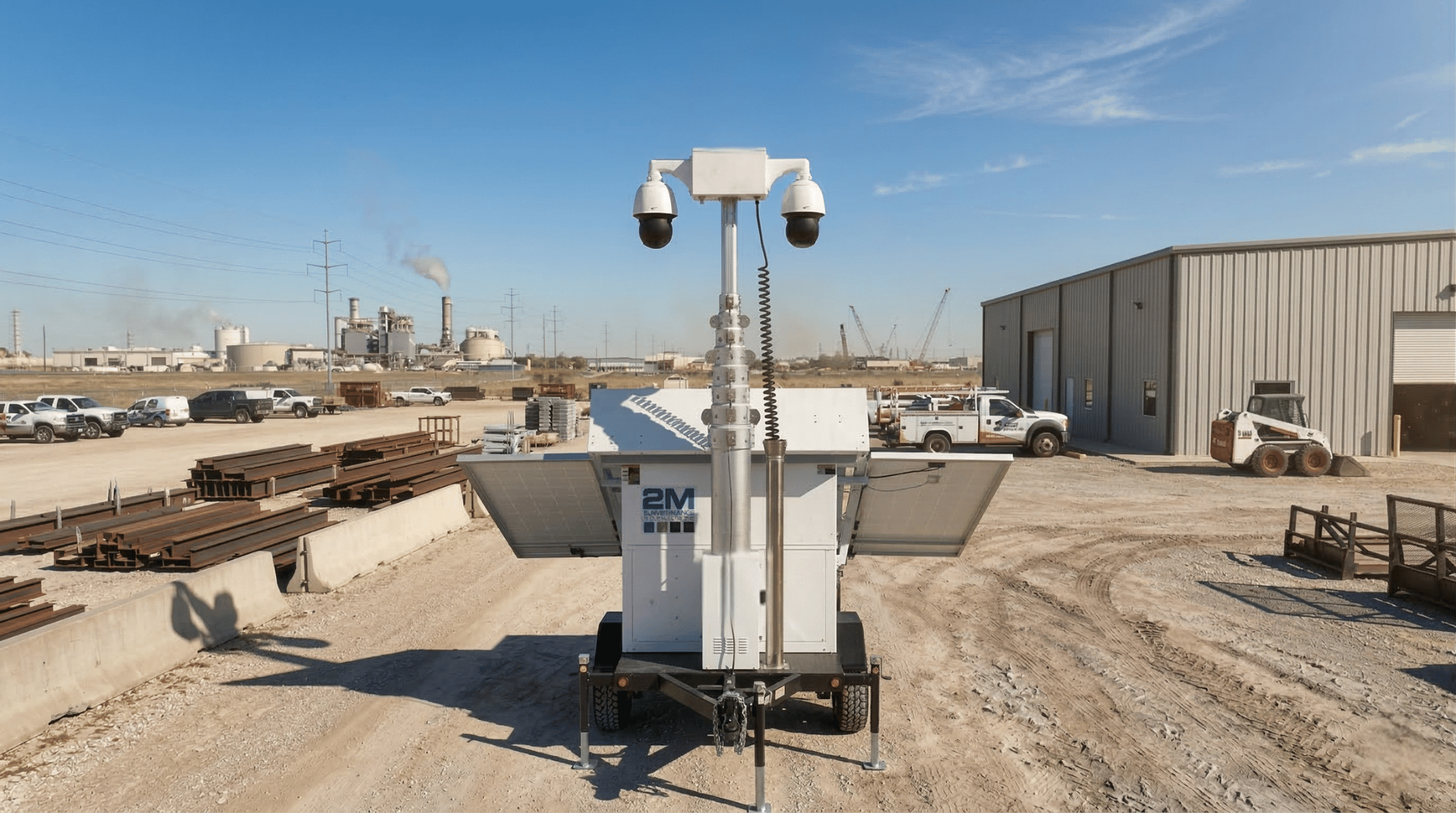
Solar surveillance trailers are self-contained, towable security systems that combine solar panels, battery storage, LTE/5G connectivity, and a full camera array into a single deployable unit. They operate independently of any wired power or internet infrastructure — arriving on-site, powering up, and streaming live video to the cloud within minutes of positioning. 2M Technology deploys solar surveillance trailers for temporary and semi-permanent security coverage wherever running conduit and fiber is impractical, cost-prohibitive, or impossible.
What Are Solar Surveillance Trailers?
A solar surveillance trailer solves the single biggest challenge in temporary and remote-site security: getting cameras running where there is no power and no network. Traditional security cameras require an electrician, a network run, and an NVR — none of which exist on an open construction site, in a casino overflow parking lot, or at a special event venue with no infrastructure.
A 2M Technology solar surveillance trailer arrives pre-wired. The solar array charges the onboard battery bank throughout the day. The LTE/5G router connects to the cellular network automatically. The camera system begins recording and streaming to Ifovea cloud VMS from the moment the mast is raised. No electrician. No network cable. No server room. One trailer, deployed in under an hour.
The trailer remains operational 24/7. Onboard battery storage powers the system overnight and through cloudy periods. Integrated IR floodlights activate on motion detection after dark, providing both deterrence and illuminated video capture. The Ifovea cloud VMS records continuously, and your security team accesses live and historical footage from any browser or mobile device, anywhere.
How a 2M Technology Solar Surveillance Trailer Works

Solar array
Tilting solar panels sized for full-day operation at Texas latitudes. Panels fold flat for transport and raise to optimal angle at deployment.
Battery bank
Deep-cycle battery storage providing 24–72 hours of autonomous operation during extended overcast periods or overnight hours.
LTE/5G router
Dual-SIM router with automatic carrier failover. Connects to Ifovea cloud VMS continuously. No on-site Wi-Fi or network required.
PTZ camera
Pan-tilt-zoom camera for remote-directed investigation. Operators can sweep the camera to any angle via the Ifovea app from any device.
Fixed wide-angle cameras
Continuous recording of a defined coverage zone in up to 4K resolution. ONVIF-compliant for universal VMS compatibility.
Thermal or AI analytics camera (optional)
AI-powered video analytics for intrusion detection, crowd density monitoring, and license plate capture.
IR floodlights
Motion-activated white-light or IR illumination for after-dark deterrence and clear video capture.
Telescoping mast
Raises cameras 15–25 feet above ground level for extended coverage radius and over-obstacle visibility.
Onboard siren and speaker
Two-way audio for remote guard intervention — speak through the trailer speaker from anywhere via the Ifovea app.
Solar Trailer vs. Fixed Camera System
| Factor | Fixed Wired Camera | Solar Surveillance Trailer |
|---|---|---|
| Power source | Requires conduit to utility power at every camera | Solar + battery. No utility connection needed. |
| Network connection | Cat6 or fiber run to each camera or NVR | LTE/5G cellular. No cable runs. |
| Deployment time | Days to weeks (electrical + network work) | Under 1 hour from tow-in to live video |
| Repositioning | Not practical — infrastructure stays where it was run | Tow to new position in minutes. Auto-reconnects. |
| Temporary projects | Infrastructure cost exceeds project duration value | Ideal — deploy for weeks or months, then relocate |
| Coverage height | Fixed mount height. Limited by pole or building | 15–25 ft telescoping mast. Above fences, equipment, crowds. |
| Recording storage | On-premise NVR — can be stolen or damaged on site | Ifovea cloud VMS — footage stored off-site, always safe |
| Power outage | System goes dark without UPS at each location | Battery continues operation through outages |
Use Cases by Industry
Solar surveillance trailers serve any site where cameras are needed but wired infrastructure is absent, temporary, or cost-prohibitive. The following industries account for the majority of 2M Technology solar trailer deployments in Texas.
Construction Sites
Construction sites are the highest-volume use case for solar surveillance trailers. An active job site has no permanent power, no network, a constantly changing footprint, and millions of dollars of vulnerable equipment and materials on the ground at all times.
Lumber, copper wire, HVAC equipment, and heavy machinery are primary theft targets. According to the National Equipment Register, construction equipment theft costs the U.S. industry $400 million annually — and fewer than 25% of stolen machines are recovered. A solar surveillance trailer positioned at the equipment staging area, materials yard, and site entrance changes the risk calculus for thieves immediately.
- Position at site perimeter — moves as the job footprint expands
- Cover materials laydown areas, equipment parking, and dumpster zones
- Provide after-hours motion detection with siren deterrence
- Document site conditions daily for insurance and liability protection
- Monitor subcontractor access and work-hours compliance
2M Technology solar trailers are standard equipment on commercial construction projects in the DFW area, including ground-up retail, multifamily, and infrastructure projects lasting 12–36 months.
Casino & Resort Properties
Casino and resort campuses combine large surface parking, valet areas, loading docks, employee entrances, and resort grounds — all requiring consistent camera coverage that fixed infrastructure may not fully address. Solar surveillance trailers supplement existing fixed systems at coverage gaps without the cost of running new conduit across paved areas or landscaped grounds.
- Cover remote parking lots and overflow lots during peak events
- Monitor valet and surface lot perimeters for auto theft and catalytic converter theft
- Deploy at resort grounds, golf course perimeters, and boat launch areas
- Provide temporary coverage during construction phases that displace fixed cameras
- Add visible deterrence at employee lot perimeters and loading dock approaches
Malls & Shopping Centers
Shopping center parking lots are among the most challenging environments for fixed camera coverage — large open surfaces, seasonal lighting changes, and the need for license plate capture at entry/exit points. Solar trailers provide flexible coverage that repositions as the center’s security priorities evolve.
- Deploy in parking lot islands — no conduit through paved surfaces
- Cover loading dock areas and service corridors
- Add visible deterrence in high-theft zones (electronics retailers, jewelry stores, pharmacy pick-up areas)
- Reposition for seasonal demand — closer to anchor retailers during holiday periods
- Provide LPR coverage at main entry/exit points to track suspect vehicles
Hospitals & Healthcare Campuses
Hospital campuses have extensive surface parking, remote outbuildings, ambulance bays, and loading areas that are difficult to cover with building-mounted fixed cameras. Staff parking lots — particularly overnight shifts — are high-incident areas for vehicle break-ins and personal safety concerns. Solar trailers extend coverage to the full campus perimeter without capital infrastructure projects.
- Cover remote staff and visitor parking areas on large campuses
- Monitor ambulance bays and emergency department drop-off zones
- Protect loading dock areas where medical supply deliveries arrive overnight
- Provide coverage during construction phases when existing cameras are moved
- Deploy at satellite clinics and outpatient facilities with limited fixed infrastructure
Events & Temporary Deployments
Outdoor events — concerts, sporting events, festivals, fairs, political rallies, and stadium overflow — require comprehensive camera coverage over a footprint that may not have any security infrastructure. Solar trailers deploy in hours, cover crowds and vehicle areas, and are removed when the event concludes.
- Perimeter monitoring of festival grounds and temporary fencing
- Parking area coverage for large vehicle volumes
- Crowd density monitoring using AI analytics cameras
- Two-way audio for remote security announcements and crowd direction
- Coordination with on-site security teams via the Ifovea mobile app
2M Technology operates a rental fleet of solar surveillance trailers available for event deployments across Texas with next-day availability for confirmed bookings.
Oil & Gas / Industrial Facilities
Remote oilfield locations, pipeline right-of-ways, gas compressor stations, and industrial facilities often have no wired power at the perimeter and require surveillance coverage that operates for months at a time unattended. Solar trailers are the only practical solution for many of these deployments.
- Monitor wellhead and tank battery areas for unauthorized access and equipment theft
- Cover pipeline right-of-way valve sites and pump stations
- Provide perimeter coverage at compressor stations and gas processing facilities
- Deploy at remote chemical storage areas with hazmat access logging
- Monitor rail spur and truck loading areas at refineries and terminals
See 2M Technology’s dedicated oilfield surveillance trailer page for oil and gas-specific configurations.
Parking Facilities & Lots
Surface parking lots, structured parking garages, and park-and-ride facilities have large coverage areas, after-hours vulnerability, and infrastructure limitations that make solar trailers an ideal supplement to fixed systems. Catalytic converter theft, auto burglary, and carjacking are primary concerns.
- Position in lot islands and perimeter corners for maximum coverage radius
- Capture license plates at all entry and exit points
- Provide remote guard services — monitoring staff can intervene via trailer audio
- Cover overflow lots that are only activated for peak demand periods
- Deter catalytic converter theft with motion-activated floodlights and sirens
Utilities & Substations
Electric substations, water treatment facilities, telecommunications infrastructure, and utility right-of-ways require persistent perimeter monitoring with minimal maintenance. Solar trailers are deployed at utility sites where grid power is unavailable at the perimeter and where access must be logged for compliance purposes.
- Monitor substation perimeter fencing and gate access 24/7
- Cover water treatment plant perimeters and chemical storage areas
- Provide access logging for NERC CIP and similar compliance frameworks
- Deploy at cell tower sites and telecommunications huts for equipment protection
- Monitor right-of-way corridors for unauthorized access and vegetation encroachment
Deployment in Hours, Not Weeks
The defining advantage of a solar surveillance trailer is the deployment timeline. A wired security system requires an electrical contractor, a network installer, permit applications, and days or weeks of installation work before the first camera goes live. A solar surveillance trailer from 2M Technology operates on a different timeline entirely.
| Step | Action | Time |
|---|---|---|
| 1. Site assessment | 2M Technology reviews site map, identifies optimal trailer positions | Same day or next day |
| 2. Equipment dispatch | Pre-configured trailer towed to site by 2M Technology field technician | Next business day in DFW |
| 3. Positioning | Trailer backed to position, leveling jacks set, mast raised | 30–60 minutes |
| 4. Live video | LTE connects to Ifovea cloud. Cameras go live and begin recording. | Within minutes of mast raise |
| 5. Access provisioned | Client receives Ifovea login. Live view and recordings accessible from phone or browser. | Same day as deployment |
2M Technology maintains a deployment-ready trailer fleet in the Dallas–Fort Worth area. Emergency deployments for active theft situations or event security gaps can typically be arranged within 24 hours.
Frequently Asked Questions
How long can a solar surveillance trailer operate without sunlight?
2M Technology solar trailers are configured with battery banks sized for 24–72 hours of autonomous operation without solar recharge. In Texas, with average solar irradiance, a properly sized system operates continuously year-round with no manual intervention.
Can the trailer be left on-site unattended?
Yes. Solar surveillance trailers are designed for unattended semi-permanent deployment. The LTE connection maintains continuous cloud recording to Ifovea. Motion alerts are delivered to security staff remotely. Many clients leave trailers deployed for months at a time with no on-site maintenance required.
What cellular network does the trailer use?
2M Technology trailers use dual-SIM LTE/5G routers with automatic failover between carriers. Trailers are provisioned with commercial data SIMs on major U.S. carriers. Signal strength is verified during the site assessment.
Can I view footage on my phone?
Yes. All footage streams to Ifovea cloud VMS. The Ifovea mobile app is available for iOS and Android. Live view, recorded video, motion alerts, and PTZ camera control are all accessible from your phone.
Do you offer rental or lease options for solar surveillance trailers?
Yes. 2M Technology offers purchase, lease, and short-term rental options. Rental is typically the right choice for events, short construction phases (under 6 months), and temporary coverage while permanent systems are installed. Contact 2M Technology at (214) 988-4302 for current rental rates.
How much does a solar surveillance trailer cost?
Solar surveillance trailer pricing depends on camera configuration, battery capacity, and deployment duration. Contact 2M Technology for a quote tailored to your site size, required coverage area, and project timeline. Rental rates for construction and event deployments are available on weekly and monthly bases.
Related Solar Surveillance Resources
- Mobile Surveillance Trailers — Full product overview and power configurations
- Oilfield Surveillance Trailers — Remote oil and gas site configurations
- Solar Surveillance Trailers San Antonio — South Texas deployments
- Construction Site Perimeter Blind Spots — Coverage gap analysis for active job sites
- Large Property Perimeter Security — Estates, ranches, and remote industrial sites
- Best Mobile Surveillance Trailer Companies — 2026 comparison guide

