
Updated May 2026 | 2M Technology | Grand Prairie, TX
Standard cameras and guard posts leave construction sites with serious coverage gaps — because they were not designed for a perimeter that changes every week. Here is why they fail and how distributed infrastructure closes the gaps.
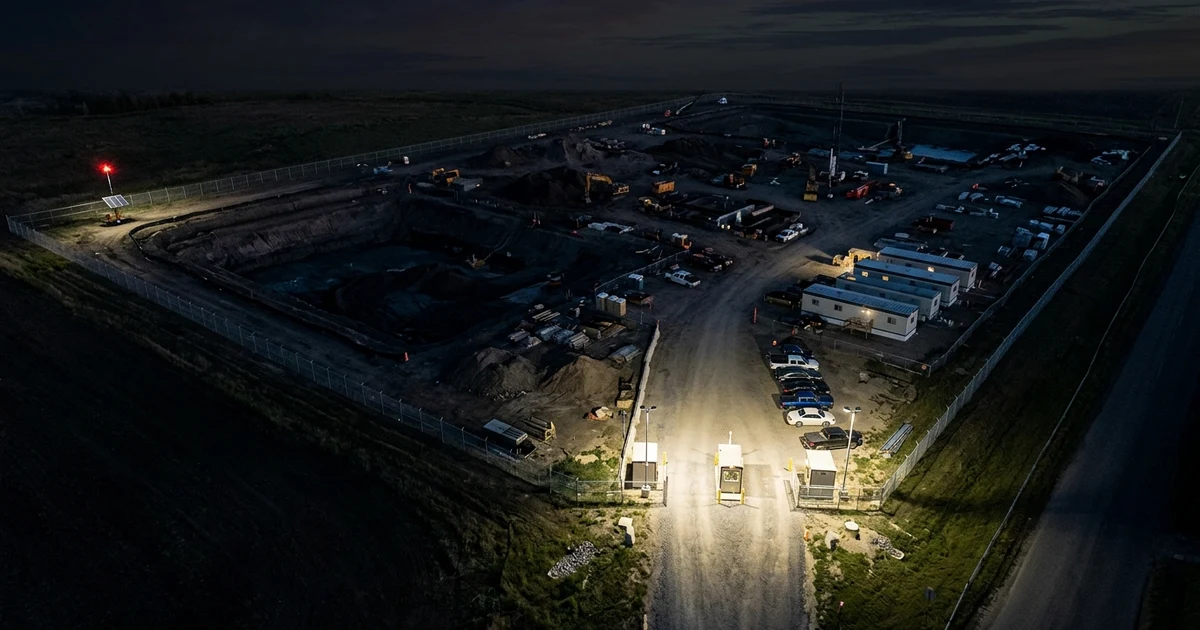
Assess Your Construction Site Access Flow →Construction site perimeter blind spots are areas of an active jobsite where no camera, guard, or sensor provides reliable surveillance coverage. They occur because construction perimeters are dynamic: site layout changes weekly, temporary fencing is moved, new access points are opened, and the areas that mattered last month are no longer where equipment and materials are staged. Blind spots are the specific locations that theft and unauthorized access incidents actually exploit — fence corners, secondary gates, and overnight staging areas where coverage has degraded or never existed.
Why Construction Sites Have More Blind Spots Than Other Facilities
Construction site perimeter blind spots are more prevalent and more damaging than blind spots at fixed facilities for three structural reasons: dynamic site layout, absence of wired infrastructure, and multiple unguarded access points that multiply as the project progresses. A warehouse or manufacturing plant has a fixed perimeter. A security camera installed at the northwest corner covers that corner for the life of the facility. A construction site has no such permanence. The fence line that defines the perimeter in month one is replaced in month three as new portions of the site come online. Equipment staging areas migrate. Temporary roads create new vehicle access points. The security system designed at groundbreaking is partially obsolete by the time the foundation is poured. Construction sites also lack the wired electrical and network infrastructure that fixed facilities take for granted. Running conduit to add a camera at a newly exposed blind spot can cost thousands of dollars and take weeks — by which time the site layout has changed again. This infrastructure friction is why most construction sites end up with fewer cameras than they need and more blind spots than they know.The Most Common Blind Spot Locations on Construction Sites
| Location | Why It Becomes a Blind Spot | Primary Risk |
|---|---|---|
| Fence line corners | Camera field-of-view gaps where fence sections meet at angles | Fence breach, material theft |
| Equipment staging areas | Location changes as project phases progress; cameras not repositioned | Equipment theft, copper/material theft |
| Secondary access gates | Added for contractor convenience; rarely receive camera coverage | Unauthorized vehicle removal |
| Overnight perimeter | Guards leave; fixed cameras cover daytime zones not overnight ingress paths | After-hours theft, vandalism |
| Active work zones after hours | Temporary lighting removed; cameras sited for daytime monitoring | High-value material staging theft |
Operational Consequences of Blind Spots
Construction site perimeter blind spots are not an abstract security concern — they have direct financial consequences that are well-documented by the industry. The National Insurance Crime Bureau (NICB) estimates that construction equipment theft costs the industry more than $1 billion annually in the United States. Individual heavy equipment theft incidents average $30,000 to $50,000 per event. Recovery rates for stolen construction equipment are below 25% when no video documentation of the theft event exists. Beyond equipment theft, blind spots enable material theft (copper wire, lumber, rebar, and HVAC components are primary targets), vandalism that can set schedules back by weeks, and unauthorized access that creates liability exposure when trespassers are injured on-site. Insurance carriers increasingly require documented perimeter coverage as a condition of construction policy renewal. Investigation failure is the compounding consequence. When a theft occurs in a blind spot, there is no footage. Without footage, police investigations stall. Without an investigation result, insurance claims are scrutinized more heavily. The cost of an unresolved theft extends well beyond the value of the stolen item.Construction Site Security | (214) 988-4302
We will map your site’s current blind spots at no cost.
View Solar Surveillance Trailers →Why Fixed Cameras Cannot Solve This Problem
Fixed cameras are the default answer to perimeter surveillance, and they work well for perimeters that do not change. Construction sites are not that kind of perimeter. The fundamental problem is that fixed cameras require cabling to power and network — and pulling cable through a construction site is slow, expensive, and produces infrastructure that becomes useless when the site layout shifts. A wired camera installation at a construction site typically takes 3 to 5 days per camera location when factoring in trenching, conduit, and network termination. By the time the camera is operational, the staging area it was meant to cover may have moved 200 feet. This lag is inherent to wired infrastructure and cannot be engineered away — it is a physical constraint of the medium. Additionally, fixed cameras sited for the initial site layout create coverage for the conditions that existed at installation, not the conditions that exist when a theft occurs six months later. Many construction site theft investigations discover that the incident occurred just outside the field of view of a camera that was correctly positioned for an earlier phase of the project.Why Guard Posts Fail at Scale
A single guard monitoring a 20-acre construction site cannot physically observe all perimeter segments simultaneously. Industry staffing models typically place one guard per 3 to 5 acres for meaningful coverage, and even then, the guard’s attention at any given moment is directed at one location. Perimeter segments not under active observation are effectively unguarded. After-hours guard coverage is the most expensive and most commonly reduced security measure on construction sites. A guard post that operates during the day shift is frequently reduced or eliminated on overnight and weekend shifts — exactly when theft incidents are most likely to occur. The economics of guard staffing create predictable blind windows that experienced thieves exploit. Guards also do not produce the documentation that insurance and law enforcement require. A guard who observes a suspicious vehicle but does not obtain a plate number or photograph provides no actionable evidence. Automated surveillance infrastructure creates an evidence record without relying on individual alertness during low-activity overnight hours.How Distributed Solar Surveillance Closes Blind Spots
Solar surveillance trailers are specifically engineered for the construction site problem. They deploy in hours rather than days, require no wired power or network infrastructure, transmit video over LTE or 5G cellular, and can be repositioned as the site evolves without any civil or electrical work. A solar surveillance trailer placed at a fence corner blind spot provides continuous 24/7 coverage immediately. When the equipment staging area moves in month four, the trailer is towed to the new location. When a secondary gate is opened for a subcontractor phase, a trailer is positioned to cover it within the same day. The coverage follows the site rather than forcing the site to accommodate fixed infrastructure. Each trailer operates autonomously: solar panels charge battery banks that power cameras, PTZ heads, IR illuminators, and cellular modems through overnight hours without external power. Video is transmitted to Ifovea cloud VMS for remote monitoring and event recording. Motion alerts are delivered immediately to designated recipients when after-hours activity is detected.LPR at All Vehicle Entry Points
Placa.ai LPR at secondary construction site gates closes the vehicle access blind spot that standard single-gate LPR deployments miss. Theft of materials by unauthorized trucks most commonly occurs through secondary access gates precisely because those gates receive less monitoring attention. Contractors and delivery drivers use secondary gates legitimately, which makes an unauthorized vehicle among them difficult to distinguish without plate verification. LPR at all vehicle gates produces a complete log of every vehicle entering and exiting the site, with plate, timestamp, and photo. Authorized contractor vehicle lists can be uploaded to Placa.ai so that unrecognized plates trigger an immediate alert to site management. The complete log provides insurance documentation and supports police investigation if a vehicle is later identified as involved in a theft. LPR systems can be deployed on solar-powered trailers at secondary gates that lack wired power — making comprehensive plate coverage achievable at every access point regardless of electrical infrastructure.The Integrated Solution
Closing construction site perimeter blind spots requires a distributed infrastructure approach rather than a single-technology solution. The components that work together for comprehensive coverage:- Solar surveillance trailers positioned at fence corners, equipment staging areas, and secondary access points
- LPR at every vehicle gate, including secondary contractor gates
- Cloud VMS aggregating all camera feeds for remote monitoring and event recording
- Motion-triggered alerts for after-hours activity at all perimeter segments
- Repositionable infrastructure that follows the site as layout evolves
Is Construction site perimeter blind spots the Right Solution for Your Site?
Construction site perimeter blind spots from 2M Technology is the right approach for any site where workforce scale, vehicle volume, or perimeter size makes traditional guard booths and fixed cameras inadequate. 2M Technology designs construction site perimeter blind spots that deploys in hours, not weeks, and scales incrementally as your operational requirements grow.
The core advantage of construction site perimeter blind spots from 2M Technology is open architecture: every component integrates with existing credentialing systems, VMS platforms, and access control software without proprietary lock-in. Organizations already operating HID, Mercury, Brivo, or Genetec systems can connect construction site perimeter blind spots without replacing existing investment.
How to Evaluate a Construction site perimeter blind spots Provider
- Confirm construction site perimeter blind spots deployment timeline — pre-wired units should be operational in 4 to 8 hours
- Verify open-architecture credential support (HID, MIFARE, Mercury, Brivo, Ubiquiti)
- Confirm LTE and 5G wireless backhaul so no site fiber is required
- Require cloud VMS and cloud LPR integration as standard components
- Validate the construction site perimeter blind spots system can relocate as site requirements evolve
Frequently Asked Questions
Assess Your Construction Site Access Flow
Share your site plan and current security setup. We will identify your perimeter blind spots and design a distributed solar and LPR solution that covers them — no new cabling required.
Request a Site Assessment Call (214) 988-4302
