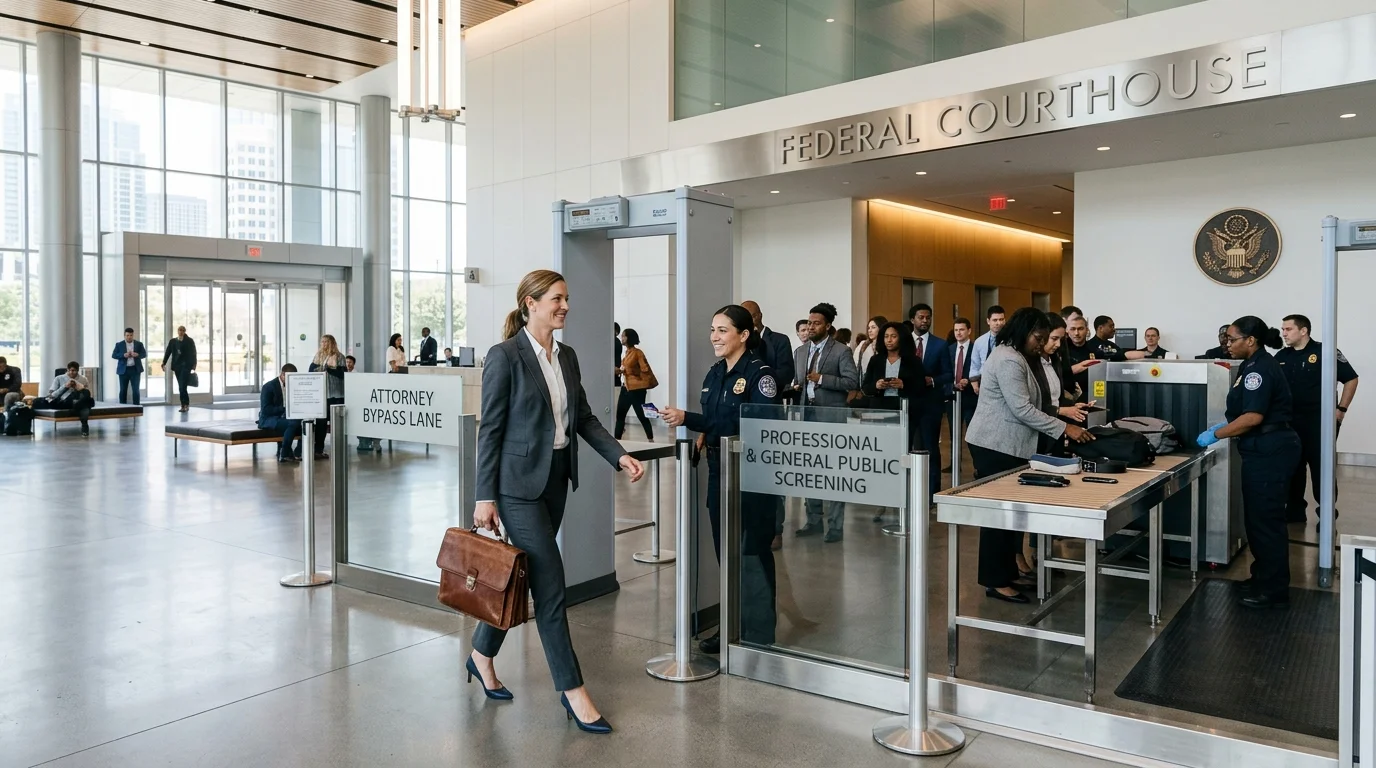
Attorney Bypass Lanes Courthouse Security — 3 Essential Design Principles
Attorney bypass lanes in courthouse security checkpoints are among the most impactful design decisions a court facility manager can make. Without attorney bypass lanes in your courthouse security system, credentialed judges, attorneys, clerks, and law enforcement slow down the public screening queue — causing docket delays and frustrated visitors on busy mornings. 2M Technology designs attorney bypass lanes for courthouse security checkpoints throughout Dallas-Fort Worth. Here are the 3 essential design principles.
Principle 1: Attorney Bypass Lanes Must Still Screen for Weapons
Attorney bypass lanes in courthouse security setups are not no-screening lanes — they are reduced-friction screening lanes. Credentialed personnel still pass through a walk-through metal detector. What they skip is X-ray bag screening of items they carry. The bypass lane uses a badge reader or credential scanner to verify identity and allow entry through a dedicated metal detector lane without joining the public X-ray queue. This keeps attorney bypass lanes courthouse security-compliant while eliminating the 3–5 minute wait that attorneys otherwise face at the public X-ray conveyor.
Principle 2: Technology Components of Attorney Bypass Lanes
A properly designed attorney bypass lane for courthouse security includes:
- Credential reader — bar card scanner, HID badge reader, or courthouse ID scanner verifies identity before entry
- Walk-through metal detector — still provides weapons screening for every person
- Security camera — records all bypass entries with credential ID and timestamp for audit purposes
- Audit log — exported daily, retained 90 days, available to court security administrators
- Emergency override — allows the security supervisor to require full X-ray screening for any individual at any time
- ADA accessible design — bypass lane must accommodate mobility equipment per Title II requirements
2M Technology integrates attorney bypass lanes with the access control system so that credential management, audit logs, and emergency overrides are handled from the same platform as the rest of courthouse access control.
Principle 3: Throughput Math for Attorney Bypass Lanes
Attorney bypass lanes in courthouse security checkpoints directly reduce the required number of public X-ray lanes. On a typical DFW county courthouse morning, 15–25% of entrants are credentialed attorneys, clerks, and law enforcement. Routing them to a bypass lane reduces public X-ray demand by that percentage — meaningfully reducing queue length and potentially eliminating one public X-ray lane. For a courthouse needing 5 public lanes without attorney bypass lanes, routing 20% of entrants through bypass reduces public X-ray demand to 4 lanes — a $45,000–$80,000 equipment savings plus ongoing operating cost reduction from one fewer X-ray operator.
Common Attorney Bypass Lane Mistakes to Avoid
2M Technology frequently audits courthouse security systems where attorney bypass lanes were poorly designed. The most common mistakes:
- No metal detector in the bypass lane — weapons can enter undetected
- No credential reader — staff “wave through” anyone who looks like an attorney
- No camera coverage — no audit trail for security reviews or incidents
- Bypass lane too narrow — doesn’t accommodate judges carrying robes bags or attorneys with trial cases
- No overflow procedure — when bypass lane is overwhelmed, credentialed staff join the public queue with no clear process
The National Center for State Courts publishes attorney bypass lane guidelines as part of their comprehensive courthouse security standards. 2M Technology designs to these standards for every courthouse security screening Dallas installation.
Contact 2M Technology for a free courthouse security assessment including attorney bypass lane design. Call (214) 988-4302 or email sales@2mtechnology.net.