Updated May 2026 | 2M Technology | Grand Prairie, TX
Large estates, ranches, and remote properties have inherent perimeter security blind spots that fixed cameras and guards cannot address economically. Here is the distributed solution that actually works.
Definition: Large Property Security Blind Spots
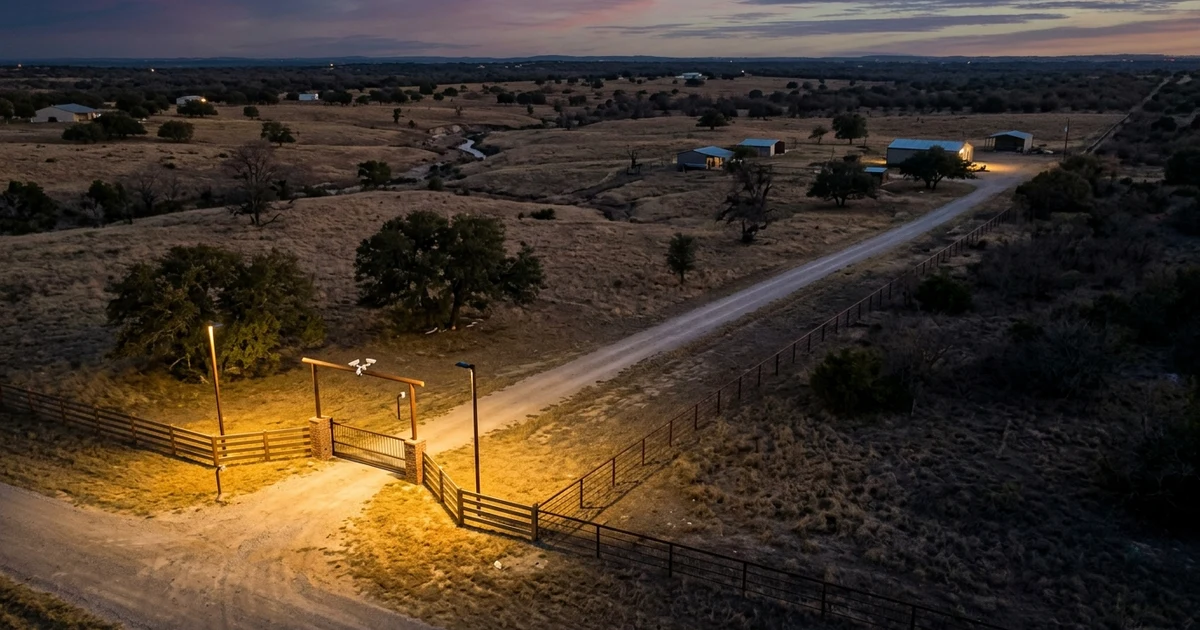
Large property security blind spots are sections of an estate, ranch, or remote facility perimeter where no camera, sensor, or monitored access point provides coverage. Unlike building security blind spots — which are typically a camera angle problem — large property blind spots are an infrastructure problem. The distances involved make wired coverage economically and physically impractical. A property with 3 miles of fence line and 6 vehicle gates simply cannot achieve comprehensive coverage through conventional fixed-camera approaches without millions of dollars in infrastructure investment.
Why Large Properties Are Harder to Secure Than Buildings
Large property security is a fundamentally different engineering problem than building or campus security. The challenges are not primarily technological — they are geometric and infrastructural. A 500-acre ranch has a perimeter of approximately 5.6 miles. A 1,000-acre property has over 8 miles of fence line. No wired camera system can economically cover these distances.
The hard cost of wired camera infrastructure — including cable, conduit, electrical, and network termination — runs $10 to $20 per linear foot under typical conditions. Covering a single mile of fence line with wired cameras positioned every quarter-mile would require roughly $50,000 to $100,000 in cabling infrastructure alone, before the cameras, poles, or installation labor are counted. This is before accounting for trenching across varied terrain, creek crossings, and the electrical panel upgrades required at remote locations.
Remote location compounds every challenge. Properties in rural Texas, the Southwest, or the Mountain West frequently have limited or no grid power at secondary structures, no wired network, and cellular coverage that varies by carrier and terrain. Any security solution must function reliably in these conditions without assuming infrastructure that does not exist.
Common Blind Spot Locations on Large Properties
Large property blind spots are predictable. They occur at locations that require either long cable runs or difficult terrain access — exactly the places where an intruder or opportunistic thief will probe first, because they know coverage is weakest there.
| Location | Why It Is Uncovered | Risk |
|---|---|---|
| Secondary gates | No power or network; not the “main” gate so not prioritized | Unauthorized vehicle entry/exit |
| Fence line corners and mid-spans | Cable cost prohibitive across acreage | Fence breach, trespass |
| Creek crossings and dry washes | No fence practical; not a standard camera location | Natural access point for foot traffic |
| Outbuildings and equipment yards | Distant from main structure; no network infrastructure | Equipment and fuel theft |
| Back of property | Most distant from main structure; overlooked | Sustained trespass, encroachment |
Why Traditional Approaches Fail
Three conventional security approaches are attempted on large properties, and each fails in a predictable way:
Fixed cameras: Cable cost is prohibitive across acreage. A 500-acre property attempting comprehensive fence-line coverage with wired cameras would face infrastructure costs in the hundreds of thousands of dollars before a single camera is mounted. Even where wired cameras are installed at the main structure, the coverage radius rarely extends beyond 300 to 500 feet — a negligible fraction of the total perimeter.
Security guards: Guards can patrol but cannot monitor miles of perimeter simultaneously. A single guard on a 500-acre property provides a patrol interval — they are at each location once every few hours — not continuous surveillance. Motivated trespassers simply observe the patrol pattern and time their access accordingly. Guard costs for 24/7 coverage of a large property also exceed $150,000 to $300,000 annually per post.
Standard VMS without remote nodes: Conventional video management systems are designed for buildings and campuses where all cameras are on a local network. They have no architecture for cameras distributed across a mile of fence line communicating via cellular. Attempting to use them for large-property perimeter coverage requires adding external network infrastructure that negates the cost advantage of the approach.
Large Property Security | (214) 988-4302
How many acres? We will calculate your coverage needs.
The Infrastructure That Actually Works
The infrastructure that addresses large property security blind spots is distributed, wireless, and solar-powered — because those are the physical requirements that large-acreage properties impose. The core components:
- Solar surveillance trailers: Self-contained units with solar panels, battery banks, PTZ cameras, IR illuminators, and LTE/5G cellular modems. No external power or network required. Deployable in hours at any location on the property. Repositionable as security priorities change.
- Placa.ai LPR at all vehicle gates: Solar-powered LPR cameras at every gate — not just the main entrance — logging every vehicle entering and exiting. Authorized vehicle lists generate automatic alerts for unrecognized plates.
- Ifovea cloud VMS: All distributed cameras connect to Ifovea over cellular. Remote monitoring, motion alerts, event recording, and PTZ control from any internet-connected device without requiring on-site network infrastructure.
Coverage Mathematics
Large property coverage planning starts with perimeter length and access point count, not acreage alone. A 200-acre square has a shorter perimeter than a 200-acre narrow rectangle. Irregular property boundaries, water features, and terrain all affect the node count required for meaningful coverage.
| Property Size | Est. Perimeter | Solar Nodes | Estimated Coverage |
|---|---|---|---|
| 50 acres | 1.8 miles | 4–6 nodes | 80–90% perimeter |
| 200 acres | 3.6 miles | 6–10 nodes | 75–85% perimeter |
| 500 acres | 5.6 miles | 10–16 nodes | 70–80% perimeter |
| 1,000+ acres | 8+ miles | 16–24 nodes | Priority zones + all gates |
For properties over 500 acres, coverage strategy shifts from attempting comprehensive perimeter coverage to prioritizing high-risk zones: all vehicle gates (100% coverage), outbuilding clusters, and perimeter segments adjacent to public roads or neighboring properties. Interior monitoring covers movement between zones once perimeter breach occurs.
LPR at Every Gate, Not Just the Main Entrance
The most common large property security oversight is deploying LPR only at the primary entrance. Secondary gates — often used by ranch hands, contractors, hunters, or agricultural operations — receive no plate monitoring. These gates are precisely where unauthorized vehicle access occurs, because they are known to be less monitored.
Placa.ai cloud LPR at solar-powered secondary gate mounts closes this gap. Every vehicle entering or exiting through any gate is logged with plate, timestamp, and photo. Authorized vehicle lists enable automatic alerts for unknown plates. The complete log provides property owners with a comprehensive record of all vehicle activity, which is essential for investigating incidents and supporting law enforcement after the fact.
Remote Monitoring Without On-Site Staff
Ifovea cloud VMS enables property owners and their security teams to monitor large properties remotely without requiring on-site staff. All distributed solar cameras transmit to the Ifovea cloud platform over cellular. Motion events at any camera location generate immediate alerts with video clip to the designated recipient’s phone or email.
Owners of remote properties — hunting ranches, agricultural operations, remote retreats — can monitor all activity in real time from their primary residence. Access to the property can be extended to a local caretaker or contracted security monitoring center without requiring any on-site infrastructure beyond the cameras themselves.
See our distributed operational security infrastructure hub for the full architecture of how solar, LPR, and cloud VMS integrate across large properties and multi-site operations.
Is Large property security blind spots the Right Solution for Your Site?
Large property security blind spots from 2M Technology is the right approach for any site where workforce scale, vehicle volume, or perimeter size makes traditional guard booths and fixed cameras inadequate. 2M Technology designs large property security blind spots that deploys in hours, not weeks, and scales incrementally as your operational requirements grow.
The core advantage of large property security blind spots from 2M Technology is open architecture: every component integrates with existing credentialing systems, VMS platforms, and access control software without proprietary lock-in. Organizations already operating HID, Mercury, Brivo, or Genetec systems can connect large property security blind spots without replacing existing investment.
How to Evaluate a Large property security blind spots Provider
- Confirm large property security blind spots deployment timeline — pre-wired units should be operational in 4 to 8 hours
- Verify open-architecture credential support (HID, MIFARE, Mercury, Brivo, Ubiquiti)
- Confirm LTE and 5G wireless backhaul so no site fiber is required
- Require cloud VMS and cloud LPR integration as standard components
- Validate the large property security blind spots system can relocate as site requirements evolve
Frequently Asked Questions
Map Your Large-Site Perimeter Coverage
Share your property size, gate count, and current security setup. We will produce a coverage map identifying blind spots and recommend the number and placement of solar nodes needed to close them.