Industrial Production — Inline Inspection Engineering
Production Line Conveyor Inspection
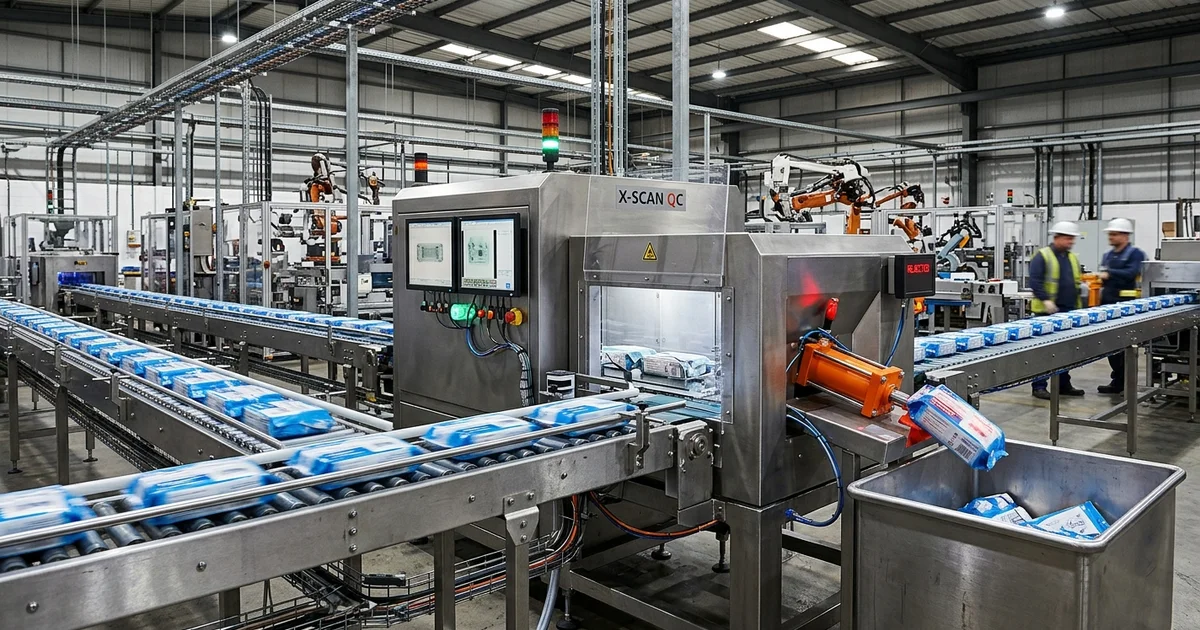
Inline X-ray, vision, and sensor integration for 100% product coverage at full production line speed. 2M Technology engineers conveyor inspection systems that match your line throughput without creating bottlenecks, sized for your specific product profile, conveyor speed, and detection requirement.
Production line conveyor inspection is the integration of X-ray imaging, machine vision cameras, weight checkweighers, metal detectors, and sensor systems directly into a production or packaging conveyor line to inspect 100% of product units continuously at full line speed. Production line conveyor inspection systems must be engineered to match the conveyor speed, product dimensions, product spacing (gap between consecutive units), and reject mechanism response time of the specific production line — ensuring that every product is inspected and that non-conforming units are rejected reliably without missing products, creating false rejects, or reducing throughput below the line’s production rate target.
100%
Coverage target of production line conveyor inspection — the fundamental advantage over sampling-based offline inspection, which can only assure quality for the sampled units while passing uninspected product
50-500ms
Typical gap time window for inspection decision per unit on a production line conveyor — the time between when one unit exits the inspection zone and the next unit enters. System processing speed must complete within this window.
20-100 m/min
Typical production conveyor speed range across food, pharmaceutical, and consumer goods packaging lines. Inspection system conveyor speed must match exactly — speed mismatch creates product overlap or excessive gaps that reduce coverage accuracy.
0.1-0.5%
Target false reject rate range for AI-tuned production line conveyor inspection systems. Higher false reject rates directly impact production yield and must be continuously monitored against the quality plan tolerance.
Production Line Conveyor Inspection Engineering Parameters
Every production line conveyor inspection system must be specified against five critical engineering parameters that are specific to the production line it will be integrated into. Generic inspection system specs are not sufficient — the system must be engineered to the line, not the other way around.
1. Conveyor Speed
The inspection system conveyor must run at precisely the same speed as the production line conveyor. Speed mismatch — even a few percent — causes product to arrive at irregular intervals, creating coverage gaps or overlapping products that the system cannot inspect accurately. 2M Technology measures actual production line speed under normal operating conditions and configures the inspection conveyor to match, including variation across speed changes during startup and shutdown cycles.
2. Product Spacing (Gap Time)
Gap time — the interval between consecutive product units entering the inspection zone — determines how much processing time the inspection system has to complete its analysis and render a pass/fail decision before the next product arrives. At 60 m/min with 200mm product spacing, gap time is approximately 200ms. At 30 m/min with the same spacing, it doubles to 400ms. Inspection system processing speed and AI model inference time must complete within the gap time with margin to spare for the reject mechanism response.
3. Product Dimensions
The inspection tunnel aperture (X-ray) or field of view (vision) must cover the largest product cross-section that will be inspected, including packaging that may vary in height across different SKUs on the same line. For X-ray systems, tunnel height and width must accommodate the product plus any packaging tolerance, with margins that prevent contact between product and tunnel walls at full line speed.
4. Reject Mechanism Timing
The reject mechanism (air blast, pusher, diverter gate) must be precisely timed to activate when the rejected product reaches the reject station — which is typically 0.5 to 2 meters downstream from the inspection zone. Reject timing errors cause good product rejection (false reject) or failed rejection (defective product passes). 2M Technology programs and validates reject timing against the actual line speed and reject station position during commissioning.
5. Detection Sensitivity vs. False Reject Balance
Detection threshold determines the minimum defect or contaminant size that will be flagged for rejection. Lower thresholds catch smaller defects but increase false reject rates as natural product variation is also flagged. 2M Technology uses AI-tuned detection models that separate natural variation from genuine defects, achieving target false reject rates of 0.1-0.5% while maintaining the required detection sensitivity for the specific hazard profile of each product line.
How to Engineer a Production Line Conveyor Inspection System
1
Line Speed and Throughput Measurement
Measure actual production line speed and throughput under normal operating conditions — not the rated line speed from the equipment spec sheet, which may differ significantly from real operating speed. Record speed variation during startup, steady-state production, and speed changes caused by upstream or downstream equipment. The production line conveyor inspection system must accommodate the full speed range, not only the nominal operating point.
2
Product Profile and SKU Matrix Documentation
Document all SKUs that will run through the inspection system: dimensions, weight range, packaging material, density profile, and natural variation range for each product. This matrix drives tunnel aperture sizing, conveyor belt width, AI model training data requirements, and detection threshold configuration. Production line conveyor inspection systems sized for one SKU often fail when a new product with different density or dimensions runs on the same line without configuration updates.
3
Inspection Zone Integration Design
Design the physical integration of the inspection system into the production line, including the upstream and downstream conveyor transitions, the inspection conveyor mounting, tunnel clearance, reject station position, and reject bin sizing. The inspection system cannot create a speed discontinuity in the product flow — product entering the inspection conveyor at line speed must exit at the same speed without acceleration or deceleration spikes that cause product tumbling or position error.
4
AI Model Training and Threshold Calibration
Train the AI detection model on production data from the specific product mix, at the actual line speed, using the same X-ray energy and conveyor configuration that will be used in production. AI models trained on generic or synthetic data consistently underperform models trained on actual production data. Calibrate detection thresholds using known-defective test pieces that represent the minimum detectable defect size specified in the quality plan, validated with statistical sampling across the full natural variation range of good product.
5
Reject Mechanism Programming and Validation
Program reject timing based on the measured distance from the inspection zone to the reject station and the actual conveyor speed. Validate reject timing by intentionally failing test pieces and confirming that every flagged unit is rejected while adjacent good units are not affected. Reject validation must be performed at the minimum, nominal, and maximum line speeds to ensure reliable rejection across the full operating range. 2M Technology performs timed reject validation as a standard commissioning step for all production line conveyor inspection deployments.
6
SPC Integration and Production Monitoring
Connect the production line conveyor inspection system to the plant’s MES and SPC platform to stream reject rate, detection event, and system health data in real time. Rejection rate trending enables quality managers to identify upstream process drift before batch failures occur. Shift-start calibration records are automatically logged for regulatory compliance documentation. 2M Technology configures all production line conveyor inspection systems with MES integration and SPC data export as standard.
Production Line Conveyor Inspection System Specifications
Frequently Asked Questions: Production Line Conveyor Inspection
What is the difference between inline and offline production inspection?
Inline production line conveyor inspection integrates directly into the moving production conveyor and inspects 100% of product units continuously at full line speed. Offline inspection removes sampled units from the line for inspection at a separate station, then returns them (or not) based on the inspection result. Inline inspection provides complete coverage but requires the inspection system to match line speed precisely. Offline inspection provides higher-resolution inspection capability (more analysis time per unit) but covers only the sampled fraction of production. For quality and safety applications where 100% coverage is required — food contaminant detection, pharmaceutical tablet count, electronics BGA inspection on high-value boards — inline production line conveyor inspection is the appropriate choice.
How fast can a production line conveyor inspection system run?
Production line conveyor inspection speed capability depends on the inspection technology and the required detection resolution. Food X-ray systems typically operate at 20-100 meters per minute. Vision inspection systems for label and surface inspection can operate at 100-300 meters per minute. Electronics X-ray inspection runs at 0.5-15 meters per minute due to the much higher imaging resolution required for solder joint analysis. The constraint is not conveyor speed but processing time — the system must complete its inspection decision within the gap time between consecutive products, which shortens as line speed increases.
What causes false rejects in production line conveyor inspection?
False rejects occur when the inspection system flags a conforming product as non-conforming. The most common causes are: detection thresholds set too conservatively without accounting for natural product variation; AI models trained on synthetic or generic data that do not reflect actual production variation; product positioning inconsistency on the conveyor causing the same product to present differently in the inspection zone on different passes; and X-ray energy settings not optimized for the specific product density and packaging material. 2M Technology addresses all of these by training AI models on actual production data, calibrating thresholds against the measured natural variation range, and validating with statistical sampling before production deployment.
How does production line conveyor inspection integrate with existing manufacturing systems?
Production line conveyor inspection systems integrate with manufacturing execution systems (MES), ERP platforms, and SPC software via standard industrial protocols including OPC-UA, Modbus, PROFINET, and Ethernet/IP. Integration outputs include per-unit inspection results, reject event logs with timestamps and images, calibration records, shift summary statistics, and real-time SPC data streams. Regulatory applications (food, pharmaceutical) require additional integration to generate 21 CFR Part 11-compliant or HACCP-compliant electronic records. 2M Technology configures all integration protocols and data formats to match the client’s existing plant systems during the deployment engineering phase.
Engineer Your Production Line Conveyor Inspection System
2M Technology designs and deploys inline X-ray, vision, and sensor inspection systems for food, pharmaceutical, electronics, and industrial production lines. Speed-matched integration, AI model training, reject validation, and SPC integration included.
2M Technology
802 Greenview Drive, Suite 100, Grand Prairie, TX 75050
(214) 988-4302 | sales@2mtechnology.net