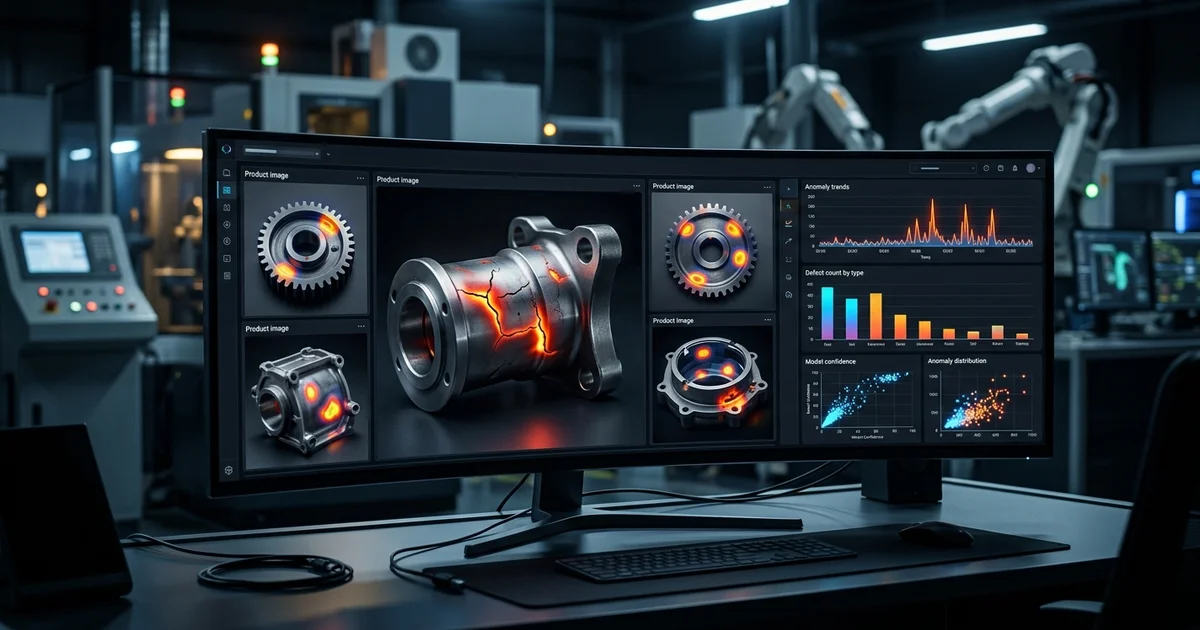
Machine Learning — Production Quality Intelligence
AI Anomaly Detection for Industrial Inspection
Neural network defect detection for food manufacturing, electronics, pharmaceutical, and production-line quality assurance. 2M Technology engineers AI anomaly detection systems that identify novel defect types, reduce false reject rates by 60-80%, and generate real-time SPC data — without requiring a predefined defect library.
What is AI Anomaly Detection for Industrial Inspection?
AI anomaly detection for industrial inspection is the use of unsupervised or semi-supervised machine learning models — trained on images or sensor data from known-good production output — to identify deviations from the established normal baseline without requiring explicit labeling of every defect type. Unlike supervised classification systems that can only detect defect categories they have been explicitly trained to recognize, AI anomaly detection for industrial inspection flags any deviation from the learned normal pattern, including novel defect types that have never been seen before. This capability is particularly valuable in manufacturing environments where new defect modes are introduced by process variation, supplier changes, or equipment wear that outpaces the human-defined rule set.
AI Anomaly Detection vs. Rule-Based Inspection
The fundamental limitation of rule-based inspection systems is that they can only detect what they were programmed to find. When a new defect type appears — a novel contamination pattern, an unfamiliar component orientation, a previously-unseen void geometry — rule-based systems pass it as conforming product. AI anomaly detection for industrial inspection eliminates this class of escape by learning from production data rather than from human-defined rules.
Capability
Rule-Based System
AI Anomaly Detection
Novel defect detection
No — only detects predefined types
Yes — detects any deviation from normal
Setup requirement
Engineer must define every defect type
Train on good-product images only
False reject rate on variable products
High — natural variation triggers alarms
60-80% lower — model learns natural variation
Performance over time
Static — does not improve
Improves continuously with production data
Process drift detection
Only if drift produces defined defect type
Detects gradual baseline shift automatically
Tuning requirement
Constant threshold adjustment as product changes
Self-calibrates; periodic retraining on new data
SPC data output
Pass/fail counts only
Anomaly score distribution, trend analysis, Cpk
How AI Anomaly Detection for Industrial Inspection Works
1
Good-Product Data Collection
The AI model is trained on images or sensor readings from confirmed good-product production runs — typically 500 to 5,000 images for unsupervised anomaly detection. Unlike supervised systems, no defect labeling is required during initial training. The model learns a statistical representation of what normal looks like across the full range of natural product variation: color variation, texture differences, dimensional tolerance, orientation diversity. Good-product data collection is the most critical step in deploying effective AI anomaly detection for industrial inspection.
2
Baseline Model Training
The collected good-product data trains an autoencoder or similar unsupervised model that learns to reconstruct normal product appearance. When the trained model encounters a defective or anomalous item during production inspection, the reconstruction error is high — because the model cannot accurately reconstruct something it has never seen before. This reconstruction error becomes the anomaly score. Items above a calibrated threshold are flagged for rejection or human review. 2M Technology engineers set thresholds based on each client’s specific balance of false reject tolerance and detection sensitivity requirement.
3
Production Deployment and Validation
Before full production deployment, 2M Technology validates the AI anomaly detection model using a validation set that includes known-good product, known-defective product (if available), and borderline-acceptable product at quality limits. Validation confirms that the model correctly flags defects above the acceptance threshold and correctly passes good product across the full natural variation range. For regulated applications (pharmaceutical, medical device, food safety), validation is documented in an IQ/OQ/PQ format compatible with regulatory audit requirements.
4
Continuous Learning and Model Refresh
AI anomaly detection models degrade in accuracy when production conditions change — new raw material lots, seasonal product variation, equipment changes, or formulation modifications can shift the normal product baseline outside the original training distribution. 2M Technology implements a scheduled model refresh protocol where new good-product data from current production is periodically incorporated into the training set, keeping the AI anomaly detection model calibrated to current production conditions without losing the defect detection capability built from historical data.
5
SPC Integration and Process Intelligence
AI anomaly detection for industrial inspection generates richer process intelligence than pass/fail counting. Anomaly score distributions across a production batch reveal whether the batch is uniformly within normal range or shows a population of borderline product that indicates process drift. Trend analysis of anomaly scores across shifts, operators, and raw material lots identifies upstream process variables correlated with quality degradation — enabling process engineering intervention before product falls out of specification.
6
Hybrid Rule + AI Architecture
For applications where certain defect types carry severe safety consequences — metal contamination in food, particulates in injectables, critical dimensional violations — 2M Technology implements a hybrid architecture: hard-coded rules with absolute rejection thresholds for safety-critical defects, combined with AI anomaly detection for quality defects where false reject rates and novel defect coverage matter. This hybrid approach provides the safety certainty of rules with the adaptability and false-reject reduction of AI anomaly detection for industrial inspection.
AI Anomaly Detection Applications by Industry
Food Manufacturing
AI anomaly detection on poultry and meat lines differentiates between naturally occurring cartilage (normal) and bone fragments (defect) with 60-80% fewer false rejects than threshold-based systems. Models trained on product-specific density profiles handle the natural variation in fresh produce and raw ingredients that makes threshold systems unreliable.
BGA solder void analysis using AI anomaly detection for industrial inspection automatically measures void percentage against IPC-A-610 criteria without operator measurement. Models detect novel void patterns caused by reflow profile drift that fixed-threshold void detection systems classify as passing product until voids become severe enough to trigger the hard threshold.
AI anomaly detection models on pharmaceutical packaging lines detect broken tablet fragments, atypical capsule density (indicating fill weight deviation), and seal anomalies that fall below the hard detection threshold of rule-based systems. FDA 21 CFR Part 11-compliant audit trails document all AI model decisions and threshold settings for regulatory inspection.
Warehouse receiving inspection, security screening of inbound parcels, and industrial component inspection all benefit from AI anomaly detection when the threat or defect profile is variable or evolving. AI models trained on normal inbound cargo identify anomalous density patterns indicating concealed items without requiring an explicit list of prohibited item signatures.
Training Data Requirements for AI Anomaly Detection
The most common question from manufacturers evaluating AI anomaly detection for industrial inspection: how much data do I need? The answer depends on product complexity and variation — but the ranges below serve as practical planning benchmarks.
500-1,000
Images for simple products with low natural variation (standard tablets, uniform packaged goods, consistent industrial components)
1,000-3,000
Images for moderate-variation products (poultry, fresh produce, PCB assemblies with component diversity)
3,000-5,000+
Images for high-variation products (complex fresh foods, mixed-component assemblies, products with significant natural color/texture range)
1-4 weeks
Typical production data collection period before a model is ready for initial deployment validation on most food and electronics applications
Frequently Asked Questions: AI Anomaly Detection for Industrial Inspection
What is the difference between AI anomaly detection and AI defect classification?
AI anomaly detection for industrial inspection uses unsupervised learning to identify any deviation from normal product — no defect examples are required during training. AI defect classification uses supervised learning to categorize detected anomalies into predefined defect types (void, bridge, crack, contamination) — defect examples for each category are required during training. In practice, the most effective AI inspection systems combine both approaches: anomaly detection identifies that something is wrong, and classification models categorize what type of defect it is to support process engineering root cause analysis.
How does AI anomaly detection reduce false reject rates?
Rule-based inspection systems reject any product that deviates from a fixed threshold — including normal product variation that exceeds the threshold due to natural biological or manufacturing variation rather than a real defect. AI anomaly detection models learn the full range of natural product variation from good-product training data, so they distinguish between normal variation (which should pass) and genuine anomalies (which should be rejected). On high-variation products like fresh poultry and root vegetables, this distinction reduces false reject rates by 60-80% versus threshold systems calibrated for the same safety sensitivity.
Can AI anomaly detection be used for security screening applications?
Yes. AI anomaly detection principles apply to security X-ray inspection as well as quality inspection — a model trained on normal bag and parcel contents identifies unusual density patterns indicating concealed weapons, prohibited items, or cargo anomalies without requiring an explicit library of every prohibited item signature. This approach is particularly valuable for warehouse receiving inspection and supply chain security applications where the threat profile is variable and evolving. 2M Technology applies AI anomaly detection to both quality inspection and security screening applications depending on the client’s specific use case.
How long does AI anomaly detection model training take?
Initial data collection for AI anomaly detection for industrial inspection takes 1 to 4 weeks of production runs to accumulate sufficient good-product training images. Model training itself typically runs in hours to days depending on dataset size and model complexity. Validation against known-good and known-defective product takes 1-2 additional weeks. Total time from project start to production deployment is typically 4 to 8 weeks for standard applications. Regulated applications (pharmaceutical, medical device) requiring formal IQ/OQ/PQ validation documentation add 4 to 8 additional weeks for validation execution and documentation.
Deploy AI Anomaly Detection for Your Production Line
2M Technology engineers AI anomaly detection systems for food manufacturing, electronics, pharmaceutical, and industrial inspection applications. Good-product model training, validation documentation, SPC integration, and ongoing model refresh support included.
2M Technology
802 Greenview Drive, Suite 100, Grand Prairie, TX 75050
(214) 988-4302 | sales@2mtechnology.net