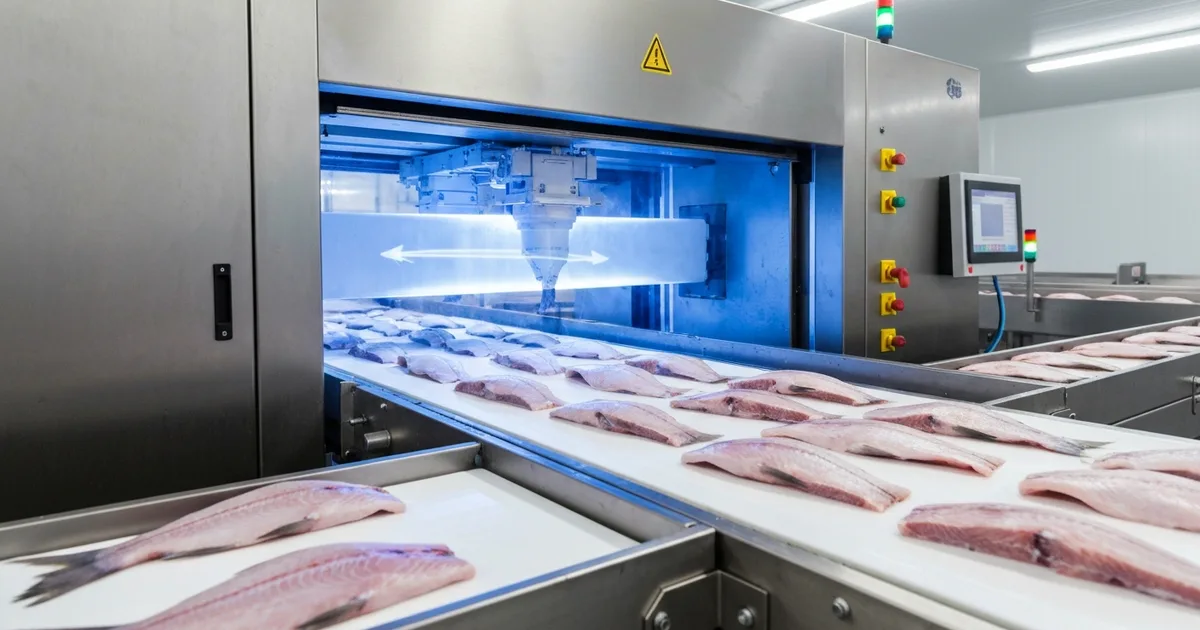
Seafood Inspection Systems for Bone, Shell, and Foreign Body Detection
Proven X-ray inspection for fish fillets, shrimp, crab, canned seafood, and breaded products — detecting bones as small as 1mm, shell fragments, and processing equipment debris while maintaining line speeds up to 400 products per minute.
Seafood inspection systems using X-ray technology provide the only reliable method for detecting bone fragments, shell pieces, and parasitic cysts in fish fillets, shrimp, crab, and canned seafood products — contaminants that metal detectors cannot detect and that cause the majority of Class I seafood recalls in the United States. 2M Technology engineers seafood inspection solutions for high-speed processing environments including pin bone removal verification, shrimp deveining line inspection, and canned product integrity checking.
Why Seafood Inspection Requires X-Ray Technology
Metal detectors are standard inspection equipment in many food facilities, but seafood processing presents three challenges that make metal detection inadequate as the primary inspection technology. First, the primary contaminants in seafood — bones, shells, and crustacean exoskeleton fragments — are biological, not metallic, and are completely invisible to metal detection. Second, the high moisture content and salt concentration of fresh and frozen seafood products creates significant product effect that degrades metal detector sensitivity by 30 to 50 percent for non-ferrous metals. Third, seafood products often travel in brine or moisture-laden packaging that further interferes with electromagnetic field detection. X-ray inspection eliminates all three limitations through density-based imaging that identifies any dense foreign body regardless of material composition.
Seafood Inspection System Performance Specifications
| Product Type | Minimum Bone/Shell Detection | Max Line Speed | Typical False Reject Rate |
|---|---|---|---|
| Fish fillets (salmon, cod, tilapia) | 1-2mm pin bone | 120 pcs/min | <0.5% |
| Shrimp (fresh and IQF frozen) | 2mm shell fragment | 400 pcs/min | <0.8% |
| Crab meat (pasteurized) | 2-3mm shell | 80 containers/min | <1.0% |
| Canned tuna / sardines | 2mm bone | 200 cans/min | <0.3% |
| Breaded / battered fish | 2-3mm bone | 180 pcs/min | <0.8% |
| Surimi / fish sticks | 3mm bone | 250 pcs/min | <0.5% |
Seafood-Specific Inspection Challenges X-Ray Solves
Pin Bone Verification
Automated verification that pin bone removal is complete in salmon and trout fillets. X-ray imaging detects residual pin bones after mechanical deboning, enabling selective rejection of fillets requiring manual rework rather than full-batch rejection.
Shell Fragment Sorting
Continuous inline detection of shell fragments in shrimp and crab processing lines. Crustacean shell has density characteristics distinctly different from meat tissue, enabling reliable detection even at high conveyor speeds with fresh or frozen product.
Canned Seafood Integrity
Simultaneous bone detection and fill level verification for canned tuna, sardines, and salmon. X-ray penetrates metal cans to inspect the full product volume — impossible with any other non-destructive inspection method.
Frozen Block Inspection
High-penetration X-ray inspection of frozen seafood blocks before further processing. Detects embedded bones, shell fragments, and processing equipment debris throughout the full block depth before the product enters the next processing stage.
The Critical Role of Seafood Inspection in FSMA Compliance
Metal Detector vs. X-Ray for Seafood Processing
| Seafood Contaminant | Metal Detector | X-Ray Inspection |
|---|---|---|
| Fish pin bones (1-3mm) | Not detected | Detected reliably |
| Crustacean shell fragments | Not detected | Detected reliably |
| Stainless steel equipment debris | Limited — salt/brine effect | Detected reliably |
| Glass fragments | Not detected | Detected by density |
| Parasitic cysts (Anisakis) | Not detected | Some detection by density |
| Fill level verification (canned) | Not available | Simultaneous check |
AI-Powered Seafood Inspection: Species-Specific Detection Models
Modern seafood inspection systems incorporate AI detection models trained on species-specific bone morphology and shell fragment density profiles. A salmon pin bone appears as a different X-ray density signature than a cod vertebral fragment or a shrimp carapace shard. Generic inspection algorithms optimized for one species produce higher false reject rates and lower detection sensitivity when applied to a different seafood product. 2M Technology configures inspection systems with product-specific models validated against representative sample sets before line deployment.
Seafood Inspection System Deployment Workflow
Regulatory References for Seafood Inspection
- FDA Fish and Fisheries Products Hazards and Controls Guidance (21 CFR 123)
- FDA Food Safety Modernization Act (FSMA)
- NOAA Seafood Inspection Program
Related Seafood and Food Inspection Resources
- Food Manufacturing X-Ray Inspection Hub
- Poultry and Meat X-Ray Inspection Systems
- Why Food Inspection Systems Fail — 8 Root Causes
- AI Anomaly Detection for Industrial Inspection
- Operational QA Workflows for Food Manufacturing
Frequently Asked Questions: Seafood Inspection Systems
Can X-ray inspection detect fish bones in salmon fillets?
Yes. X-ray seafood inspection systems detect pin bones in salmon fillets as small as 1mm using species-specific AI detection models trained on salmon bone morphology. This is the primary application for inline X-ray inspection in salmon processing and is not achievable with metal detection. After pin bone removal, X-ray inspection verifies that all bones have been successfully extracted before the fillet advances to portioning or packaging.
What is the difference between X-ray and metal detection for shrimp inspection?
Metal detectors cannot detect shell fragments in shrimp because crustacean shell is not metallic. High-moisture shrimp products also create significant product effect that reduces metal detector sensitivity for any metallic contaminant. X-ray seafood inspection detects shell fragments, foreign body debris from processing equipment, and performs simultaneous weight-by-density estimation — providing a complete inspection solution that metal detection cannot match for shrimp applications.
What HACCP documentation is required for seafood X-ray inspection?
FDA 21 CFR 123 requires seafood processors to maintain HACCP plans identifying physical hazard CCPs with documented critical limits, monitoring procedures, corrective action procedures, verification activities, and recordkeeping requirements. For X-ray inspection CCPs, this includes equipment validation studies, species-specific test piece protocols, calibration certificates, shift verification records, and corrective action logs for all detected and rejected events.
Design Your Seafood Inspection System
2M Technology engineers configure seafood inspection systems for your specific species, product form, and line speed — with HACCP documentation and validation protocol included.