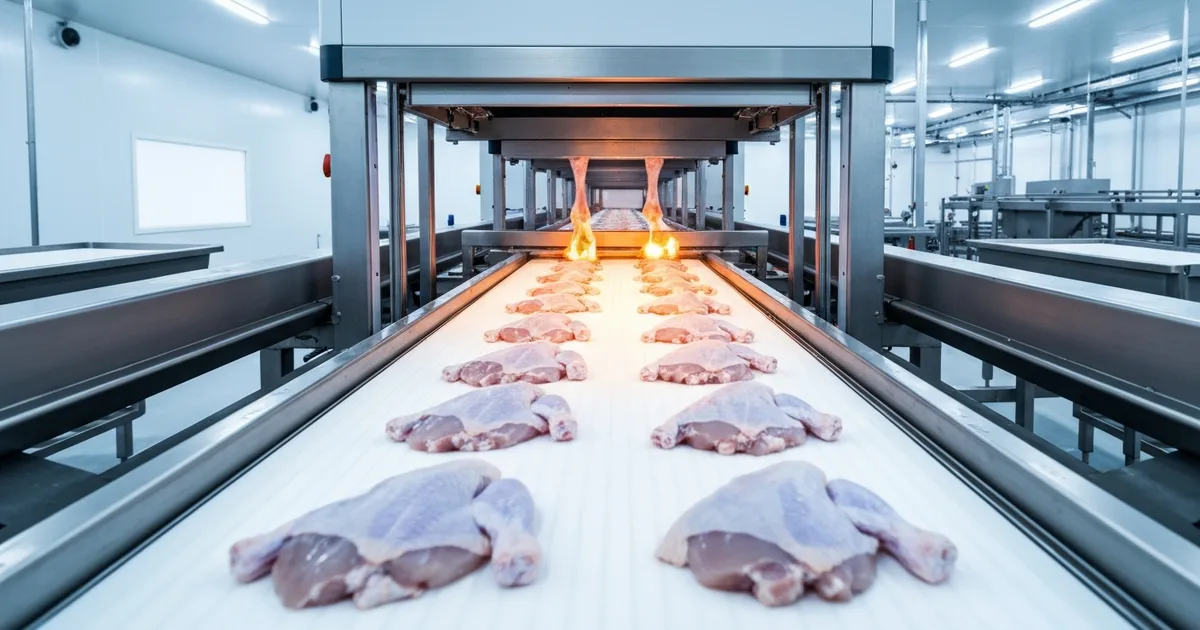
Poultry and Meat
X-Ray Inspection Systems
Bone fragment detection, metal contamination, injection needle tips, and fill level verification for poultry deboning lines, meat processing operations, and packaged protein production. 2M Technology engineers poultry and meat X-ray inspection systems with AI models calibrated to species-specific bone density profiles — reducing false rejects on natural cartilage and connective tissue while maintaining detection sensitivity for genuine bone fragments.
What is poultry and meat X-ray inspection?
Poultry and meat X-ray inspection is the inline deployment of X-ray imaging systems on poultry deboning lines, meat processing conveyors, and protein packaging operations to detect bone fragments, metal contamination, injection needle tips, and other physical hazards that pose serious consumer injury risk. Bone fragment detection is the primary application of poultry and meat X-ray inspection — machine deboning of poultry and mechanical processing of meat generate bone fragment contamination at rates that manual inspection cannot reliably detect. AI-powered poultry and meat X-ray inspection models learn the species-specific bone density signature of each product, distinguishing genuine bone fragments (reject) from natural cartilage and connective tissue (pass) with 60-80% lower false rejection rates than threshold-based systems. 2M Technology engineers and deploys complete poultry and meat X-ray inspection systems with HACCP CCP documentation and FDA 21 CFR compliance for processors of all sizes. See also: food manufacturing X-ray inspection, AI anomaly detection, and the AI-powered industrial inspection hub.
Minimum bone fragment size detectable by calibrated poultry and meat X-ray inspection systems — versus 5-8mm for typical metal detectors on high-moisture poultry, and zero detection capability for bone by metal detectors
Reduction in false rejection rate when AI-powered poultry and meat X-ray inspection models replace threshold-based systems — by learning to distinguish bone from natural cartilage and connective tissue variation
Average direct cost of a poultry or meat product recall — the primary ROI benchmark against which poultry and meat X-ray inspection investment should be evaluated, not equipment cost alone
Dual regulatory oversight of poultry and meat processing — USDA FSIS for federally inspected facilities, FDA 21 CFR Part 117 (FSMA) for other protein manufacturers — both requiring documented physical hazard preventive controls
Why Poultry and Meat X-Ray Inspection Outperforms Metal Detection
Metal detection is standard in most poultry and meat processing facilities. It detects conductive metal well — but it cannot detect bone, and its metal detection sensitivity degrades significantly in high-moisture, high-salt products like fresh poultry and brined meat. Poultry and meat X-ray inspection detects all of the following in a single inspection pass.
| Contaminant | Metal Detector | Poultry/Meat X-Ray | Notes |
|---|---|---|---|
| Bone fragments | No | Yes (1-2mm) | Primary application — bone not detectable by metal detectors |
| Ferrous metal | Yes | Yes (smaller) | X-ray achieves smaller minimum size in high-moisture products |
| Stainless steel | Difficult | Yes | SS has low magnetic permeability; X-ray detects density regardless |
| Injection needles/tips | Partial | Yes | Broken injection needle tips reliably detected by X-ray density difference |
| Metal detection in high-salt/moisture | Degraded | Unaffected | X-ray performance is independent of product moisture and salt content |
| Fill level / weight check | No | Yes | Simultaneous fill level and portion weight verification in same pass |
AI-Powered Bone Detection in Poultry and Meat X-Ray Inspection
The fundamental challenge in poultry and meat X-ray inspection is distinguishing genuine bone fragments (which must be rejected) from natural cartilage, connective tissue, fat deposits, and anatomical structures (which should pass). Threshold-based X-ray systems set a density threshold that triggers rejection — but cartilage and connective tissue often cross that threshold, producing high false reject rates on clean product.
AI models trained on species-specific poultry and meat X-ray inspection data learn the visual and density signature of bone versus cartilage for each specific product. A broiler breast deboning line AI model differs from a pork rib inspection model and from a ground meat patty inspection model — because bone appearance, size distribution, and background product density are different. 2M Technology trains product-specific AI models for every poultry and meat X-ray inspection deployment.
Chicken, turkey, pork, beef, and lamb all have distinct bone density profiles requiring separate model training for optimal detection accuracy
Raw versus cooked, whole muscle versus ground, fresh versus frozen — each product state changes the X-ray image characteristics requiring model recalibration
AI models improve as production data accumulates — detection accuracy and false reject rates both improve over the first 90 days of production operation
Versus threshold-based systems on equivalent poultry and meat products — recovering clean product value lost to overcautious threshold settings
Poultry and Meat X-Ray Inspection by Product Type
Poultry Deboning Lines
Broiler breast, thigh, and leg deboning operations produce bone fragment contamination at rates that vary by equipment type and blade wear. Poultry and meat X-ray inspection on deboning lines provides real-time bone fragment detection and SPC trend data that quality engineers use to predict blade wear and schedule preventive maintenance before contamination rates rise.
Whole Muscle Cuts (Pork, Beef)
Whole muscle beef and pork cuts require poultry and meat X-ray inspection primarily for metal contamination detection — bone fragments are less common in properly processed whole muscle cuts but metal from cutting equipment is a significant hazard. High-moisture products require X-ray rather than metal detection to maintain sensitivity across the product density range.
Ground and Formed Products
Ground beef, turkey, chicken patties, and formed meat products present high-density, uniform X-ray backgrounds that are well-suited to poultry and meat X-ray inspection. Small bone and metal fragments that would be masked by product texture variation in whole muscle cuts become more visible against the uniform density of ground product.
Further Processed and Cooked Products
Cooked poultry and meat products (rotisserie chicken, deli meats, cooked sausages) require inspection both before and after cooking — cooking changes bone and product density, requiring separate AI model calibration for pre- and post-cook inspection. Packaged cooked products also benefit from seal integrity and fill level verification in the same inspection pass.
Poultry and Meat X-Ray Inspection: Inline Workflow Architecture
Effective poultry and meat X-ray inspection integrates with the production line workflow — not as a standalone endpoint check but as an inline system connected to upstream process data and downstream corrective action protocols.
Poultry and Meat X-Ray Inspection System Specifications
| Parameter | Poultry Lines | Red Meat / Whole Muscle | Ground / Formed |
|---|---|---|---|
| Min. bone detection | 1.0-2.0mm | N/A (metal primary) | 1.5-3.0mm |
| Min. metal detection | 0.8-1.2mm Fe sphere | 0.8-1.5mm Fe sphere | 0.8-1.2mm Fe sphere |
| Conveyor width | 300-800mm | 400-1,000mm | 200-600mm |
| Line speed | 20-60 m/min | 15-40 m/min | 20-80 m/min |
| IP rating | IP65-IP69K (washdown) | IP65-IP69K | IP65-IP69K |
| Regulatory output | HACCP, USDA FSIS, FDA 117 | HACCP, USDA FSIS | HACCP, FDA 117 |
Poultry and meat inspection standards: USDA Food Safety and Inspection Service (FSIS) governs federally inspected poultry and meat facilities. The FDA FSMA Preventive Controls Rule applies to facilities not under FSIS inspection. The HACCP Alliance provides training and certification standards for meat and poultry processors.
Related Resources
Frequently Asked Questions: Poultry and Meat X-Ray Inspection
Deploy Poultry and Meat X-Ray Inspection
2M Technology engineers and deploys poultry and meat X-ray inspection systems for deboning lines, whole muscle processing, ground product, and further processed protein operations. Species-specific AI model training, HACCP CCP documentation, and USDA/FDA compliance support included.
(214) 988-4302 | sales@2mtechnology.net