
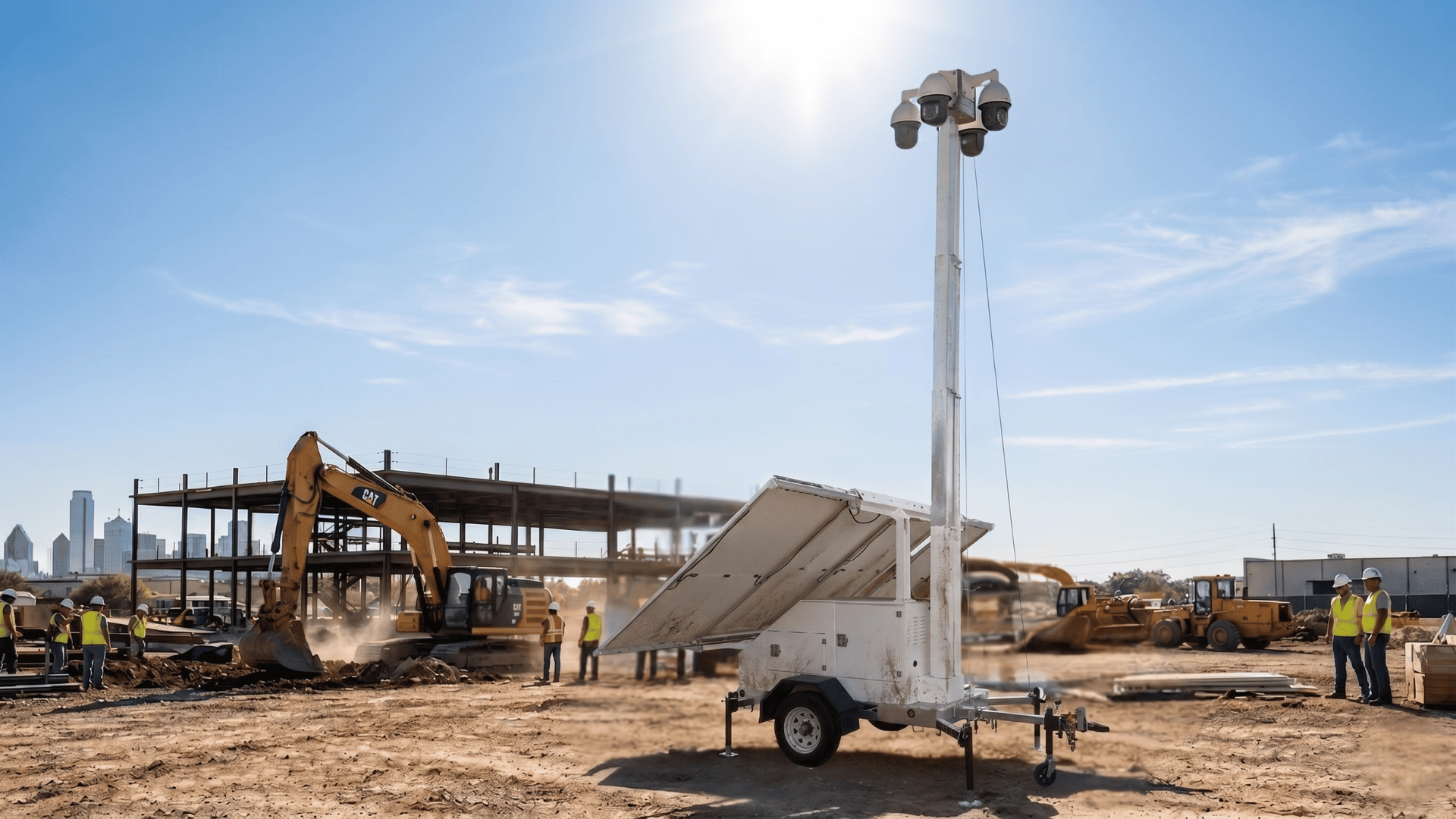
Solar-Powered Surveillance Trailers: The Complete Guide for Construction Site Managers in 2026
Solar-powered surveillance trailers: have become one of the fastest-growing security investments in U.S. construction. According to the National Equipment Register, construction sites lose over $1 billion annually to theft and vandalism. In 2026, with material costs still elevated, that number makes job site protection a financial priority — not an afterthought.
Site managers across Texas and the Southwest are discovering that traditional wired camera systems simply cannot keep pace with dynamic job sites. Mobile solar surveillance trailers solve the core problem: delivering professional-grade security wherever and whenever it is needed, with zero dependency on utility infrastructure.
Solar-Powered Surveillance Trailers: What They Are and How They Work
A solar-powered surveillance trailer is a towable steel unit mounted with solar panels, lithium battery banks, PTZ cameras, and a cellular or wireless transmitter. The solar array typically ranges from 200W to 800W depending on the model. Battery storage runs from 100Ah to 400Ah, supporting 3 to 7 days of autonomous operation even without sunlight.
Most units include 4 to 8 cameras covering a 360-degree field of view. Cameras capture 1080p to 4K resolution footage continuously. Motion-activated floodlights, two-way audio, and remote monitoring dashboards are standard on modern systems. Site managers can view live feeds from any smartphone or desktop browser in real time.
Deployment is remarkably simple. A standard unit can be towed with any half-ton pickup truck. Setup takes 90 minutes or less. No trenching, no electrical contractors, no permit delays. This speed is critical on phased projects where perimeter boundaries shift weekly.
Essential Benefits That Make Solar Surveillance Trailers Proven Job Site Assets
The financial case is straightforward. Renting a solar-powered surveillance trailer typically costs $500 to $1,500 per month depending on camera count and features. Purchasing a unit ranges from $8,000 to $30,000. Compare that to a single theft incident: stolen copper wire, lumber, or heavy equipment can easily exceed $25,000 in losses.
Beyond theft deterrence, these systems reduce liability exposure. Recorded footage resolves disputes over workplace incidents, vandalism claims, and unauthorized access. OSHA guidelines recommend documented site monitoring as part of a broader safety management program. Video evidence supports compliance and incident reporting requirements directly.
Solar-powered surveillance trailers: also support workforce accountability. Time-lapse features document daily progress for project owners. Insurance carriers increasingly offer premium discounts of 5% to 15% when verified video monitoring systems are in place on high-value construction projects.
Solar Surveillance Trailer Features: What to Evaluate Before You Buy
Not all solar-powered surveillance trailers: are built equally. Managers should evaluate these features before committing to a vendor or rental agreement.
Camera resolution and night vision: Minimum 1080p with IR night vision at 100 feet or greater is essential. Color night vision is now available on premium units and dramatically improves incident identification after dark.
Battery autonomy: Sites in cloudy climates or shaded areas need larger battery banks. Confirm the system’s rated autonomy in zero-sun conditions before deployment.
Cellular connectivity: 4G LTE is the standard. Dual-SIM failover — switching between carriers automatically — ensures continuous uptime even in fringe coverage areas common at rural construction sites.
Tamper protection: Look for units with reinforced steel housings, anti-climb mast designs, and tamper alarms. ASIS International recommends physical hardening as a baseline requirement for temporary security installations.
AI-powered analytics: Modern solar-powered surveillance trailers: now offer perimeter intrusion detection, license plate recognition, and object classification. These features reduce false alarms and allow security teams to respond only to verified threats.
2M Technology, based in Grand Prairie, TX, designs and deploys solar surveillance systems that meet these exact specifications for construction clients across the Dallas-Fort Worth metroplex and beyond.
Solar Panel & Battery Technology: The Specifications That Determine Runtime
Two trailer vendors can both advertise “400W solar panels” and deliver dramatically different real-world performance. Panel type, battery chemistry, and IP rating are the three specs that actually determine how long your system runs — especially during a Texas summer where ambient temperatures regularly exceed 100°F.
Solar Panel Type: Monocrystalline vs Polycrystalline vs Thin-Film
The efficiency rating on a solar panel is measured at 25°C (77°F). As temperature rises above that baseline, output drops — and the rate of that drop differs by panel type. Monocrystalline panels carry a temperature coefficient of −0.29 to −0.35% per degree Celsius above 25°C. Polycrystalline panels degrade faster at −0.40 to −0.50%/°C. At 45°C (113°F), that means a monocrystalline 400W panel produces approximately 376W while a polycrystalline 400W panel produces approximately 352W — a 24W difference per panel, which scales across every panel on the trailer.
| Panel Type | Efficiency | Temp Coefficient | Output Loss at 45°C (113°F) | Best For |
|---|---|---|---|---|
| Monocrystalline | 20–22% | −0.29 to −0.35%/°C | ~7% loss | Limited space, hot climates, maximum output |
| Polycrystalline | 15–17% | −0.40 to −0.50%/°C | ~12% loss | Cost-sensitive, mild climates, larger roof area |
| Thin-Film | 10–12% | −0.20 to −0.25%/°C | ~5% loss | Specialty flexible applications, diffuse light |
Battery Chemistry: Gel, AGM, and LiFePO4 Compared
Battery chemistry is the most under-examined spec in solar trailer procurement. Most entry-level trailers use gel or AGM batteries because of lower upfront cost. LiFePO4 (lithium iron phosphate) batteries carry a higher purchase price but deliver 4–6× longer service life and 40% less weight per unit of usable capacity. Over a 5-year deployment, LiFePO4 is typically less expensive when total cost of ownership — including replacement cycles — is calculated.
| Chemistry | Cycle Life | Depth of Discharge | Weight (12V 150Ah) | Discharge Temp Range | Cost (Relative) |
|---|---|---|---|---|---|
| Gel | 500–800 cycles | 50–60% | ~50 kg | −20 to 60°C | Low (baseline) |
| AGM | 500–1,000 cycles | 50–60% | ~48 kg | −20 to 60°C | Low–Moderate |
| LiFePO4 (Lithium) | 2,000–5,000 cycles | 80–90% | ~22 kg | −20 to 60°C | High (2–4× gel) |
DoD explained: A 200Ah gel battery at 50% DoD delivers 100Ah of usable capacity. The same-capacity LiFePO4 at 80% DoD delivers 160Ah — 60% more usable energy from the same rated size.
Camera Housing IP Ratings: What Each Grade Means for Texas Deployment
IEC 60529 defines the Ingress Protection (IP) rating system used for camera housings. The first digit (1–6) rates dust protection; the second (1–8) rates water protection. For outdoor construction sites in Texas — where dust storms, pressure washing, and heavy storms are routine — IP66 is the minimum recommended rating. Construction sites near bodies of water, chemical plants, or in the Gulf Coast region should specify IP67 or higher.
| IP Rating | Dust Protection | Water Protection | Texas Construction Use |
|---|---|---|---|
| IP54 | Limited dust ingress | Splashing water | Inadequate — avoid for outdoor trailers |
| IP65 | Dust-tight | Water jets, any direction | Minimum for protected outdoor locations |
| IP66 ✓ Recommended | Dust-tight | Powerful water jets, heavy rain | Standard for Texas outdoor deployment |
| IP67 | Dust-tight | Immersion up to 1 m / 30 min | Flood-prone sites, river/coastal proximity |
| IP68 | Dust-tight | Continuous immersion (depth per spec) | Underwater/submersible applications |
Solar Surveillance Trailer Deployment: Strategies for Maximum Job Site Coverage
Placement determines effectiveness. A single solar-powered surveillance trailer typically covers 300 to 500 feet of perimeter effectively. Large sites exceeding 5 acres should plan for multiple units positioned at primary entry points, material staging areas, and equipment storage zones.
Stagger unit placement to eliminate blind spots between coverage zones. Coordinate with your project superintendent to relocate trailers as construction phases progress. The mobility advantage of solar-powered surveillance trailers: is only realized when relocation is built into your security plan from the start.
For hazardous industrial construction — oil and gas, chemical, or utility projects — confirm that camera equipment meets appropriate safety classifications. Standards from IECEx govern equipment used in explosive atmospheres. 2M Technology maintains expertise in explosion-proof camera integration for these specialized environments.
| Feature | Basic Unit | Mid-Range Unit | Premium Unit |
|---|---|---|---|
| Solar Panel Wattage | 200W | 400W | 800W |
| Battery Capacity | 100Ah | 200Ah | 400Ah |
| Autonomous Runtime (No Sun) | 1–2 Days | 3–4 Days | 5–7 Days |
| Camera Count | 2–4 Cameras | 4–6 Cameras | 6–8 Cameras |
| Resolution | 1080p | 1080p–2K | 4K |
| AI Analytics | No | Basic Motion Detection | Full AI Perimeter Analytics |
| Cellular Connectivity | Single SIM 4G | 4G LTE | Dual-SIM 4G/5G Failover |
| Monthly Rental Cost (Est.) | $500–$700 | $800–$1,100 | $1,200–$1,500 |
| Purchase Price (Est.) | $8,000–$12,000 | $13,000–$20,000 | $21,000–$30,000 |
How Much Does a Solar Surveillance Trailer Cost in 2026?
A solar surveillance trailer system for a construction site or temporary venue typically ranges from $1,200 to $4,500 per month for a rental, or $18,000 to $65,000 for an outright purchase — depending on camera count, battery capacity, and AI analytics options.
| Configuration | Cameras | Monthly Rental | Purchase Price |
|---|---|---|---|
| Basic solar surveillance trailer | 2–4 cameras, 1080p | $1,200–$1,800/mo | $18,000–$28,000 |
| Standard solar surveillance trailer | 4–6 cameras, 4K + PTZ | $1,800–$2,800/mo | $28,000–$42,000 |
| Premium solar surveillance trailer | 6–8 cameras, 4K + AI analytics | $2,800–$4,500/mo | $42,000–$65,000 |
Key cost factors for any solar surveillance trailer deployment include: camera resolution (4K vs 1080p), battery bank size (affects cloudy-day autonomy), cellular vs Wi-Fi transmission, AI motion analytics licensing, and whether LPR (license plate recognition) is integrated. For Texas construction sites, 2M Technology provides solar surveillance trailer systems with 24/7 live monitoring and rapid deployment anywhere in DFW, Houston, or Austin.
Request a free solar surveillance trailer quote — 2M Technology typically responds within one business day with a site-specific system recommendation.
Frequently Asked Questions About Solar-Powered Surveillance Trailers
-
How long do solar-powered surveillance trailers: operate without direct sunlight?
Most mid-range solar-powered surveillance trailers: carry enough battery capacity to operate 3 to 5 days without any solar input. Premium units with 400Ah lithium banks can extend that window to 7 days. For extended cloudy periods, optional generator backup ports are available on many commercial-grade systems. Always confirm rated autonomy with your vendor before deployment in northern or shaded locations.
-
Are solar-powered surveillance trailers suitable for hazardous construction environments?
Standard solar-powered surveillance trailers: are suitable for conventional construction sites. For hazardous environments involving flammable gases, vapors, or combustible dust, equipment must meet specific safety certifications. IECEx and ATEX classifications define acceptable equipment grades for these zones. 2M Technology in Grand Prairie, TX specializes in explosion-proof camera integration and can configure compliant surveillance systems for high-risk industrial job sites.
-
Can solar-powered surveillance trailers: integrate with existing site security systems?
Yes. Modern solar-powered surveillance trailers: are designed for integration. Most units support ONVIF-compliant protocols, allowing camera feeds to merge with existing VMS platforms, access control systems, or guard monitoring stations. Remote video monitoring services can also be layered on top of any deployment, providing 24/7 human-verified alarm response without adding on-site security personnel costs.
-
How many solar-powered surveillance trailers does a large construction site need?
Site size and layout determine unit count. A general rule is one trailer per 300 to 500 linear feet of active perimeter. A 10-acre site typically requires 4 to 6 units for complete coverage without blind spots. High-priority zones — equipment yards, material storage areas, and site entrances — should always receive dedicated units regardless of overall site size. A professional security assessment from 2M Technology can determine the exact configuration for your project.
Related Resources
- Solar Trailer Power Sizing Guide — Calculate Battery & Panel Requirements
- Solar Surveillance Trailers — Browse 2M Models
- Explosion-Proof Solar Surveillance Trailers for Hazardous Locations
- Explosion-Proof Ratings Guide — NEC, ATEX & IECEx Explained
- Custom Mobile Surveillance Trailer Configurations
A solar surveillance trailer from 2M Technology includes professional delivery, setup, and 24/7 remote monitoring support. Every solar surveillance trailer we deploy comes with a dedicated account manager and next-business-day response SLA for any technical issues.
Get a Free Security Consultation
Contact 2M Technology for a custom system design for your Dallas-Fort Worth facility.
Related: Mobile Solar Surveillance Trailer for Construction Sites — deployment planning, battery specs, and ROI analysis from 2M Technology.

