
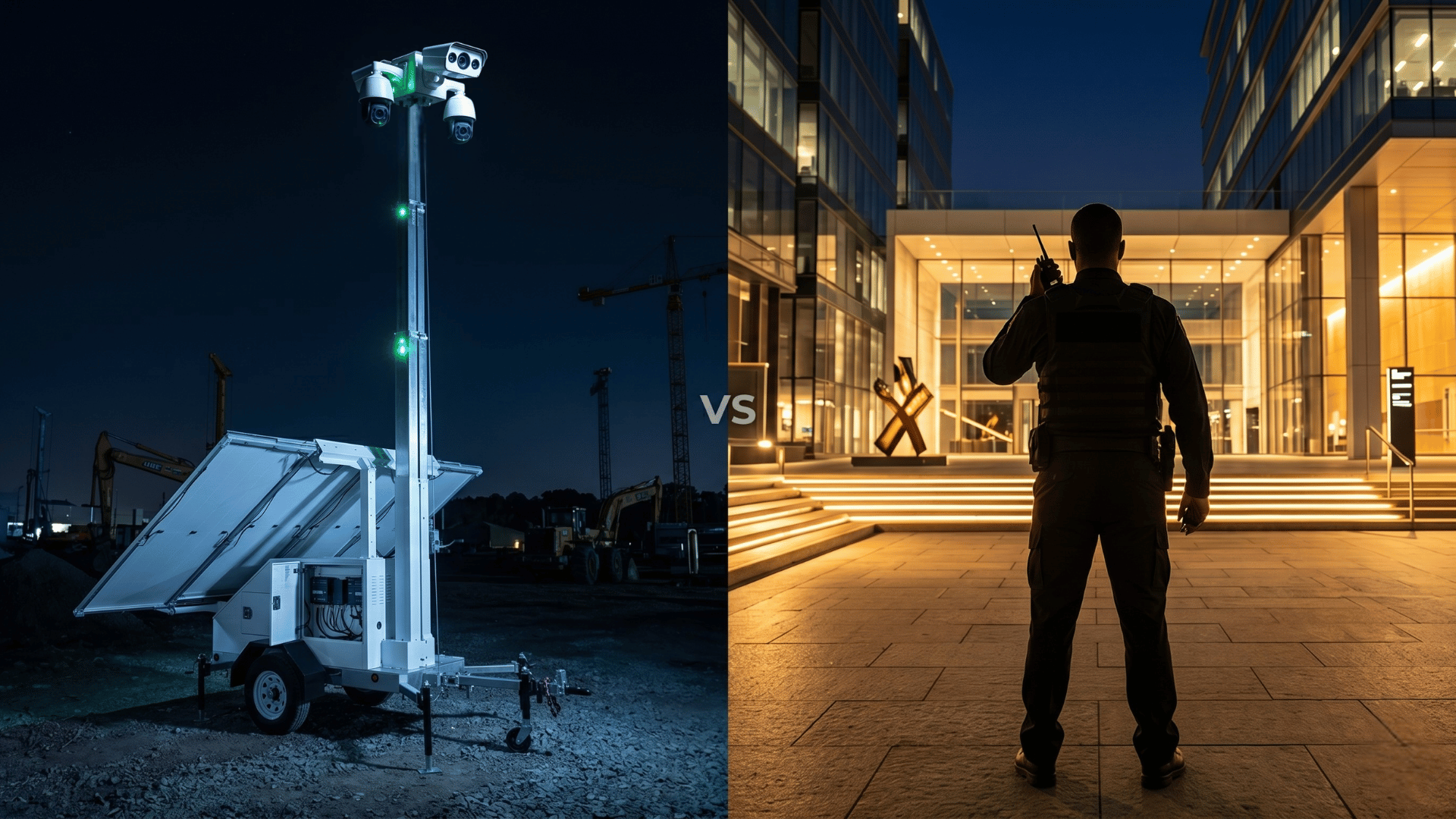
Mobile surveillance trailer vs security guards — this is one of the most consequential security decisions facing construction managers, oil and gas operators, parking facility owners, and industrial site managers in 2026. Both options protect sites from theft, vandalism, and unauthorized access. They differ fundamentally in cost structure, coverage capability, technology advantage, and long-term ROI.
This guide delivers a complete mobile surveillance trailer vs security guards comparison — with specific application to Texas construction sites, DFW equipment yards, Gulf Coast oil and gas facilities, and remote industrial infrastructure. ? with specific application to Texas construction sites, DFW equipment yards, Gulf Coast oil and gas facilities, and remote industrial infrastructure. — including operational realities, AI technology advantages, site-specific ROI analysis, and a clear framework for deciding which option — or which combination — fits your operation.
Mobile Surveillance Trailer vs Security Guards: Direct Comparison
| Factor | Mobile Surveillance Trailer | Security Guard |
|---|---|---|
| 24/7 monitoring | Continuous — no shift gaps | Limited by shifts, fatigue, and callouts |
| Coverage area | Wide-angle PTZ + multi-camera simultaneous | One location at a time |
| AI video analytics | Yes — person detection, LPR, perimeter alerts | No |
| Physical intervention | No | Yes |
| Evidence recording | Continuous HD footage with timestamps | No automatic recording |
| Remote site deployment | Yes — fully solar off-grid | Requires infrastructure |
| Fatigue and attention risk | None | High — measurably declines through shift |
| Scalability | Add cameras at low incremental cost | Each post adds full labor cost |
| Active deterrence | Strobe lights, audio speakers, virtual guard alerts | Visible presence |
| License plate recognition | Yes — with LPR-capable camera | Manual log only |
| Deployment speed | Operational in under 2 hours | Hiring, onboarding, scheduling delays |
| Recurring monthly cost | Cellular data only — flat low rate | Wages + agency markup per shift |
Why Companies Are Switching from Guards to Mobile Surveillance Trailers
The mobile surveillance trailer vs security guards shift is accelerating across construction, oil and gas, and logistics sectors for four converging reasons:
1. AI Video Analytics Changed the Equation
Modern commercial IP cameras — Verkada, Axis, Hanwha, Cisco Meraki — run on-camera AI that detects people, vehicles, and defined perimeter events in real time. A mobile surveillance trailer equipped with AI-capable cameras delivers active deterrence through automated alerts that notify your security team or a remote monitoring center the moment a threat is detected. A guard watching a monitor or patrolling a perimeter cannot process multiple camera feeds simultaneously. AI can.
AI video analytics capabilities available on surveillance trailer-mounted cameras include:
- Person and vehicle detection — distinguishes humans and vehicles from animals and environmental movement, dramatically reducing false alarms
- License plate recognition (LPR) — logs every vehicle entering and exiting, flags unauthorized plates, integrates with PLACA.AI for enforcement
- Perimeter tripwire alerts — triggers instant notification when anyone crosses a defined boundary after hours
- Loitering detection — flags individuals who remain in a defined zone longer than a set threshold
- Object left behind / removed — detects when equipment or materials are moved during off-hours
2. Construction Theft Is a Growing Problem
Equipment theft on construction sites costs the US industry an estimated $1 billion annually according to the National Association of Home Builders. The most common theft patterns at construction sites include:
- Copper wire and cable theft — typically occurs after-hours when only guard shifts with limited patrol coverage are active
- Small equipment and tool theft — targets trailers, job boxes, and unsecured storage during the overnight hours between 2am and 5am
- Fuel theft — diesel from generators and heavy equipment, often a repeat occurrence at the same site
- Material theft — lumber, copper pipe, HVAC components, and fixtures as projects near completion
A mobile surveillance trailer with 4–6 cameras and AI perimeter detection covers these risk windows continuously — something a single guard post cannot match. PTZ cameras with 360-degree coverage and IR night vision up to 100 feet deliver footage quality that supports law enforcement prosecution and insurance claims. Guard incident reports do not.
3. Guard Fatigue Is Real and Measurable
Research in occupational health consistently documents measurable declines in guard alertness and incident detection rates during the second half of overnight shifts. A guard working from midnight to 8am has meaningfully lower vigilance at 4am than at midnight — a well-documented phenomenon studied by the ASIS International security standards body. Mobile surveillance trailers have no equivalent limitation. Cameras maintain identical detection capability from the first minute of deployment to the last.
4. Remote and Off-Grid Sites Are Guard-Unfriendly
Remote well pads, pipeline corridors, grain storage facilities, and construction sites in early development phases often lack the infrastructure to support a guard post — no booth, no lighting, no restrooms, no utilities. A solar-powered mobile surveillance trailer requires none of these. It operates completely off-grid on solar panels and a lithium battery bank rated for 3–7 days without direct sunlight, transmitting footage via 4G LTE, 5G, or Starlink satellite to a cloud VMS or remote monitoring center.
The Operational Reality of Guard Coverage
In a direct mobile surveillance trailer vs security guards comparison, understanding the operational limitations of guards is as important as their advantages.
Shift coverage gaps: A single guard covers one shift — typically 8 hours. Achieving 24/7 coverage requires three guards per position, plus redundancy for sick days, turnover, and no-shows. Guard turnover in the security industry regularly exceeds 100% annually, creating ongoing recruitment and training overhead that compounds the labor cost.
Single-point coverage: A guard can physically be in one place at one time. A 10-acre construction site, a multi-entry parking facility, or a pipeline staging yard cannot be effectively monitored by one person from one position. A mobile surveillance trailer with 6 cameras provides simultaneous multi-point coverage that no individual guard replicates.
No digital evidence trail: When an incident occurs on a guard-only site, the evidence is a written report — subject to memory accuracy, shift timing, and documentation quality. A mobile surveillance trailer delivers timestamped HD video from multiple angles, AI metadata tagging the event, and LPR records of every vehicle on site. That evidence quality is categorically different for insurance claims, law enforcement, and legal proceedings.
AI and Technology Advantages of Mobile Surveillance Trailers
The technology gap between mobile surveillance trailers and traditional guard coverage has widened significantly in 2024–2026. Today’s commercial solar surveillance trailers support:
- Cloud video management (VMS) — footage accessible from any device, anywhere, in real time
- Virtual guard services — remote monitoring centers watch trailer camera feeds and intervene via two-way audio when threats are detected, replicating the deterrence of a physical guard at a fraction of the cost
- Cellular surveillance systems — 4G LTE and 5G uplinks deliver live streaming with sub-second latency; Starlink integration handles remote locations with no cellular coverage
- Active deterrence systems — integrated strobe lights and directional audio speakers allow remote operators or automated AI responses to challenge intruders verbally before they complete a theft or vandalism act
- License plate recognition integration — PLACA.AI or equivalent platforms log and cross-reference every plate, alerting your team to flagged or unauthorized vehicles instantly
- PTZ cameras with auto-tracking — pan-tilt-zoom cameras with auto-tracking follow detected movement across the site, providing coverage equivalent to a guard actively panning a camera
These capabilities, combined on a single mobile platform deployable in under 2 hours, represent a fundamentally different security posture than a guard with a flashlight and a radio.
Where Mobile Surveillance Trailers Win Over Security Guards
- Construction sites — Continuous AI-monitored coverage during off-hours when copper theft, tool theft, and fuel theft occur. Redeployable as the project moves. No infrastructure required.
- Oil and gas remote facilities — Well pads, pipeline monitoring stations, and tank farms operate in locations where guard deployment is impractical. Solar trailers with satellite uplink monitor these sites continuously. For classified hazardous areas, 2M Technology builds ATEX and NEC-certified explosion-proof trailer configurations that no guard-based solution can match.
- Parking lots and towing facilities — LPR cameras on solar trailers log every plate, trigger alerts on flagged vehicles, and integrate with PLACA.AI for enforcement documentation. This capability exceeds what any guard can manually provide.
- Equipment yards and staging areas — Heavy equipment, materials, and vehicles left overnight are prime theft targets. Multi-camera AI coverage with perimeter alerts delivers better protection than a single guard patrol.
- Event and temporary sites — Venues, festivals, and temporary government installations need enterprise-grade coverage for a defined period. A solar trailer deploys in hours and disappears when the event ends.
Where Security Guards Still Make Sense
- Physical intervention required — Guards can stop, detain, and redirect people. A mobile surveillance trailer with virtual guard audio can challenge and deter, but cannot physically act.
- High-traffic access control — Entry points processing hundreds of people per hour with credential verification, ID checking, and visitor management benefit from human judgment that camera AI cannot fully replicate.
- Professional presence and hospitality — Corporate lobbies, government buildings, hotels, and hospitals require human presence for public interaction, first aid response, and professional image.
- Court-ordered guard requirements — Some facility permits, insurance policies, or regulatory requirements specify human guard presence by name. Cameras do not satisfy these requirements regardless of capability.
The Hybrid Approach: Mobile Surveillance Trailers and Guards Together
The most effective security programs for large industrial sites, campus environments, and multi-entry facilities combine both sides of the mobile surveillance trailer vs security guards comparison. The trailers handle perimeter monitoring, overnight coverage, AI threat detection, and evidence capture. Guards focus on access points, visitor management, and active response when camera alerts fire.
This hybrid model reduces guard headcount by 40–60% compared to camera-free guard-only operations while maintaining — and typically improving — overall security outcomes. The cameras pay for themselves through labor reduction. The remaining guards are more effective because they are operating with real-time camera intelligence directing their attention to verified threats rather than patrolling blind.
Companies that have moved from pure guard coverage to hybrid solar surveillance trailer and guard programs consistently report:
- Faster incident response — guards dispatched to specific locations based on camera alerts, not general patrol
- Better evidence quality — every guard-investigated incident documented with camera footage
- Reduced false alarm burden — AI-filtered alerts replace guard judgment calls on ambiguous situations
- Lower total security spend — trailer hardware offset by guard headcount reduction within 12 months for most sites
Site-Specific ROI: Mobile Surveillance Trailer vs Security Guards
Construction Sites (12-Month Project)
Construction sites commonly deploy overnight and weekend guard services to protect materials, equipment, and completed work. This recurring labor cost is the largest controllable security expense on most projects. A 2M Technology solar trailer covers the same site 24/7 with AI monitoring, providing superior coverage to a single guard position at a one-time hardware investment that follows the project to the next site when it completes.
Oil and Gas Remote Sites (Ongoing)
Remote facilities paying for guard services face compounding challenges: high pay rates for isolated posts, difficult scheduling, high turnover, and limited guard effectiveness in locations they cannot easily patrol. Solar-powered surveillance trailers eliminate the guard labor equation entirely for perimeter and equipment monitoring, with optional virtual guard monitoring services adding human oversight at a fraction of in-person guard cost.
Parking and Towing Facilities (Long-Term)
Overnight guard services at parking lots and towing facilities address theft and vandalism but produce no digital evidence trail. A solar trailer with LPR integration creates a complete record of every vehicle on the property — documentation that guards cannot provide and that insurance companies increasingly require for claims processing.
Mobile Surveillance Trailer vs Security Guards — FAQ
-
Are mobile surveillance trailers cheaper than security guards?
Yes. In virtually every mobile surveillance trailer vs security guards analysis beyond 6–12 months, the trailer delivers lower total security cost. Guard coverage requires ongoing labor expense for every hour of coverage. A solar surveillance trailer only requires cellular data after the initial hardware purchase — no wages, no agency fees, no shift management.
-
Can a mobile surveillance trailer replace security guards completely?
For outdoor and remote sites — construction, pipelines, parking lots, equipment yards — yes. Mobile surveillance trailers with AI analytics and optional virtual guard monitoring replace guard coverage effectively in these environments. Applications requiring physical intervention, visitor management, or regulatory guard requirements still need guards, typically alongside cameras rather than fully replaced by them.
-
What AI analytics do mobile surveillance trailers support?
2M Technology trailers support any commercial IP camera including AI-native models from Verkada, Axis, Cisco Meraki, and Hanwha. Available AI capabilities include person and vehicle detection, license plate recognition (LPR), perimeter tripwire alerts, loitering detection, and PTZ auto-tracking — all running in real time with instant alert delivery.
-
Do mobile surveillance trailers work at remote sites without power?
Yes. Solar-powered trailers operate completely off-grid on solar panels and lithium battery banks rated for 3–7 days without direct sunlight. Cellular 4G LTE, 5G, or Starlink satellite uplink transmits footage. No utility power, trenching, or electrical permits are required for deployment.
-
How quickly does a mobile surveillance trailer deploy compared to a guard service?
A 2M Technology mobile surveillance trailer is operational in under 2 hours after arriving on site. No permits, no construction, no infrastructure setup required. Setting up a new guard post requires contracts, onboarding, scheduling, and often physical improvements like a booth and lighting — typically taking days to weeks.
-
Are mobile surveillance trailers effective for construction site theft prevention?
Yes. AI-enabled cameras with perimeter alerts detect after-hours intrusions — including copper wire theft, fuel theft, and equipment theft — in real time. Continuous HD recording provides evidence quality that guard incident reports cannot match, supporting law enforcement prosecution and insurance claims.
Have a specific project in mind?
Quotes returned within 24 hours • (214) 988-4302

