Texas Security License B15309 | Licensed, Insured & Bonded | Headquartered in Grand Prairie, TX | Free Site Assessment | (214) 988-4302
|
✍ By 2M Technology Engineering Team
|
Screening Infrastructure Engineering Center
Warehouse Security
Screening Systems
X-ray inspection, personnel screening, and access control for loading docks, mailrooms, pedestrian gatehouses, and receiving stations. 2M Technology engineers warehouse security screening systems that match your operational throughput without creating inbound bottlenecks.
What is Warehouse Security Screening?
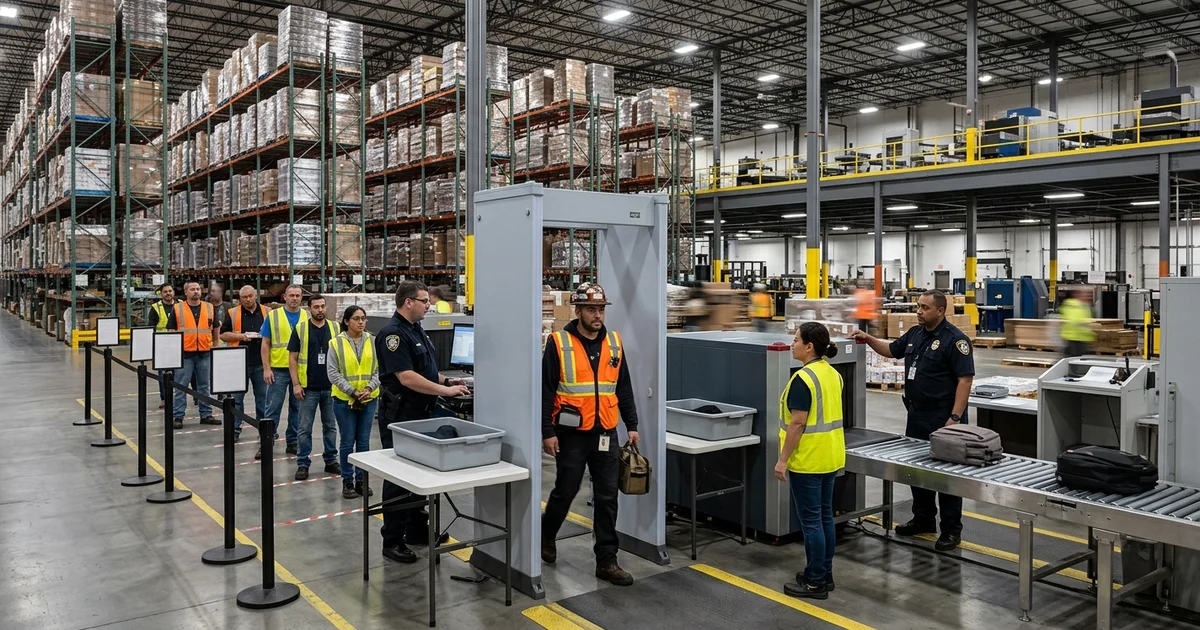
Warehouse security screening is the deployment of X-ray inspection systems, walkthrough metal detectors, parcel scanners, and access control infrastructure at the entry points of distribution centers, fulfillment warehouses, manufacturing facilities, and logistics hubs to detect weapons, stolen goods, contraband, and prohibited items carried in by employees, visitors, and deliveries. Unlike public-facility checkpoint security, warehouse security screening must operate within the constraints of an industrial operational environment — high throughput, shift-change surges, forklift traffic, large parcel volumes, and a workforce that moves rapidly between secured and unsecured areas throughout the day.
Annual cargo theft losses in U.S. supply chains (NICB and FreightWatch International estimates) — warehouse and distribution center perimeters are the primary theft point for organized retail crime and cargo diversion operations
Of cargo theft events involve inside knowledge — an employee, contractor, or driver who knows shipment schedules and facility access patterns. Warehouse security screening at personnel entry points is the primary countermeasure for insider-enabled theft
CBP Customs-Trade Partnership Against Terrorism certification requires documented physical security controls for importers — X-ray inspection of inbound cargo and personnel screening at facility entry are core compliance elements
The highest-risk access window in a warehouse is shift change — hundreds of outbound employees exiting simultaneously while inbound employees enter, creating screening bottlenecks if the checkpoint is undersized for the concurrent load
Warehouse Security Screening Zones
Effective warehouse security screening is not a single checkpoint — it is a layered zone architecture that applies different screening levels to different access categories based on threat profile and operational impact.
Employee Pedestrian Entry
All warehouse employees should pass through WTMD and bag X-ray at shift start and exit. Shift-change surge planning requires lane counts based on employees per 10-minute window, not total shift headcount. Outbound exit screening (checking for merchandise being carried out) is equally important as inbound screening and often overlooked in warehouse security design.
Loading Dock and Receiving
Loading docks are the highest-volume cargo entry point and the primary target for cargo substitution, contraband concealment, and organized theft operations. X-ray inspection of inbound parcels and packages at the dock identifies items placed inside legitimate shipments. Driver access control limits dock access to credentialed carriers during scheduled windows.
Mailroom and Parcel Inspection
Corporate mailrooms and receiving areas for inbound correspondence, packages, and deliveries require X-ray inspection for threat items (explosive devices, suspicious powders, weapons) before mail enters the office or facility. Post-2001 threat assessment requirements for government contractors and critical infrastructure operators specifically require mailroom X-ray inspection.
Gatehouse and Vehicle Inspection
Large distribution facilities with vehicle entry control require gatehouse checkpoint design that handles inbound tractor-trailers, employee vehicles, and visitor passenger cars at appropriate inspection levels. Under-vehicle inspection systems and large-format cargo X-ray can be integrated at the gatehouse for high-security industrial sites.
Warehouse Security Screening Throughput Reference
Checkpoint sizing for warehouse and distribution center applications. Personnel screening is sized against shift-change surge; parcel screening is sized against peak receiving throughput.
| Facility Type | Peak Shift-Change | Personnel Lanes | Parcel Inspection |
|---|---|---|---|
| Small Warehouse (under 100 staff) | 40-60 persons/10 min | 1-2 WTMD + 1 X-ray | 1 parcel X-ray lane |
| Mid-Size DC (100-300 staff) | 80-150 persons/10 min | 2-4 WTMD + 2 X-ray | 1-2 parcel X-ray lanes |
| Large DC (300-1,000 staff) | 150-400 persons/10 min | 4-8 WTMD + 3-4 X-ray | 2-4 parcel X-ray lanes |
| Fulfillment Center (1,000+ staff) | 400+ persons/10 min | Multi-entry + 6-12 WTMD | Conveyor-integrated system |
| Mailroom / Corporate Receiving | N/A (parcel-focused) | 1 WTMD at reception | 1 small-format X-ray |
How to Design a Warehouse Security Screening System
Warehouse Security Screening Cost Reference
| Application | Equipment | Installed Cost |
|---|---|---|
| Mailroom X-Ray System | Small-format X-ray + inspection station | $28,000-$55,000 |
| Single Pedestrian Entry | 1-2 WTMD + 1 X-ray + access control | $45,000-$85,000 |
| Loading Dock Parcel Inspection | Parcel X-ray + conveyor + reject station | $55,000-$120,000 |
| Mid-Size DC Full Perimeter | 2-4 WTMD + 2 X-ray + access control + cameras | $120,000-$240,000 |
| Large DC / Fulfillment Center | Multi-entry + 6-12 WTMD + conveyor X-ray + integrated access | $280,000-$650,000+ |
Related Security and Inspection Resources
Frequently Asked Questions: Warehouse Security Screening
Design Your Warehouse Security Screening System
2M Technology engineers loading dock inspection, mailroom X-ray, personnel checkpoint, and gatehouse systems for distribution centers, fulfillment operations, and industrial facilities across Texas and nationwide.
(214) 988-4302 | sales@2mtechnology.net