
Updated May 2026 | 2M Technology | Grand Prairie, TX
Manual verification, single-lane entry, and inadequate checkpoint infrastructure create dangerous workforce bottlenecks at industrial sites. Here are the engineering solutions that eliminate them.
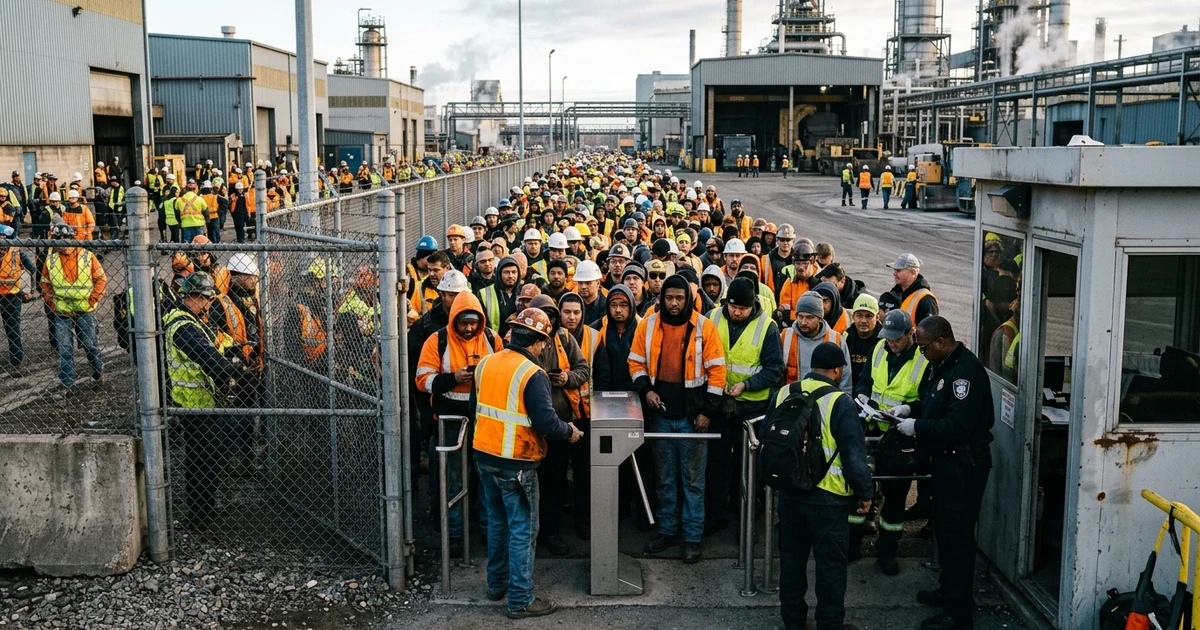
Engineer Industrial Workforce Access →Workforce checkpoint bottlenecks at industrial sites are entry point congestion events in which the processing capacity of the checkpoint — measured in people per minute — is lower than the rate at which workers arrive for shift change. Bottlenecks occur when the wrong combination of verification method, lane count, and credential technology is applied to the workforce volume. The operational impacts include crowd compression (a direct safety hazard), delayed shift starts that cost production time, security failures through tailgating, and inaccurate headcount records that compromise emergency mustering.
The Most Common Bottleneck Causes
Workforce checkpoint bottlenecks at industrial sites share a common set of root causes. Each bottleneck cause can be engineered around with the right infrastructure design.| Bottleneck Cause | Processing Rate | Primary Problem |
|---|---|---|
| Single-lane manual ID check | 2–4 people/min | Throughput insufficient for any large shift |
| Paper sign-in sheet | 3–5 people/min | No audit trail; illegible records; no alerts |
| No credential system (visual ID only) | 2–6 people/min | Security failure; no zone enforcement |
| Insufficient turnstile count | Limited by lane count | Even good credentials bottleneck at 1–2 lanes |
| X-ray without pre-clearance lane | 8–15 people/min | Screening becomes mandatory bottleneck for all |
Operational Consequences of Checkpoint Bottlenecks
Workforce checkpoint bottlenecks at industrial sites produce consequences that extend well beyond inconvenience. They create four categories of operational damage: Late shift starts. When the outgoing shift cannot exit while the incoming shift queues, production handover is delayed. At plants operating continuous processes, a delayed shift start means extended run time for the outgoing team, overtime costs, and disrupted maintenance windows. Even a 10-minute average shift start delay across three shifts per day accumulates to 182 hours per year of lost production time per checkpoint. Safety hazards from crowd compression. A 400-worker queue compressing toward a 2-lane checkpoint creates crowd densities that have caused crush injuries at industrial sites. OSHA citations have been issued for inadequate egress and entry infrastructure that creates foreseeable crowd hazards during predictable high-density events like shift change. Security failures through tailgating. Workers who have waited 20 minutes in a queue will tailgate through a turnstile when given the opportunity — not maliciously, but as a natural response to frustration. Tailgating in this context means that credential verification is bypassed, headcount records are inaccurate, and zone access controls are defeated. The checkpoint that was meant to provide security produces false confidence instead. Supervisor time on manual logs. Sites still relying on paper sign-in sheets or manual badge logs require supervisor time to reconcile those records for compliance reporting, contractor billing, and emergency mustering. Average time: 18 minutes per shift change for a 200-person workforce.Throughput Mathematics
Checkpoint throughput is a physics problem with a direct engineering solution. The variables are: arrival rate (workers per minute entering the queue), processing rate (people per minute per lane), and lane count. The bottleneck exists when arrival rate exceeds total processing capacity (processing rate multiplied by lane count).| Method | People per Minute | 200-Worker Clear Time | 500-Worker Clear Time |
|---|---|---|---|
| Manual ID check (1 lane) | 2–4 | 50–100 min | 125–250 min |
| RFID turnstile (1 lane) | 20–30 | 7–10 min | 17–25 min |
| RFID turnstile (4 lanes) | 80–120 | 2–3 min | 4–7 min |
| RFID turnstile (8 lanes) | 160–240 | 1–2 min | 2–3 min |
Industrial Checkpoint Engineering | (214) 988-4302
Tell us your shift size — we will calculate your lane requirement.
View Container Turnstile Checkpoints →The Engineering Solution: Checkpoint Infrastructure Design
Eliminating workforce checkpoint bottlenecks at industrial sites requires addressing all four variables simultaneously: lane count, credential technology, pre-enrollment process, and x-ray bypass design. Lane count: The minimum lane count is calculated from shift size divided by the desired clear time, divided by the per-lane throughput rate. A 500-person shift with a 10-minute target clear time requires a minimum of 500 / 10 / 30 = 1.7 lanes — rounded to 2 minimum, with 3 to 4 recommended for queuing distribution and redundancy. Credential technology: RFID credentials (HID, MIFARE, or equivalent) reduce per-person processing time to under 3 seconds. Biometric credentials reduce it further by eliminating the card presentation step for enrolled workers. The credential standard selected must be compatible with the access control platform managing contractor and employee records. Credential pre-enrollment: Workers who arrive at the checkpoint without pre-enrolled credentials must be enrolled on-site — typically a 2 to 5 minute process per person. For large turnarounds with hundreds of new contractors arriving simultaneously, on-site enrollment creates a severe bottleneck within the bottleneck. Pre-enrollment via web portal or mobile app before arrival is the engineering solution. Workers arrive credentialed and proceed directly to the turnstile lane. X-ray bypass lanes: When x-ray screening is required, pre-cleared regular employees should have a bypass lane that routes them directly to turnstiles after credential verification. Only contractors, visitors, and flagged individuals proceed through the x-ray screening lane. This segregation doubles effective throughput for the regular workforce while maintaining screening requirements for new entrants.Modular Container Checkpoints for High-Throughput Industrial Entry
2M Technology’s modular CONEX container checkpoints — the 2MFHT-5C (5-turnstile) and 2MFHT-4C (4-turnstile) configurations — are specifically designed for industrial sites that need to scale checkpoint capacity quickly without permanent construction. Each container unit arrives with integrated turnstile lanes, RFID readers, access control panels, and security cameras pre-installed and pre-wired. A site requiring 8 turnstile lanes for a major turnaround can deploy two 2MFHT-4C units side by side, each on a standard concrete pad, and be operational within 24 to 48 hours. When the turnaround is complete and the contractor population returns to normal, one unit can be removed — or repositioned to another gate — without dismantling any permanent infrastructure. The modular approach also addresses the budget reality of industrial turnarounds: the capital expenditure for permanent checkpoint infrastructure is difficult to justify for a condition that occurs for 4 to 8 weeks per year. Modular container units provide the same throughput capability on a deployment model that matches the temporary nature of turnaround workforce density.How Access Control Software Eliminates Manual Logs
The access control software layer — whether Brivo cloud, Genetec Security Center, or an equivalent platform — eliminates paper sign-in sheets and manual badge logs by recording every entry and exit event automatically. The data is timestamped, associated with a specific individual, and tied to the credential presented at the turnstile. This produces several operational improvements beyond throughput:- Real-time headcount: The number of workers currently inside the facility is always accurate based on entry and exit records. Emergency mustering is verified against this count rather than estimated from a paper log.
- Automated shift reports: Shift start/end reports showing who entered, when, and through which gate are generated automatically and delivered to supervisors without manual compilation.
- Contractor expiry alerts: When a contractor’s credential is set to expire — either by date or by project completion — the system generates an alert to the safety coordinator before the credential is used again. Expired credentials are automatically suspended without manual intervention.
- Overtime and access anomaly detection: Workers who remain on-site past their authorized shift end, or who present credentials at gates outside their authorized zones, generate automatic alerts rather than being discovered during a manual audit days later.
Specific Design Patterns by Shift Size
| Shift Size | Turnstile Lanes | Vehicle Lanes | Recommended Platform |
|---|---|---|---|
| Up to 100 workers | 2 lanes | 1 lane + LPR | Brivo cloud |
| 100–250 workers | 3–4 lanes | 1–2 lanes + LPR | Brivo or Genetec + Mercury |
| 250–500 workers | 5–8 lanes (2MFHT-4C/5C) | 2 lanes + LPR | Genetec + Mercury |
| 1,000+ workers | 10+ lanes, dual checkpoint | 3+ lanes, dual gate | Genetec Federation |
Is Workforce checkpoint bottlenecks the Right Solution for Your Site?
Workforce checkpoint bottlenecks from 2M Technology is the right approach for any site where workforce scale, vehicle volume, or perimeter size makes traditional guard booths and fixed cameras inadequate. 2M Technology designs workforce checkpoint bottlenecks that deploys in hours, not weeks, and scales incrementally as your operational requirements grow.
The core advantage of workforce checkpoint bottlenecks from 2M Technology is open architecture: every component integrates with existing credentialing systems, VMS platforms, and access control software without proprietary lock-in. Organizations already operating HID, Mercury, Brivo, or Genetec systems can connect workforce checkpoint bottlenecks without replacing existing investment.
How to Evaluate a Workforce checkpoint bottlenecks Provider
- Confirm workforce checkpoint bottlenecks deployment timeline — pre-wired units should be operational in 4 to 8 hours
- Verify open-architecture credential support (HID, MIFARE, Mercury, Brivo, Ubiquiti)
- Confirm LTE and 5G wireless backhaul so no site fiber is required
- Require cloud VMS and cloud LPR integration as standard components
- Validate the workforce checkpoint bottlenecks system can relocate as site requirements evolve
Frequently Asked Questions
Engineer Industrial Workforce Access
Tell us your shift size, current checkpoint setup, and the bottleneck symptoms you are experiencing. We will design the turnstile lane count, credential system, and pre-enrollment workflow that eliminates the problem.
Request a Checkpoint Design Call (214) 988-4302
