Commercial Panic Bar & Electrified Exit Device Installation in Dallas, TX
What We Do
2M Technology installs commercial panic bars, fire exit hardware, and electrified exit devices in Dallas–Fort Worth. The work covers Von Duprin and Sargent hardware, access control integration, electric latch retraction, door position monitoring, and power transfers. Where a fire alarm panel connection is required, a licensed fire alarm contractor performs that part of the work.
Exit devices are the push-bar hardware that lets people leave a building from the inside while the outside stays secure, when the door is specified and installed to code. On a commercial building they are a code item, a fire-safety item and, more and more, part of the access control system. 2M Technology installs mechanical and electrified exit devices from Von Duprin and Sargent on commercial, industrial, and institutional doors (commercial work only) and wires them into the access control system: card readers, door position switches, and request-to-exit signals. Where a door must also interface with the fire alarm, 2M’s work stops at the door side; the fire alarm panel work is done by a licensed fire alarm contractor.
What We Install
- Von Duprin and Sargent exit devices for commercial doors, mechanical and electrified
- Single and double doors, including double doors with vertical rod devices
- Trim, dogging, and cylinder options to match how each door is used
- Electrified options: latch retraction for card access, request-to-exit switches, door position switches, and the power supplies and power transfers the devices need
Panic Hardware vs. Fire Exit Hardware
Panic hardware and fire exit hardware look alike but are listed for different doors. Fire-rated doors need hardware listed for use on fire doors, and the device and its options have to match the door’s label. We match the device to the door’s label.
Which Doors Need Exit Devices
The building and life-safety codes adopted by your city, and the fire marshal, decide which doors need panic or fire exit hardware. Requirements vary with the occupancy, the door rating and the code edition your city has adopted. We confirm the requirement for each door during the survey and before ordering hardware.
Exit Devices in Access Control and Fire Alarm Systems
- Card access on an exit device door: electric latch retraction lets a credential or schedule unlatch the door; free egress from inside is kept when the door is specified and installed to code.
- Request-to-exit: where the device has a request-to-exit switch and the controller is programmed for it, the access system can tell an exit from inside apart from a forced door.
- Fire alarm interface: where the locking arrangement and the adopted code require it, 2M’s scope is the door side only: the door hardware, its power supply, and the release input. The licensed fire alarm contractor is responsible for the connection at the fire alarm panel and all other fire alarm work.
- Door position switches: report held-open and forced doors to the access control and video systems.
2M installs the access control, the door hardware and the low-voltage cabling on the door side. For how exit devices compare with other electrified locking, see magnetic locks vs. electric strikes.
Doors in Demanding Environments
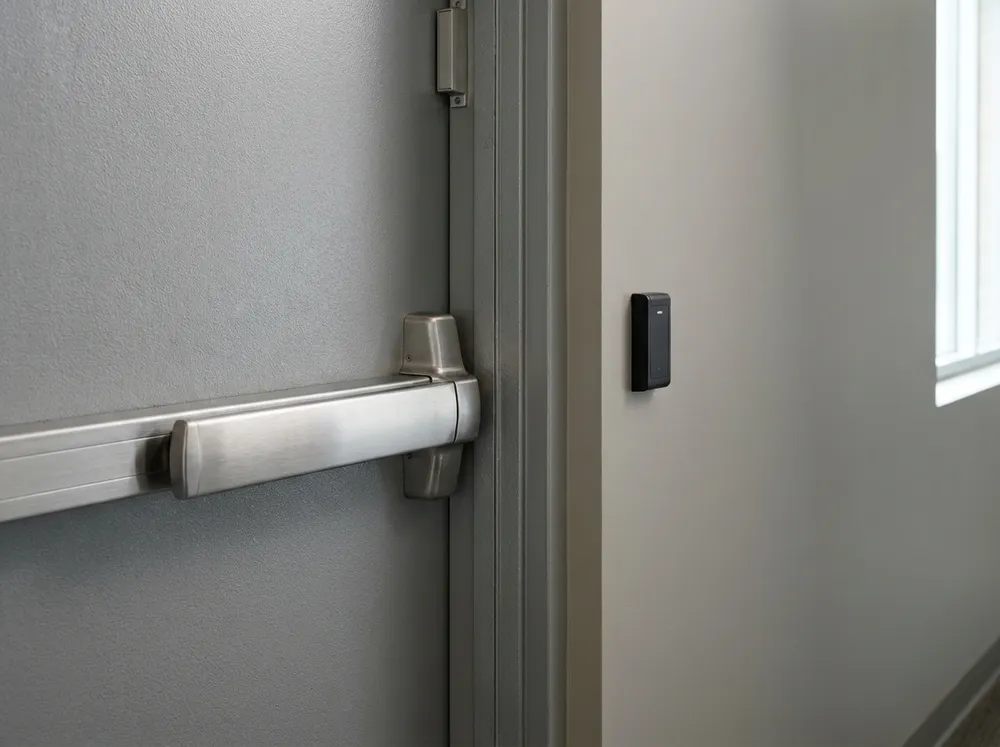
Example from 2M’s own project work (as described by the 2M project owner; customer not named): at a food manufacturing site in Dallas, 2M Technology installed electrified exit devices, specified in a stainless steel finish, on five doors. The doors are tied into the fire alarm system; 2M did the door side, and the connection at the fire alarm panel was made by the licensed fire alarm contractor.
Electrified Double-Door Packages
A common configuration we install is a pair of electrified exit devices on a double door, with vertical rods, outside trim on each leaf and a concealed power transfer or electric hinge to bring power and signal wires into each door. We supply this package with Von Duprin or Sargent devices in a stainless steel finish. With electric latch retraction, the access control system can unlatch both leaves; exit from inside is kept when the doors are specified and installed to code. 2M Technology supplies, installs and wires the package into the access control system. Where a fire alarm interface is required, 2M’s scope is the door side only, and the licensed fire alarm contractor is responsible for the panel connection.
What a Project Usually Involves
- A door survey: door type and rating, frame, existing hardware, wiring paths, and how each door should behave (who gets in, when, and what happens in an alarm)
- A hardware schedule: device, trim, finish, electrified options, and power for each door
- Installation and wiring: of the door hardware and access control, plus the door-side release input where a fire alarm interface is required
- Testing the doors: in normal, access-granted and power-loss conditions, and a walkthrough with your staff
- Service area: installation, training, and technical support throughout Texas; larger out-of-state projects are eligible for onsite installation and support, subject to project requirements, scheduling, and location
Frequently Asked Questions
How do panic bars work?
Pushing the bar, or touchpad, retracts the latch so the door opens in the direction of exit without a key or special knowledge. From outside, the door opens with a key, a lever or pull trim, or, on an electrified device, a card reader or schedule through the access control system.
Where is panic hardware required by code?
Under the International Building Code, swinging doors serving rooms or spaces with an occupant load of 50 or more in assembly (Group A) or educational (Group E) occupancies, and doors serving high-hazard (Group H) occupancies, may only have panic or fire exit hardware as their latch. The code also requires it on doors serving transformer vaults, battery or energy storage rooms and some rooms with electrical equipment. The code edition your city has adopted and the fire marshal decide for each door; we confirm it during the door survey.
What is the mounting height for panic hardware?
The International Building Code requires door operating hardware, including panic hardware, to be installed between 34 and 48 inches above the finished floor, and the push bar must extend across at least half of the door leaf. We set the height from the device template and the code your city has adopted.
What is considered panic hardware?
Panic hardware is a door-latching device with a bar or touchpad that releases the latch when pushed, listed to UL 305. On a fire-rated door the device has to be fire exit hardware, listed to UL 10C and UL 305, and match the door’s label; we match the device to the label.
Do you install Von Duprin and Sargent exit devices?
Yes. 2M Technology installs mechanical and electrified exit devices from both manufacturers on commercial doors in Dallas-Fort Worth and across Texas.
Can an exit device work with card access?
Yes. An electrified exit device with latch retraction can unlatch on a valid credential or schedule; exit from inside is kept when the door is specified and installed to code.
Do exit devices need to connect to the fire alarm?
It depends on how the door is locked and controlled; the adopted code and the fire marshal decide. Where release is required, 2M’s scope is the door side only; the licensed fire alarm contractor is responsible for the fire alarm panel connection.
How much does it cost to install a panic bar?
It depends mostly on the kind of job. Replacing a mechanical exit device on an existing door is the simplest. An electrified retrofit adds electric latch retraction, a power supply, a power transfer and wiring back to the access control system. A double-door package with vertical rods, outside trim and power transfers on both leaves is the most involved, and a fire-rated door limits which devices and options can be used. 2M quotes after a door survey; we do not publish prices because no two doors are the same.
Contact 2M Technology for a Commercial Exit Device Installation
- Texas Private Security License B15309
- (214) 988-4302
- sales@2mtechnology.net