Drone Detection Trailers: Solar-Powered Counter-Drone Security

What a Drone Detection Trailer Does
A drone detection trailer continuously monitors the RF spectrum for the control and video links that consumer and commercial drones use. When a drone enters range, the system identifies it — often down to manufacturer, model, and serial number — and, depending on configuration, locates both the drone and its operator. Because passive RF sensors emit no signal of their own, they can be operated by private facilities without transmitting anything, and they draw little enough power to run entirely on a solar trailer platform.
Detection-only systems generally avoid the federal restrictions that apply to jamming or disabling drones, which is reserved to a small set of authorized agencies. Legality still depends on the specific technology, the information it collects, and how it is operated, so 2M recommends a system-specific legal review before deployment — that authority is reserved for a small set of federal agencies. Our counter-drone law guide covers exactly what facilities can and cannot do.
Platform: The 2M Solar Trailer
Every drone detection trailer starts from the same platform that powers our mobile surveillance trailers deployed across Texas and beyond:
| Platform Element | Specification |
|---|---|
| Power | 400W-class solar array with 200Ah–400Ah battery bank options |
| Autonomy | 3–5 days of operation without solar input (configuration dependent) |
| Mast | Telescoping mast, 18 ft (5.5 m) standard; taller configurations available |
| Sensor Payload | Passive RF drone detection sensor + optional PTZ / thermal cameras |
| Connectivity | LTE cellular backhaul; satellite available for remote sites |
| Deployment | Tow to site, level, raise mast — operational the same day, no trenching, no utility power |
Passive RF detection is the right first configuration for a solar platform: the sensors are low-power, add modest mast loading, and require no radiation licensing. For sites that need to see RF-silent or autonomous drones, we offer radar and thermal-PTZ options as a premium configuration — see our drone detection technology comparison for the honest trade-offs.
3 Configurations
| Configuration | What It Includes | Best For |
|---|---|---|
| Detection | Passive RF sensor, alerting to phone/SOC, drone + operator localization (sensor dependent) | Airspace awareness on a budget; corrections; utilities |
| Detection + Video | Adds PTZ camera slew-to-cue: camera turns toward the detected drone automatically | Events, stadiums, evidence collection |
| Premium | Adds radar and/or thermal imaging for RF-silent drone coverage | Critical infrastructure, government sites |
Bring Your Preferred Detection Technology
2M Technology is a systems integrator, not a single-vendor shop. We engineer the trailer, power budget, mast, and connectivity around the RF detection sensor that fits your requirement and procurement path:
- Skycope — passive RF detection with 360° coverage and a large drone-signature library; in active integration on 2M trailers today
- ApolloShield — omni-directional RF detection with high accuracy and precision
- MyDefence — Danish/US manufacturer with US production; vehicle-mount and perimeter RF detectors
- DroneShield — widely deployed RF detection with strong US government adoption
- Aaronia — German RF spectrum-analysis systems for high-end requirements
- AeroDefense — US-made RF detection with a strong record in correctional facilities
If your agency or company has already selected a detection vendor, we can evaluate integrating it onto the 2M platform — power, mounting, environmental protection, and connectivity engineering are what we do across our custom engineering lines.
Current Build: ApolloShield Integration at Our Grand Prairie Facility
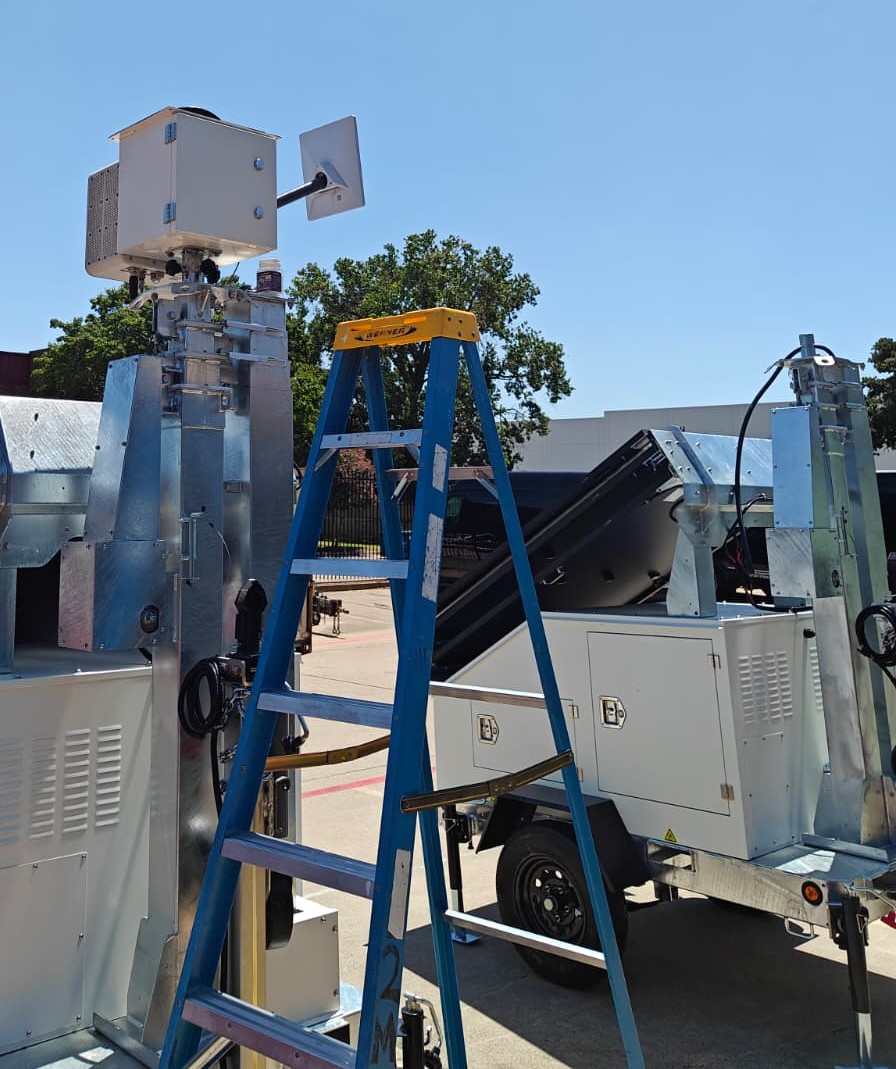
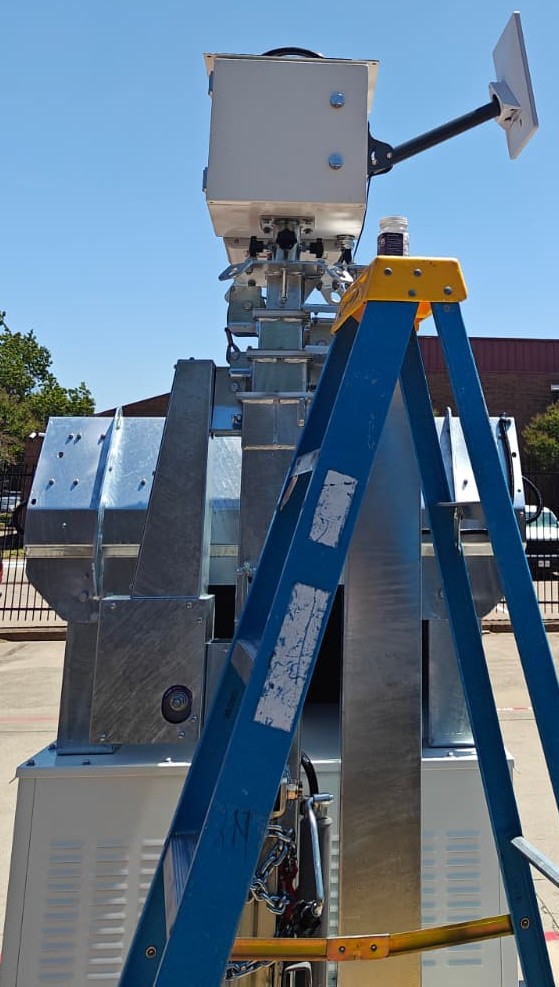
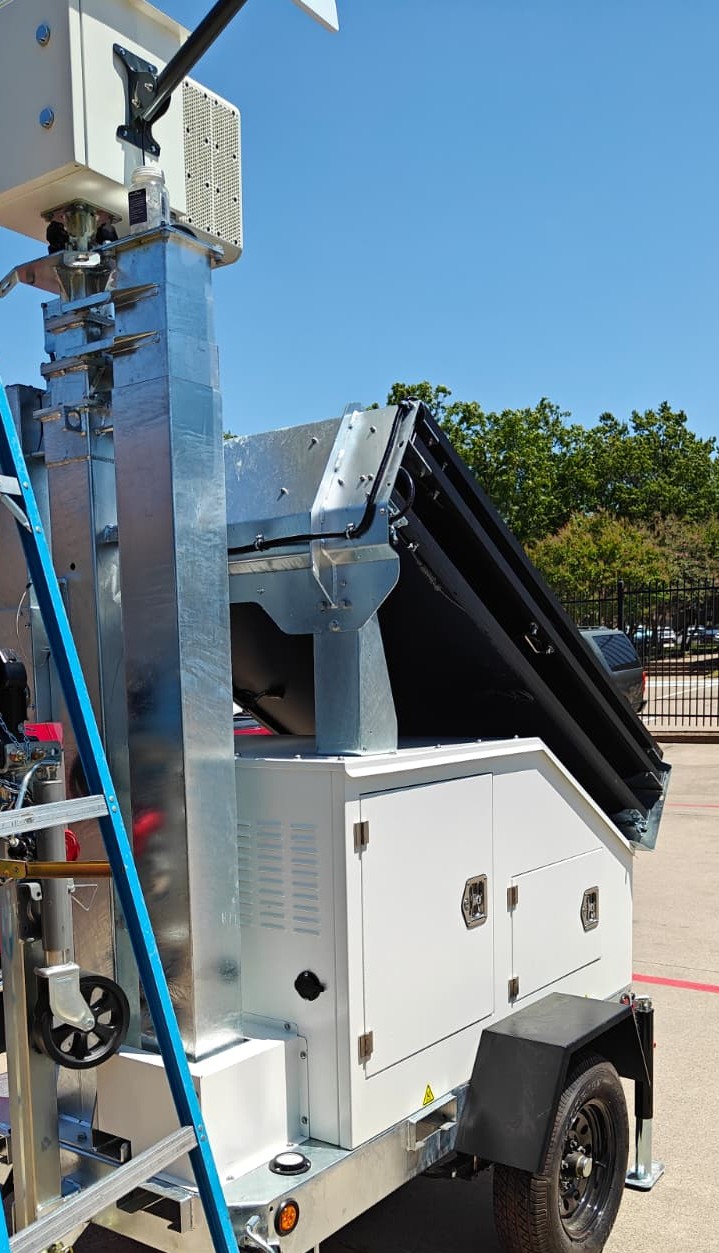
We are currently producing solar trailers fitted with ApolloShield RF drone detection equipment at our Grand Prairie, TX facility — mast-mounted sensor and directional antenna on our telescoping mast, powered entirely by the trailer’s solar array and battery bank. This is not a concept: it is in fabrication now, using the same galvanized trailer platform, enclosure, and solar architecture as our fielded surveillance trailers.
Who Uses Drone Detection Trailers
- Stadiums and events — temporary airspace awareness for game days and festivals, paired with our event screening infrastructure
- Correctional facilities — drone contraband delivery is the fastest-growing prison security problem in the US
- Critical infrastructure — substations, water treatment, data centers, refineries
- Oil & gas — remote sites already using our oilfield surveillance trailers
- Government & law enforcement — mobile deployments for VIP events and temporary flight restriction support
How a Detection Trailer Fits Your Security Program
Drone detection is not a standalone gadget — it is an airspace layer on top of the ground security you already run. Detection alerts flow to the same people who watch your cameras: an on-site guard post, a corporate SOC, or a monitoring partner. When the system flags an incursion, the response playbook is ordinary security work — dispatch to the operator location, document the event, notify law enforcement when the incursion is hostile or repeated. Facilities that already operate our surveillance trailers add the airspace layer without changing how their team works: same trailer platform, same connectivity, one more sensor feed.
Three deployment patterns come up again and again.
- Perimeter awareness: one trailer at the fence line of a substation, plant, or yard, watching the airspace approach paths.
- Event coverage: a trailer deployed for game day, a festival weekend, or a VIP visit, then towed home — airspace security as a temporary service rather than a capital project.
- Rotating coverage: corrections and logistics operators moving one trailer among facilities on an unpredictable schedule, which is often more deterrent per dollar than fixed sensors at every site.
Why Solar Changes the Economics
Fixed counter-UAS installations carry the same cost problem as fixed cameras: trenching, conduit, utility power, and permanent mounting often cost more than the sensor itself. The solar trailer removes every one of those line items. Power is generated on the platform, the mast is the mounting structure, and connectivity is cellular — which means the total cost of airspace awareness is the trailer plus the sensor, and the asset follows your risk instead of being poured into one location’s concrete. For seasonal or project-based requirements, that difference typically decides the business case.
Counter-UAS for Government and Critical Infrastructure
Agencies and critical-infrastructure operators typically frame this requirement as counter-UAS (C-UAS): detecting, identifying, and tracking unmanned aircraft as part of a layered security posture. The 2M platform fits that framing directly — a mobile, solar-powered counter-UAS detection node that deploys without construction, integrates with existing command-and-control environments through the sensor manufacturer’s APIs, and repositions as the threat picture changes. For authorized federal agencies with mitigation authority, 2M trailers serve as the detection layer feeding lawful mitigation systems; for other organizations, detection-focused deployments are the practical path, subject to system-specific legal review.
Frequently Asked Questions
Is drone detection legal for a private business?
Yes. Passive RF detection — listening for the signals drones already broadcast — is lawful for private facilities in the US. What private parties may not do is jam, spoof, or physically disable a drone. See our full legal guide.
What information does RF detection actually give me?
Depending on the sensor, a detection event can include drone manufacturer and model, serial number, position, altitude, speed, heading — and in many cases the operator’s location. That last item is often the most operationally useful: security responds to the pilot, not the aircraft.
How far can a trailer detect drones?
Detection range depends on the sensor, antenna height, terrain, and RF environment. Manufacturer-stated ranges for premium passive RF systems run from several kilometers to tens of kilometers under ideal conditions; dense urban RF environments reduce that. We spec realistic coverage for your actual site rather than quoting brochure maximums.
Can it detect drones that don’t emit RF?
No — passive RF cannot see a drone flying a fully autonomous mission with its radios silent. That is a genuine limitation, and the reason our premium configuration adds radar. Most consumer and commercial drone incursions, however, involve active control or video links that RF detection sees well. Since 2024, most drones are also required to broadcast Remote ID, which is designed to be received.
How long does the trailer run without sun?
Our platform is engineered for 3–5 days of operation without solar input, configuration dependent — the same architecture fielded on our surveillance trailers.
Can you add drone detection to a trailer we already own?
Often, yes. If your trailer has mast capacity and power headroom, we can evaluate a retrofit. Otherwise the sensor mounts on a new 2M platform sized for it from the start.
What does a drone detection trailer cost?
Pricing depends primarily on the detection sensor selected — RF detection systems range widely between manufacturers — plus the trailer configuration. Request a quote with your site details and we will spec and price the configuration that fits.
Does 2M offer drone jamming or takedown?
No. Counter-drone mitigation is federally restricted to authorized agencies (DOJ, DHS, DoD, DOE). We build detection systems, which are lawful for commercial and government facilities alike, and we support authorized agencies with detection infrastructure that integrates with their mitigation authorities.
Deploy Airspace Awareness This Month
- Texas Private Security License B15309
- •
- (214) 988-4302
- •
- sales@2mtechnology.net
Regulatory references: FAA — Unmanned Aircraft Systems; CISA — UAS security guidance.