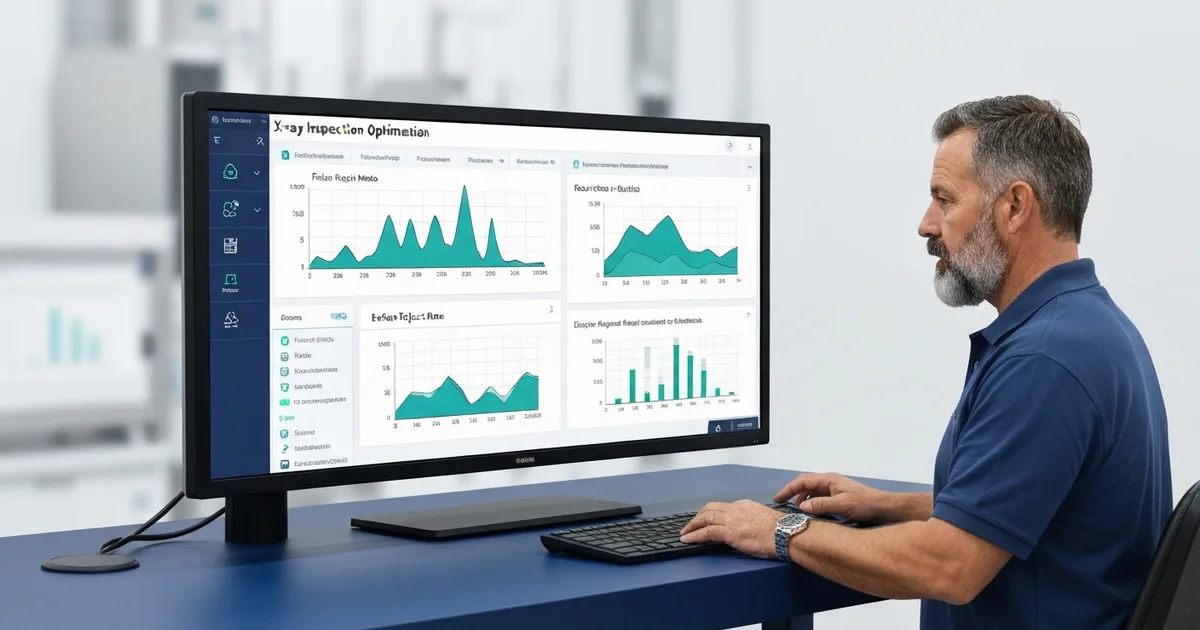
False Reject Reduction in Food X-Ray Inspection
Engineering approaches to reduce false reject rates in food X-ray inspection systems from 2-5% to under 0.5% — without compromising contamination detection sensitivity or violating HACCP critical limits.
False reject reduction in food X-ray inspection is the process of engineering inspection system parameters, AI discrimination models, and product handling configurations to minimize the rejection of conforming product while maintaining or improving detection of actual contaminants. Lines achieving false reject rates above 1 percent are wasting product, generating rework costs, and creating production line pressure that often leads to operators raising reject thresholds in ways that compromise food safety — the exact outcome false reject reduction engineering is designed to prevent.
The False Reject Problem in Food X-Ray Inspection
False rejects in food X-ray inspection — legitimate product incorrectly flagged as contaminated — occur for five primary reasons: product density variation, product positioning inconsistency, conveyor vibration, inadequate AI model training, and sensitivity thresholds set too aggressively during initial calibration. The engineering challenge is that every reduction in false reject rate must be achieved through improved discrimination between true contaminants and acceptable product variation, never by simply raising the detection threshold. Raising the threshold reduces false rejects but simultaneously degrades sensitivity to actual contamination — a trade-off that food safety engineers must never accept without formal re-validation.
False Reject Rate Benchmarks by Product Category
| Product Category | Industry Average FRR | Optimized Target FRR | Waste Cost at 200 pcs/min |
|---|---|---|---|
| Fresh poultry (bone-in) | 2.5 — 4% | <0.8% | $180k+/year |
| Fish fillets (pin bone check) | 1.5 — 3% | <0.5% | $240k+/year |
| Shrimp (IQF) | 1.0 — 2% | <0.5% | $120k+/year |
| Ground beef / bulk meat | 0.8 — 2% | <0.3% | $90k+/year |
| Canned / packaged goods | 0.3 — 0.8% | <0.15% | $40k+/year |
| Produce / bakery (variable density) | 1.5 — 3.5% | <0.8% | $160k+/year |
The 6 Engineering Levers for False Reject Reduction
1. AI Discrimination Model Refinement
The most impactful single intervention in false reject reduction is training the inspection system’s AI discrimination model on a statistically representative sample of the specific product at the specific line conditions. Generic factory-default models are optimized for average product from the manufacturer’s test environment — not for your specific product density variation, moisture profile, or size distribution. Retraining with 500 to 2,000 representative product samples at actual line temperature and moisture conditions typically reduces false reject rates by 40 to 60 percent without any change to detection thresholds.
2. Product Positioning and Lane Discipline
X-ray inspection performance is not uniform across the full aperture width. Products traveling near the edges of the beam path encounter different X-ray path lengths and intensity profiles than products traveling through the aperture center. Inconsistent product positioning — common on wide conveyors handling variable-size product — produces inconsistent density readings that the system interprets as density anomalies. Lane guides, product singulation, and orientation fixtures that ensure product passes through a consistent aperture zone reduce positioning-driven false rejects by 20 to 35 percent.
3. Conveyor Vibration Isolation
Vibration in the conveyor structure causes micro-movement of product during the X-ray exposure window, creating motion blur in the density image that can register as false density anomalies. Lines where the X-ray inspection system shares a conveyor frame with high-vibration equipment — band saws, portioners, tumblers, or heavy forming equipment — experience elevated false reject rates that disappear when vibration isolation is added between equipment sections. Vibration isolation pads and decoupled conveyor sections cost a fraction of the ongoing waste from elevated false reject rates.
4. Product Temperature and Moisture Stabilization
X-ray density measurements are affected by product temperature and moisture because both parameters affect the actual density of the product being imaged. Fresh chicken breast inspected at 35 degrees Fahrenheit has a different effective X-ray density than the same product at 28 degrees Fahrenheit after additional chilling. Lines that process product across a wide temperature range without compensating the detection algorithm experience higher false reject rates during temperature transition periods. Inspection system calibration across the full operating temperature range and product-specific temperature compensation parameters reduce this source of false rejects by 15 to 25 percent.
5. Dual-Energy X-Ray for Material Discrimination
Dual-energy X-ray systems use two X-ray energy levels simultaneously to create both a standard density image and a material composition image. This technology enables the inspection system to discriminate between product tissue density variation — which is acceptable — and foreign body density anomalies — which require rejection. For high-value products like salmon fillets where natural density variation between lean and fatty tissue would generate false rejects under standard single-energy inspection, dual-energy X-ray inspection systems achieve 60 to 80 percent lower false reject rates while maintaining superior contamination detection sensitivity.
6. Statistical Process Control and Threshold Trending
Most food X-ray inspection systems log every rejection event with the associated density signature. Lines that analyze this data systematically can identify whether false reject rates are increasing due to seasonal product variation, equipment wear, or upstream process changes — before operators feel pressure to adjust thresholds manually. Statistical process control applied to the reject data stream identifies the root cause of false reject rate increases and guides engineering interventions rather than threshold adjustments that compromise food safety.
False Reject Reduction ROI Analysis
What NOT to Do: False Reject Reduction Mistakes
| Incorrect Approach | Why It Fails | Correct Alternative |
|---|---|---|
| Raise detection threshold | Reduces sensitivity to real contaminants | Retrain AI discrimination model |
| Disable the reject mechanism temporarily | CCP violation — creates recall liability | Stop line and investigate root cause |
| Switch to manual inspection during high FRR | Manual inspection misses >60% of sub-3mm contaminants | Investigate product and equipment root cause |
| Re-run rejected product without inspection | HACCP violation — assumes all rejects were false | Inspect rejected product and segregate non-conforming |
| Change speed without re-validation | Faster speed reduces detection dwell time | Re-validate at new speed before production use |
False Reject Reduction Engineering Services
2M Technology provides false reject reduction analysis for food X-ray inspection systems across poultry, meat, seafood, and packaged goods applications. The engagement begins with a production audit to quantify the current false reject rate and identify the primary contributing factors, followed by an engineering intervention plan targeting root causes rather than symptoms. Validated AI model retraining, positioning optimization, and statistical monitoring setup are delivered with HACCP-compatible documentation that demonstrates detection sensitivity was not compromised during the optimization process.
Related Food Inspection Resources
- Food Manufacturing X-Ray Inspection Hub
- Poultry and Meat X-Ray Inspection Systems
- Seafood Inspection Systems
- Why Food Inspection Systems Fail
- AI Anomaly Detection for Industrial Inspection
- FDA FSMA Requirements
Frequently Asked Questions: False Reject Reduction
What causes high false reject rates in food X-ray inspection systems?
False reject rates in food X-ray inspection are caused by product density variation, inconsistent product positioning within the X-ray aperture, conveyor vibration, temperature and moisture variation in the product, and AI discrimination models not trained on the specific product being inspected. The most common cause is using factory default detection models rather than product-specific models validated against the actual production line conditions.
Can false reject rates be reduced without compromising food safety?
Yes. False reject reduction through AI model discrimination improvement, product positioning optimization, and vibration isolation reduces false rejects by improving the system’s ability to distinguish between acceptable product variation and actual contamination — without raising the detection threshold. This is fundamentally different from simply making the system less sensitive. A validated false reject reduction program documents that detection sensitivity was maintained or improved throughout the optimization process.
What is dual-energy X-ray and how does it reduce false rejects?
Dual-energy X-ray inspection uses two simultaneous X-ray energy levels to generate both a density image and a material composition image. The composition image enables the system to distinguish between density variation caused by natural fat-to-lean tissue variation in protein products — acceptable — and density anomalies caused by foreign body contamination — requiring rejection. For high-value products like salmon fillets, dual-energy X-ray typically achieves 60 to 80 percent lower false reject rates compared to single-energy systems.
Reduce Your False Reject Rate Without Compromising Food Safety
2M Technology engineers analyze your current X-ray inspection system and identify specific interventions to reduce false rejects — at no charge for the initial assessment.