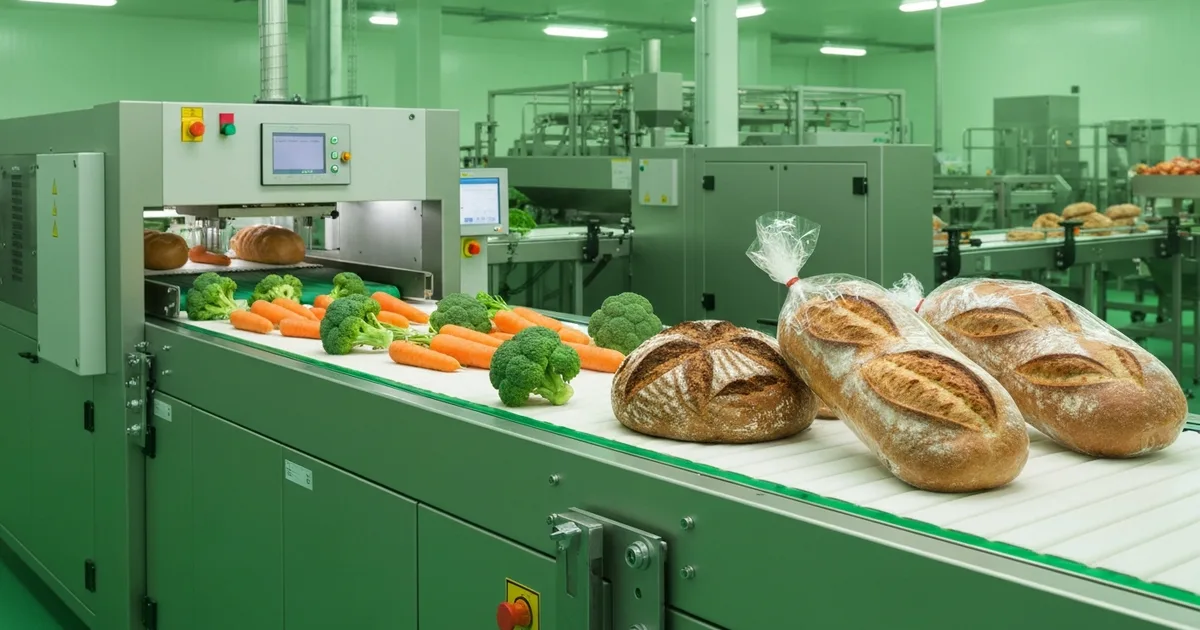
Fresh Produce and Bakery X-Ray Inspection for Stone, Metal, and Foreign Body Detection
Proven X-ray inspection for fresh vegetables, salad mix, frozen produce, bread, baked goods, and snack products — detecting stones, metal fragments, glass, and dense foreign bodies while managing the high density variation and irregular shapes that cause excessive false rejects with conventional inspection methods.
Fresh produce and bakery X-ray inspection addresses two of the most technically challenging food inspection applications: high-moisture produce with extreme density variation from soil, stones, and biological matter, and baked goods with complex internal structure and variable air pocket distribution that creates density patterns resembling foreign body signatures. 2M Technology engineers inspection solutions for both categories using AI-powered discrimination models that achieve reliable foreign body detection without the false reject rates that make conventional inspection impractical for these product types.
The Produce Inspection Challenge: Soil, Stones, and Variable Density
Fresh produce arriving at processing facilities carries field contamination including soil clods, stones, and crop debris that must be removed before the product enters the processing line. Whole produce items — heads of lettuce, bell peppers, cucumbers, root vegetables — also carry surface soil and embedded stones that survive washing. The inspection challenge is severe: the density of a stone and the density of a dense soil clod are similar to the density of the produce itself, and the irregular shapes of produce items create complex X-ray images that generic detection algorithms struggle to interpret without generating high false reject rates. Purpose-configured fresh produce and bakery X-ray inspection systems address this by combining produce-specific AI models with density calibration against the actual product and contaminant mix at each facility.
Fresh Produce X-Ray Inspection Applications
| Product | Primary Contaminant Risks | Detection Capability | Challenge Level |
|---|---|---|---|
| Leafy greens / salad mix | Stones, metal, soil clods | 3-5mm stone | High |
| Root vegetables (carrots, beets, potatoes) | Stones, embedded metal, glass | 3mm stone | Medium-High |
| Frozen vegetables (peas, corn, beans) | Stones, metal fragments, glass | 2-3mm stone | Medium |
| Whole fruit (citrus, apples, stone fruit) | Metal, glass, processing debris | 3-4mm metal | Medium |
| Cut / processed produce (diced, sliced) | Metal from cutting equipment, glass | 2mm metal | Medium |
| Dried fruit / nuts | Stones, shell fragments, metal | 2-3mm stone | Medium |
The Bakery Inspection Challenge: Air Pockets, Inclusions, and Dense Toppings
Baked goods present a different but equally challenging X-ray inspection problem. Bread, rolls, pastries, and snack items have complex internal density structures — air pocket distributions, inclusion clusters, topping concentrations, and crust density gradients — that create X-ray images with many localized density variations. A metal fragment inside a baguette may appear at the same density level as a cluster of dense seeds or a concentrated crust area. Fresh produce and bakery X-ray inspection systems for baked goods must be configured with product-specific algorithms trained on the actual internal structure of each SKU, distinguishing acceptable density variation from foreign body signatures based on density profile characteristics rather than simple threshold detection.
Bakery X-Ray Inspection Applications
Bread and Rolls
Detection of metal fragments from slicing and packaging equipment, stones from grain processing, and glass. Configured to handle the high internal density variation of artisan breads with seeded crusts and open crumb structures that generate complex background density images.
Crackers and Snack Items
High-speed inspection for laminated and extruded cracker products. Metal from forming equipment and stones from flour milling are the primary risks. Low-moisture product reduces the product effect that degrades metal detector performance, but X-ray provides simultaneous fragment detection and portion weight verification.
Pastries and Filled Products
Filled pastries, pies, and turnovers with fruit, cream, or meat fillings require inspection that accounts for the high-density filling material against the lower-density pastry shell. X-ray inspection simultaneously verifies fill presence and weight against the product specification while detecting metal or glass contamination in either component.
Cereals and Granola
Bulk and packaged cereal, granola, and trail mix inspection for stones, metal fragments, and glass. Grain processing introduces stone risk; packaging equipment introduces metal risk. High-throughput X-ray inspection with bulk product configurations handles the volume requirements of large-format cereal production lines.
Why Metal Detection Underperforms for Produce and Bakery
| Limitation | Impact on Produce Lines | Impact on Bakery Lines |
|---|---|---|
| Cannot detect stone or soil | Stone in produce is primary hazard — undetectable | Stone from grain milling — undetectable |
| High moisture product effect | Fresh produce is high-moisture — SS sensitivity reduced 30-50% | Less significant for dry baked goods |
| Cannot detect glass | Glass from greenhouses, packaging, or lighting | Glass from ingredient packaging breakage |
| No fill/weight verification | Cannot verify pack weight or count | Cannot verify fill weight in pastries or pies |
Managing False Rejects in Variable-Density Products
Fresh produce and bakery products generate the highest false reject rates of any food category under conventional X-ray inspection — typically 2 to 5 percent for unoptimized systems — because their natural density variation overlaps significantly with the density range of foreign body contaminants. The engineering solution is not to lower detection sensitivity, which would miss real contaminants, but to train the AI discrimination model to recognize the difference between product-origin density variation and foreign body density profiles based on spatial distribution, shape characteristics, and density gradient patterns. A stone embedded in a carrot has a fundamentally different density signature profile than the carrot’s vascular tissue, even if the peak density value is similar. Well-trained models distinguish these signatures and reduce false rejects by 60 to 80 percent compared to factory default algorithms.
Regulatory Requirements for Produce and Bakery Inspection
FDA FSMA Produce Safety Rule (21 CFR Part 112) establishes requirements for physical hazard controls in fresh produce processing. FSMA Preventive Controls for Human Food (21 CFR Part 117) covers bakery and packaged produce operations. Both regulations require written food safety plans with documented physical hazard CCPs — including identification of the specific contaminant risks for each product and evidence that the selected inspection technology is capable of detecting those hazards. For fresh produce with stone contamination risk, FDA auditors evaluate whether the identified stone hazard is controlled by a technology capable of detecting stone — which means X-ray inspection rather than metal detection.
Related Food Inspection Resources
- Food Manufacturing X-Ray Inspection Hub
- Why Metal Detectors Miss Low-Density Contaminants
- False Reject Reduction in Food X-Ray Inspection
- Packaged Goods X-Ray Inspection for CPG
- Why Food Inspection Systems Fail
Frequently Asked Questions: Fresh Produce and Bakery X-Ray Inspection
Can X-ray inspection detect stones in fresh produce?
Yes. X-ray inspection detects stones in fresh produce by density differentiation — stones are significantly denser than surrounding vegetable tissue and appear as high-density anomalies in the X-ray image. Metal detectors cannot detect stones regardless of size or configuration because stone is not electrically conductive. Minimum detectable stone size for fresh produce applications is typically 3 to 5mm depending on product type, stone composition, and system configuration.
Why do bakery products have high false reject rates with X-ray inspection?
Bakery products generate high false reject rates with factory default X-ray inspection algorithms because their natural internal density variation — from air pockets, dense seeds, crust gradients, and inclusion clusters — overlaps with the density range of foreign body contaminants. Product-specific AI discrimination models trained on the actual internal structure of each bakery SKU distinguish between acceptable density variation and foreign body signatures, reducing false reject rates by 60 to 80 percent compared to generic algorithms.
Does FSMA require X-ray inspection for fresh produce processors?
FDA FSMA does not mandate X-ray inspection by name, but requires that physical hazard CCPs be capable of detecting the hazards identified in the food safety plan. For fresh produce processors where the HACCP hazard analysis identifies stone as a physical hazard — which it must for field-harvested produce — the selected CCP technology must be capable of detecting stone. Metal detectors cannot detect stone. FDA auditors evaluate this gap during inspections, making X-ray inspection effectively required for fresh produce operations with documented stone hazard.
Configure X-Ray Inspection for Your Produce or Bakery Line
2M Technology engineers configure fresh produce and bakery X-ray inspection systems with product-specific AI models — reducing false rejects while maintaining reliable stone, metal, and glass detection.
Request Produce/Bakery Inspection Consultation