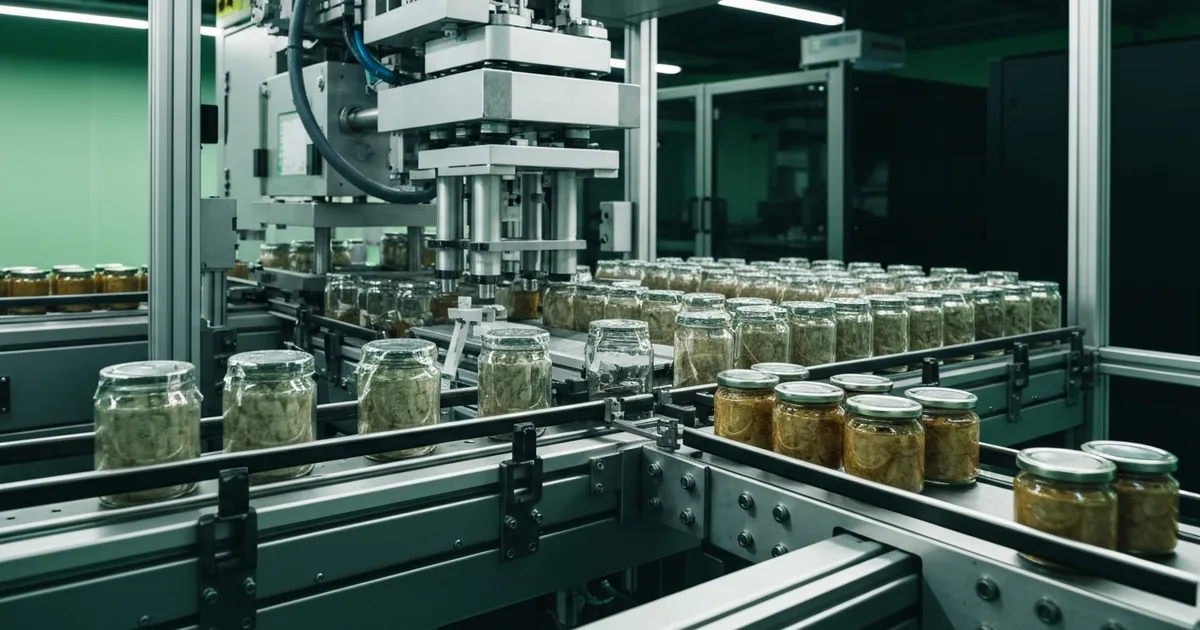
Packaged Goods X-Ray Inspection for CPG and Retail Food Manufacturing
Complete X-ray inspection solutions for consumer packaged goods — detecting glass, metal, stone, dense plastics, and fill-level non-conformance in jars, cans, pouches, trays, and retail cartons at production line speeds.
Packaged goods X-ray inspection provides consumer packaged goods manufacturers with the only inline inspection technology capable of detecting glass shards, dense plastic fragments, stone, and rubber contamination inside sealed retail packaging — while simultaneously verifying fill weight, seal integrity, and package count without breaking the package or slowing the line. 2M Technology engineers X-ray inspection systems for CPG lines producing jars, cans, pouches, trays, cartons, and multi-component retail packages.
Why CPG Manufacturers Choose X-Ray Over Metal Detection
Metal detection remains the most widely deployed inline inspection technology in CPG food manufacturing, but it has three fundamental limitations that X-ray inspection eliminates. First, metal detectors cannot detect glass, stone, hard plastic, ceramic, or rubber contamination — the physical foreign body types most commonly cited in CPG recall events after equipment-origin metal fragments. Second, metal detectors cannot perform fill level, fill weight, or package count verification simultaneously with contamination inspection. Third, metalized packaging — foil pouches, metallic lidding, and aluminized cartons — creates interference that either prevents metal detection entirely or forces reduced sensitivity settings that miss small contaminants. X-ray inspection operates on density differentiation and is not affected by packaging material conductivity.
Packaged Goods X-Ray Inspection by Package Type
| Package Type | Detectable Contaminants | Additional Checks | Max Line Speed |
|---|---|---|---|
| Glass jars (condiments, sauces, baby food) | Glass, metal, stone, dense plastic | Fill level, headspace, cap presence | 300 jars/min |
| Metal cans (soup, vegetables, pet food) | Metal, glass, stone, bone | Fill weight, lid integrity | 500 cans/min |
| Flexible pouches (retort, stand-up) | Metal, glass, stone, dense plastic | Fill level, seal inspection | 200 pouches/min |
| Retail trays (fresh/frozen entrees) | Metal, glass, bone, dense plastic | Component count, fill weight | 150 trays/min |
| Foil / metalized pouches | Metal, stone, dense contaminants | Fill level (metal detector cannot inspect) | 250 pouches/min |
| Retail cartons (cereal, crackers, dry goods) | Metal, glass, stone, dense plastic | Product count, correct liner placement | 400 cartons/min |
Simultaneous Quality Checks: Beyond Contamination Detection
Fill Level Verification
X-ray density imaging measures the actual product mass distribution inside sealed containers — detecting underfill, overfill, and fill distribution non-conformance that cannot be verified externally without breaking the seal. Applicable to jars, cans, pouches, and cartons simultaneously with contamination inspection.
Component Count Verification
For multi-component retail packages — meal kits, sauce packets, condiment sets — X-ray inspection verifies that each sub-component is present and correctly positioned before the outer carton is sealed, eliminating missing-component complaints and rework costs from downstream discovery.
Cap and Seal Presence
Inline X-ray inspection confirms that caps, lids, and foil seals are present and correctly seated on glass and plastic jars before downstream labeling. Catching missing or misaligned closures before labeling eliminates label waste and downstream rework that costs $15 to $40 per affected unit at typical CPG line speeds.
Straw and Insert Verification
Juice boxes, drink pouches, and aseptic cartons with attached straws can be verified for straw presence and position via X-ray inspection before shrink wrapping. The high-density straw material is clearly visible against the lower-density liquid contents of the package.
CPG Recall Cost Context: What Packaged Goods X-Ray Inspection Prevents
Glass Jar Inspection: The Highest-Risk CPG Application
Glass jars represent the highest-risk combination of packaging and contaminant in CPG food manufacturing. The packaging material itself — glass — is one of the most dangerous contaminants, and glass jars are most commonly used for high-value, high-visibility products including baby food, premium condiments, nut butters, and preserves where a recall creates disproportionate brand damage. Glass-on-glass contamination events — fragments from jar handling, filling, or capping equipment that enter the product inside the jar — are invisible to metal detection and require X-ray inspection for reliable detection. 2M Technology configures glass jar X-ray inspection systems with sensitivity calibrated against glass test pieces at the specific product density and jar geometry of the production line.
Metalized Packaging: Where Metal Detection Fails and X-Ray Succeeds
Foil pouches, metallic lidding, and aluminized cartons are standard packaging formats for premium CPG products including coffee, snack foods, pet food, and infant formula. Metal detectors cannot inspect through metallic packaging because the packaging material itself generates a signal that overwhelms any contaminant signal inside. Lines using metal detection with metalized packaging typically either run the inspection before packaging — missing any contamination from the filling and sealing process — or operate without inspection entirely. X-ray penetrates metallic packaging without interference, enabling complete inspection of sealed metalized packages including fill level verification.
Packaged Goods X-Ray Inspection Workflow
GFSI and Retailer Audit Requirements for Packaged Goods X-Ray Inspection
Major retail customers including Walmart, Kroger, Target, and Costco increasingly require CPG suppliers to demonstrate X-ray inspection capability as a condition of product acceptance — particularly for glass-packaged products and products in metalized packaging. GFSI-recognized certification schemes including SQF, BRC, and FSSC 22000 include physical hazard control requirements that specifically address the limitations of metal detection for glass and non-metallic contaminants. CPG manufacturers investing in packaged goods X-ray inspection frequently cite retailer audit requirements and GFSI recertification as the primary business driver, with the recall risk reduction as the secondary benefit.
- SQF Institute — Safe Quality Food certification requirements
- BRCGS Global Standard for Food Safety
- FDA FSMA Preventive Controls for Human Food
Related CPG and Food Inspection Resources
- Food Manufacturing X-Ray Inspection Hub
- Why Metal Detectors Miss Low-Density Contaminants
- False Reject Reduction in Food X-Ray Inspection
- Why Food Inspection Systems Fail
- AI Anomaly Detection for Industrial Inspection
Frequently Asked Questions: Packaged Goods X-Ray Inspection
Can X-ray inspection detect glass inside sealed glass jars?
Yes. X-ray inspection detects glass fragments inside sealed glass jars by density differentiation. Glass contaminant fragments appear as density anomalies against the lower-density product content. The minimum detectable glass fragment size depends on the product density, jar geometry, and X-ray system configuration — typically 2 to 3mm for most condiment and sauce applications. Metal detectors cannot detect glass contamination regardless of configuration.
Can X-ray inspection work with foil and metalized packaging?
Yes. X-ray inspection penetrates metallic packaging materials without signal interference. Foil pouches, metallic lidding, aluminized cartons, and retort packaging are all inspectable by X-ray systems. Metal detectors cannot inspect through metalized packaging because the packaging material generates an overwhelming electromagnetic signal. This is one of the primary reasons CPG manufacturers using foil or metallic packaging specify X-ray inspection systems.
What GFSI certifications require X-ray inspection for CPG manufacturers?
GFSI-recognized schemes including SQF Level 2 and 3, BRCGS Issue 9, and FSSC 22000 Version 6 include physical hazard control requirements that mandate documented physical contaminant detection CCPs for glass-packaged products and products with glass-origin contamination risk. While these standards do not universally mandate X-ray inspection by name, auditors evaluate whether the selected technology is capable of detecting the identified physical hazards — which for glass contamination risk means X-ray inspection is typically required.
Design Your CPG X-Ray Inspection System
2M Technology engineers configure packaged goods X-ray inspection systems for your specific package format, line speed, and GFSI audit requirements — at no charge for the initial consultation.
Request CPG Inspection Consultation