Why Metal Detectors Miss Low-Density Contaminants in Food Processing
The physics of electromagnetic detection explains why metal detectors cannot find glass, bone, stone, hard plastic, rubber, and wood contaminants — and why these gaps cause the majority of physical contamination food recalls in the United States.
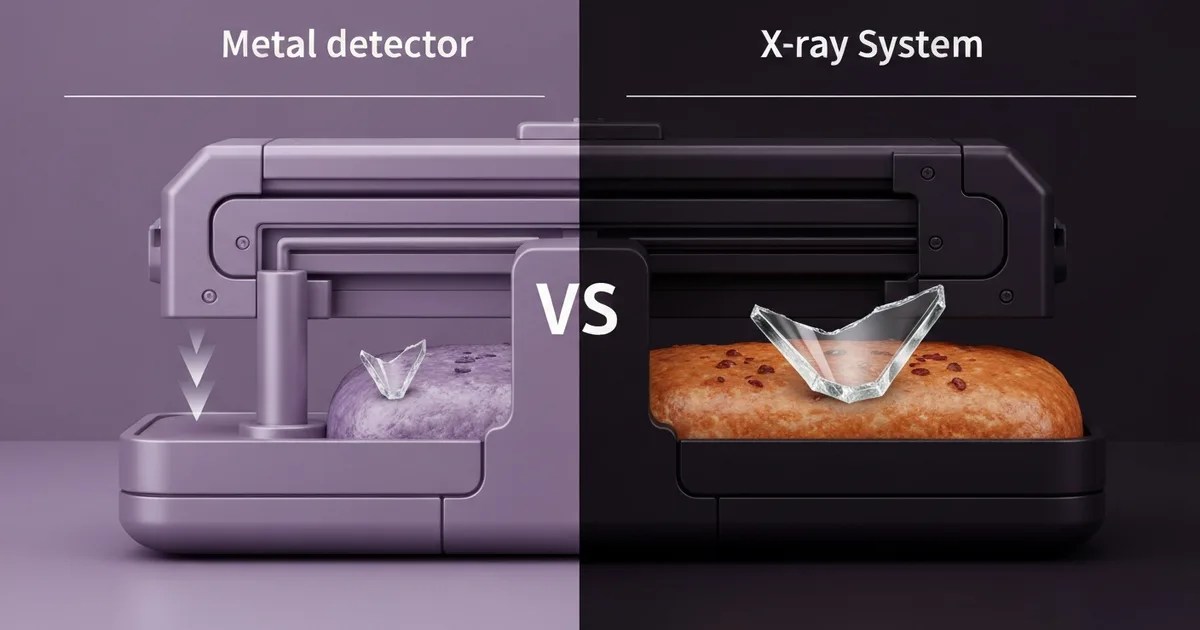
Metal detectors miss low-density contaminants in food processing because they operate on electromagnetic induction — a detection principle that is physically incapable of detecting non-conductive materials regardless of sensitivity settings, frequency optimization, or equipment cost. Glass, bone, stone, hard plastic, rubber, wood, and ceramic fragments generate no electromagnetic signal and are permanently invisible to metal detection technology. Understanding this fundamental limitation is essential for food manufacturers designing compliant HACCP physical hazard control programs.
How Metal Detectors Work — and Why It Creates Blind Spots
Metal detectors generate an oscillating electromagnetic field between transmitter coils. When an electrically conductive material passes through this field, it disrupts the field pattern in a measurable way — the detector registers this disruption as a detection event and triggers a rejection response. The detection principle is entirely dependent on electrical conductivity: the foreign body must conduct electricity to be detectable. Materials that do not conduct electricity — glass, bone, stone, ceramic, most hard plastics, rubber, and wood — produce no electromagnetic disruption and pass through the detector completely undetected, regardless of their size, shape, or the sensitivity settings of the metal detector.
Metal detection sensitivity has no meaning for non-conductive contaminants. A metal detector set to its maximum sensitivity will detect a 0.3mm ferrous metal sphere and simultaneously miss a 30mm glass shard. These are not sensitivity failures — they are the physical boundaries of electromagnetic induction detection. No engineering improvement to metal detector sensitivity will enable detection of glass, bone, or stone.
Contaminant Detectability by Technology
| Contaminant Material | Electrically Conductive? | Metal Detector | X-Ray Inspection |
|---|---|---|---|
| Ferrous metal (iron, steel) | Yes | Excellent | Excellent |
| Stainless steel (304, 316) | Weakly | Limited — product effect | Reliable |
| Aluminum | Yes | Detectable | Excellent |
| Glass (all types) | No | Not detected — ever | Detected by density |
| Bone fragments | No | Not detected — ever | 1-2mm capability |
| Stone / mineral | No | Not detected — ever | Detected by density |
| Hard plastic (nylon, delrin) | No | Not detected — ever | Detected if density sufficient |
| Rubber (gaskets, seals) | No | Not detected — ever | Limited — low density |
| Wood | No | Not detected — ever | Limited — low density |
The Product Effect Problem: Why Metal Detectors Also Miss Some Metals
Beyond non-conductive contaminants, metal detectors also struggle with stainless steel contamination in high-moisture food products due to the product effect phenomenon. High-moisture products — fresh meat, seafood, poultry, dairy, produce, and brined or marinated products — conduct electricity because of their water and salt content. This conductivity generates a background electromagnetic signal that partially overlaps with the signal profile of stainless steel contaminants. To prevent excessive false rejects from product signal, the detector must be tuned to reduce sensitivity in the frequency range where product signal is strongest — which is the same frequency range where stainless steel is detected. The practical result is that metal detectors on high-moisture food lines achieve stainless steel sensitivity that is 30 to 50 percent lower than their nominal specification. For a detector nominally sensitive to 2mm stainless steel spheres, product effect may reduce actual achieved sensitivity to 3.5 to 4mm under production conditions.
Recall Data: What Metal Detectors Are Missing
The HACCP Implication: Technology Must Match Identified Hazards
FDA FSMA Preventive Controls regulations and GFSI-recognized HACCP standards require that physical hazard control measures be capable of detecting the hazards identified in the food safety plan. A food manufacturer producing bone-in poultry that operates a metal detection CCP without acknowledging that metal detection cannot detect bone has a documented non-conformance: the identified physical hazard (bone) is not controlled by the selected CCP technology. FDA investigators who identify this gap during an inspection can cite it as a failure of the hazard analysis — not just a technical limitation. The practical consequence is that metal detector use must be evaluated against the specific physical hazards identified for each product, and where those hazards include glass, bone, stone, or non-conductive plastics, X-ray inspection must be specified as the CCP technology.
When Metal Detection Is Sufficient — and When It Is Not
| Application | Metal Detection Adequate? | Reason |
|---|---|---|
| Dry bakery / confectionery (low moisture) | Often adequate | Primary risk is metallic equipment debris; no bone/glass risk |
| Bone-in poultry processing | Not adequate | Primary hazard (bone) not detectable by metal detection |
| Fish fillet processing | Not adequate | Bone not detectable; high moisture reduces SS sensitivity |
| Glass jar filling (sauces, condiments) | Not adequate | Glass-on-glass contamination risk not detectable |
| Foil / metalized pouch filling | Not adequate | Packaging material prevents metal detection entirely |
| Produce and fresh vegetables | Not adequate | Stone/soil contamination; high moisture product effect |
| Dry bulk grain / flour milling | Partially adequate | Metal detection for metallic debris; X-ray adds stone detection |
X-Ray Inspection: How It Detects What Metal Detectors Cannot
X-ray inspection operates on a fundamentally different physical principle: X-ray attenuation by mass density. X-rays passing through a food product are partially absorbed based on the density of the material they encounter. Dense foreign bodies — glass, bone, stone, metal, and some plastics — absorb more X-ray energy than surrounding product tissue and appear as darker regions in the resulting density image. The detection algorithm identifies these density anomalies and triggers rejection. Because the detection mechanism is mass density rather than electrical conductivity, X-ray inspection detects any foreign body that is sufficiently denser than the surrounding product — regardless of whether it is electrically conductive.
Related Food Inspection Resources
- Food Manufacturing X-Ray Inspection Hub
- Packaged Goods X-Ray Inspection for CPG
- Seafood Inspection Systems
- Poultry and Meat X-Ray Inspection
- Why Food Inspection Systems Fail
- FDA FSMA Preventive Controls Guidance
Is Metal detectors miss low-density contaminants the Right Approach for Your Operation?
Metal detectors miss low-density contaminants from 2M Technology is appropriate when standard security measures cannot address the scale, throughput, or detection requirements of the operation. 2M Technology engineers metal detectors miss low-density contaminants solutions that are calibrated to your specific site, threat profile, and operational workflow — not generic off-the-shelf configurations.
The core advantage of metal detectors miss low-density contaminants from 2M Technology is open architecture and interoperability. Every component integrates with existing credentialing, video management, and access control platforms already in use — there is no proprietary lock-in and no requirement to replace functioning systems.
Key Questions When Evaluating Metal detectors miss low-density contaminants Options
- Does the metal detectors miss low-density contaminants solution deploy without permanent structural changes?
- Can the metal detectors miss low-density contaminants system scale incrementally as operational requirements grow?
- Is the solution cloud-connected for remote oversight and event review?
- Does the metal detectors miss low-density contaminants provider offer site assessment and ongoing support?
- Can the system integrate with your existing access control and VMS platforms?
Contact 2M Technology at (214) 988-4302 for a site-specific metal detectors miss low-density contaminants assessment.
Frequently Asked Questions: Metal Detector Limitations
Why can’t metal detectors detect glass contamination?
Metal detectors cannot detect glass because glass is not electrically conductive. Metal detection works by measuring disruptions to an electromagnetic field caused by conductive materials. Glass produces no electromagnetic disruption regardless of its size, shape, or the sensitivity settings of the detector. This is a fundamental physical limitation of the detection technology, not an engineering deficiency — no amount of sensitivity increase or frequency optimization will enable a metal detector to detect glass. X-ray inspection detects glass by density differentiation and is not subject to this limitation.
What is product effect and how does it reduce metal detector sensitivity?
Product effect occurs when food products contain moisture and dissolved salts that make the product itself electrically conductive. High-moisture foods including fresh meat, seafood, poultry, dairy, and brined products generate a background electromagnetic signal as they pass through the metal detector aperture. This background signal partially masks the signal from metal contaminants, requiring the detector to operate at reduced sensitivity to avoid excessive false rejects. The result is that stainless steel sensitivity is typically 30 to 50 percent lower under production conditions than under dry product or air-calibration conditions.
Does using a metal detector with X-ray provide complete contamination coverage?
Yes. For most food manufacturing applications, combining metal detection with X-ray inspection provides comprehensive physical contaminant coverage. However, for products where product effect significantly degrades metal detector performance — fresh meat, seafood, high-moisture produce — a well-configured X-ray system alone provides superior coverage for both metallic and non-metallic contaminants. Many facilities transition from metal-detection-only to X-ray-only inspection when the product effect limitation is identified as a significant gap in their hazard analysis.
Evaluate Whether Your Inspection Technology Matches Your Hazard Profile
2M Technology engineers review your HACCP physical hazard analysis against your current inspection technology — and identify gaps where metal detection is insufficient for the identified contaminant risks.
Request Hazard Analysis Review