
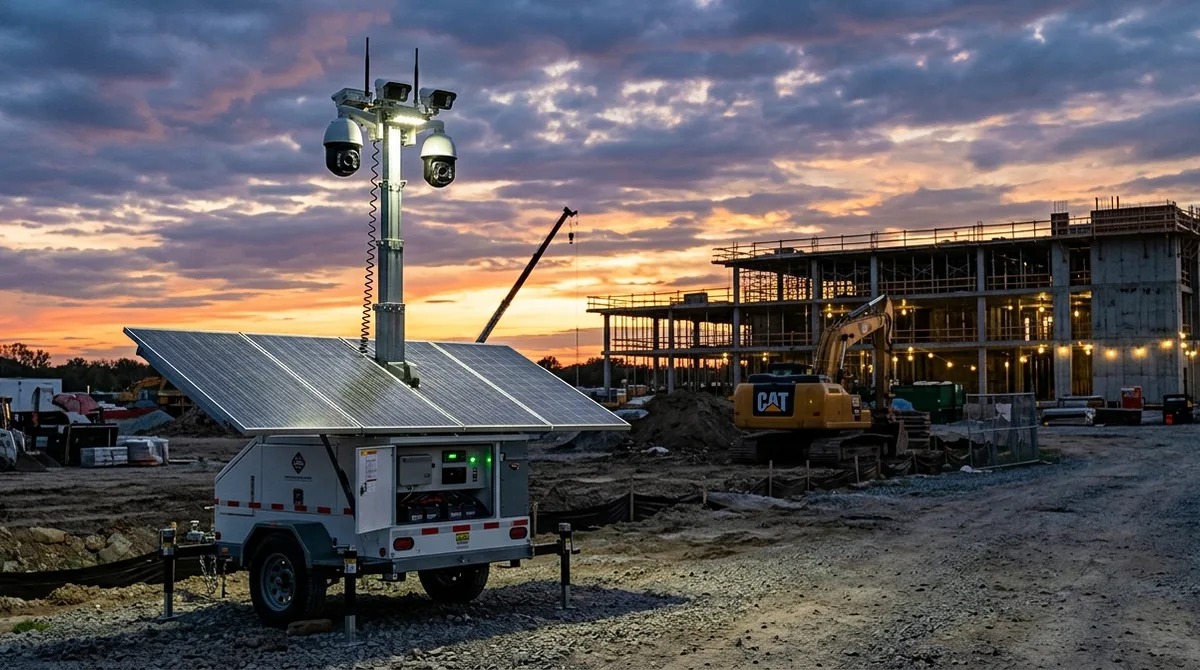
Pro-Vigil sells remote video monitoring as a service: cameras (often on mobile surveillance units) watched by an offsite monitoring center, billed as a monthly subscription. Buyers researching Pro-Vigil alternatives usually have one of three concerns — the recurring contract cost, response quality from the monitoring center, or whether they’d rather own the equipment outright instead of renting a service. This guide compares the serious alternatives in both categories: competing monitoring services, and the buy-once ownership route.
Why Buyers Look for Pro-Vigil Alternatives
Remote monitoring exists because construction and industrial sites lose real money to theft — the National Insurance Crime Bureau has put annual U.S. construction equipment theft near $1 billion, with recovery rates commonly cited below 25%. The question is not whether to protect the site; it’s the cost model. Monitoring services bill every month for as long as the site exists; equipment you own is a one-time purchase that moves to the next project with you. Federal guidance on layered site protection is collected at CISA’s physical security resource hub.
The 5 Alternatives Compared
1. Own the Equipment: 2M Solar Surveillance Trailers
The structural alternative to any monitoring subscription: buy the surveillance unit instead of renting the service. 2M Technology’s solar surveillance trailers are self-powered mobile units — solar array, battery bank, PTZ and fixed cameras, LTE backhaul — that you own outright and redeploy from project to project. Alerts route to your own staff, a guard service, or any third-party monitoring center you choose, so the monitoring layer stays competitive instead of bundled. Over a multi-year horizon, one owned trailer typically costs less than a single year-plus of monitored-service billing on a comparable unit — and it still has resale value when the project ends. See which industries deploy them.
2. Deep Sentinel
Live-guard monitoring aimed at small commercial properties and residences: human guards watch AI-flagged events and intervene via two-way audio. Strong for storefronts and small lots; pricing is per-camera monthly, and the hardware is theirs, not yours.
3. Stealth Monitoring
One of the largest remote video monitoring providers in North America, focused on construction, multifamily, and auto dealerships — a direct Pro-Vigil peer; see our full Stealth Monitoring alternatives guide. Same cost model: installed or mobile cameras plus a monthly monitoring contract per site.
4. Elite Interactive Solutions
Monitoring-center service known for voice-down intervention and law-enforcement relationships, deployed mostly on fixed commercial properties in urban markets. Again subscription-billed — evaluate their verified-response claims for your city specifically.
5. LiveView Technologies (LVT)
The best-known mobile surveillance unit brand — solar trailer hardware plus a bundled software/monitoring subscription. LVT units are leased as a service rather than sold, which is exactly the model ownership buyers are trying to escape; we compare the trade-offs in detail in our LVT alternatives guide.
Side-by-Side Comparison
| Option | Model | Best For | Cost Structure | You own the hardware? |
|---|---|---|---|---|
| 2M solar surveillance trailer | Equipment purchase | Construction, laydown yards, events, multi-site contractors | One-time purchase; monitoring optional & unbundled | Yes |
| Pro-Vigil | Monitored service | Construction, dealerships | Monthly per site | No |
| Deep Sentinel | Live-guard service | Small commercial, residential | Monthly per camera | No |
| Stealth Monitoring | Monitored service | Large commercial portfolios | Monthly per site | No |
| Elite Interactive | Monitored service | Urban fixed commercial | Monthly per site | No |
| LVT | Leased unit + service | Enterprise multi-site | Lease + subscription | No |
Service vs. Ownership: The 3-Year Math
Monitored-service pricing for a construction site commonly lands in the four figures per month once the mobile unit, monitoring hours, and response coverage are bundled. Across a 3-year build that is a five-figure to six-figure operating expense with nothing owned at the end. An owned solar trailer is a capital purchase in the low-to-mid five figures that serves that project and every one after it — and if your insurer or GC requires third-party monitoring, you can still contract just that layer competitively, because the hardware isn’t locked to one vendor. Sites with staffed gates can pair a trailer with container-based turnstile entry control to cover both theft and workforce access in one checkpoint.
Pro-Vigil Alternatives FAQ
-
What is the main difference between Pro-Vigil and buying a surveillance trailer?
Pro-Vigil is a service: their unit, their monitoring center, your monthly bill for the life of the site. Buying a trailer means you own the cameras and power system outright, choose (or skip) a monitoring provider, and redeploy the unit to the next project instead of restarting a contract.
-
Is remote video monitoring worth the monthly cost?
For unstaffed sites with high-value equipment, some monitoring layer usually pays for itself against NICB-scale theft losses. The real question is whether the monitoring must be bundled with rented hardware — unbundling the two almost always lowers the multi-year total.
-
Who are Pro-Vigil’s biggest direct competitors?
Stealth Monitoring is the closest like-for-like peer for construction and dealership sites; Elite Interactive competes on fixed urban properties; Deep Sentinel plays at the small-business end; LVT competes on the mobile-unit side with a leased-hardware model.
-
Does 2M Technology offer monitoring contracts?
2M sells the surveillance equipment — trailers, cameras, and the network behind them — and configures alerts to route wherever you want: your superintendent’s phone, your guard company, or an independent monitoring center. You keep the monitoring layer competitive instead of locked in.
-
What does a solar surveillance trailer cost compared to a monitoring subscription?
An owned unit is a one-time purchase typically in the low-to-mid five figures depending on camera payload and power configuration; monitored-service contracts commonly total more than that every 12–24 months per site. Over three years the ownership route usually wins decisively — and the asset keeps working after the contract would have ended.
-
Can a trailer really replace a monitoring service on an active construction site?
The trailer replaces the rented hardware; whether you also want live human monitoring is a separate decision. Many contractors run owned trailers with AI motion alerts to their own staff during a project’s early phases, then add third-party monitoring only for high-risk stretches — an option a bundled service contract doesn’t give you. Request a trailer quote to price your site.
Also worth comparing: 2M offers counter-drone detection trailers — an airspace security layer beyond standard camera monitoring.

