Container Turnstiles for Construction Sites — The Complete 2026 Buyer’s Guide
Texas Security License B15309 | Jobsite Access Control | Container Turnstiles | Worker Entry Logs | Cameras | Nationwide Deployment
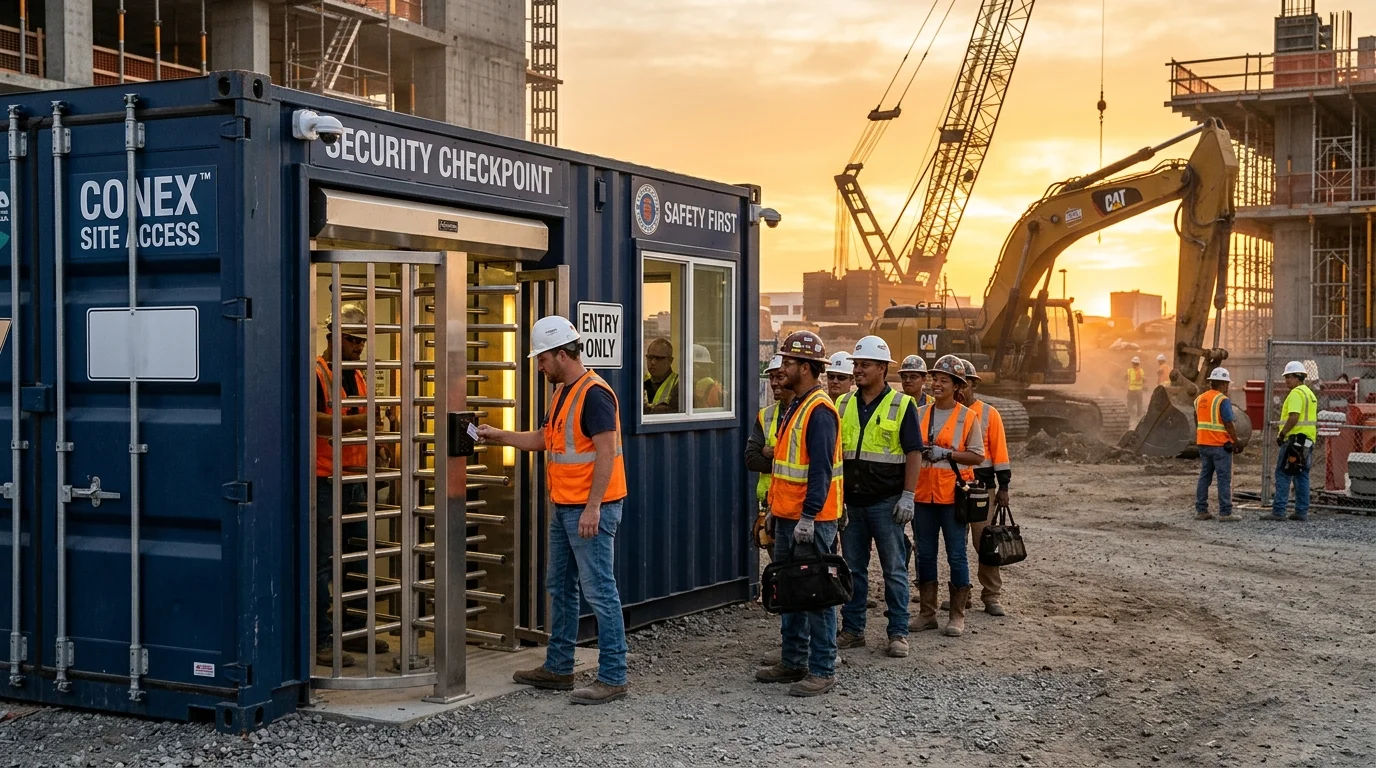
Construction sites face a specific security problem: you need professional access control for months or years, but the job site moves when the project ends. Permanent card readers and gates require expensive rough-in work that gets torn out the moment you break ground on your next contract. Container turnstiles solve this by housing a fully functional access control system inside a portable CONEX box — deploy it today, relocate it tomorrow.
What Is a Container Turnstile for a Construction Site?
A construction site container turnstile is a security turnstile permanently installed inside a shipping container (typically a 20-ft or 40-ft ISO CONEX box). The container becomes a portable guard shack, badging station, and access control checkpoint all in one.
The complete system includes the turnstile mechanism, a card reader or biometric reader, an access controller, a UPS battery backup, internal lighting, HVAC for electronics protection, and a network switch for cloud management. All wiring is pre-run inside the container before delivery — the only field connection is a single power drop.
Tripod Turnstile vs. Full-Height Turnstile — Which Is Right for Your Site?
The two most common configurations for construction environments are:
- Tripod (waist-high) turnstile: Controls pedestrian flow with minimal footprint. Best for sites with a permanent security guard at the kiosk window. Lower cost per lane.
- Full-height (7-foot) turnstile: Physically prevents unauthorized entry without a guard present. Best for unstaffed early-morning or night-shift access points where tailgating is a real threat.
Single-Lane vs. Multi-Lane Container Configurations
A 20-ft container typically fits one to two turnstile lanes. A 40-ft container can house three to four lanes plus a handicap-accessible swing gate and an ADA-compliant bypass lane. Multi-lane containers are ideal for large GC projects with 200+ workers on site simultaneously — they prevent morning entry queues that push shift-start costs into overtime.
5 Problems Container Turnstiles Solve on Construction Sites
1. Unauthorized Entry and Equipment Theft
Tool theft alone costs the U.S. construction industry over $1 billion annually. Container turnstiles restrict site access to badged personnel only, eliminating the risk of after-hours vehicle or pedestrian intrusion. Access logs provide an immediate audit trail if theft does occur, showing exactly which credentials were used and when.
2. Inaccurate Worker Headcounts and Safety Compliance
OSHA muster requirements and owner-mandated headcounts are manual nightmares when workers sign paper logs or wave at a gatehouse. A container turnstile records every entry and exit electronically, giving your safety team a real-time headcount for emergency evacuations and daily reports for OSHA compliance documentation.
3. Payroll Fraud and Buddy-Punching
A turnstile that requires a physical credential — or better, a biometric scan — eliminates buddy-punching at the source. Payroll hours pull directly from the access log rather than a paper timesheet, reducing reported hours discrepancies by 8-12% on average according to independent workforce management studies.
4. Subcontractor and Vendor Credentialing
Most GC projects have dozens of subs and vendors on site simultaneously. Container turnstile systems support separate access levels per company, per shift, and per zone. A concrete sub may have site access Monday through Friday, 6am to 6pm, while an electrical inspector gets a one-day temporary credential. All credentials are managed from a single cloud dashboard — no physical keys to track.
5. Lack of Permanent Power and Infrastructure
Early-phase construction sites often lack permanent electrical panels. Container turnstiles connect to a standard 30-amp or 50-amp temporary power feed — the same type used for job site trailers. Battery backup inside the container keeps the turnstile operational during power interruptions for up to 8 hours.
Construction Site Container Turnstile: Feature Comparison
| Feature | Basic Tripod Container | Full-Height Container | Multi-Lane 40-ft Container |
|---|---|---|---|
| Turnstile Type | Waist-high tripod | 7-ft full-height | Mix of lanes + swing gate |
| Lanes | 1-2 | 1-2 | 3-4 + ADA bypass |
| Best For | Staffed entry points | Unstaffed nights/weekends | 200+ worker sites |
| Credential Options | RFID, PIN | RFID, Biometric, PIN | RFID, Biometric, Mobile |
| Climate Control | Filtered vent | HVAC unit | Full HVAC + insulation |
| Relocation | Forklift or crane | Crane recommended | Flatbed + crane |
| Deployment Time | 2-3 hours | 3-4 hours | 4-6 hours |
| Cloud Management | Yes | Yes | Yes |
Deployment Timeline: From Order to First Badge Swipe
| Phase | Activity | Duration |
|---|---|---|
| Site survey | 2M Technology reviews site plan, entry count, worker headcount, power availability | 1-2 days |
| Configuration | Turnstile type selected, access levels programmed, credential type confirmed | 2-3 days |
| Build & test | Container turnstile assembled, wired, tested, and sealed for transport | 5-7 days |
| Delivery & setup | Container delivered to site, positioned, powered, and commissioned | 1 day |
| Credential issuance | All workers badged and enrolled (or biometric enrolled) | 2-4 hours onsite |
| Total lead time | 10-14 business days |
Why 2M Technology for Construction Site Container Turnstiles
2M Technology is a Dallas-based security integrator serving construction GCs, industrial contractors, and project owners across Texas and the Gulf Coast. We are not a rental-only company — we design, build, program, and service every container turnstile system we deliver. That means one point of contact from site survey through project closeout.
- In-house fabrication: We build the containers in our Grand Prairie shop, not outsourced — so customizations are faster and cheaper.
- Same-state logistics: No freight delays from an out-of-state manufacturer. Texas sites get faster delivery.
- Multi-site contracts: GCs with multiple active job sites can set up a master access control account and manage all sites from a single dashboard.
- Integration-ready: Container turnstiles can pair with our solar surveillance trailers, IP camera systems, and alarm monitoring for a complete site security package.
Frequently Asked Questions — Container Turnstiles for Construction Sites
Below are the questions project managers and safety directors ask most often before committing to a container turnstile system.
How quickly can a container turnstile be deployed at a construction site?
Our container turnstiles arrive fully pre-wired and pre-tested inside a CONEX box. Setup on a leveled pad typically takes 2-4 hours, including power connection and credential programming. Same-day commissioning is standard on most projects.
What credentials can construction workers use to enter a container turnstile?
Container turnstiles support RFID badges, proximity cards, mobile credentials via Bluetooth, PIN codes, and biometric readers (fingerprint or facial recognition). We match the credential type to your site’s security level and workforce size.
Can the turnstile track worker hours and attendance automatically?
Yes. Every entry and exit is timestamped in the access control log. Reports can be exported daily or synced with payroll software to eliminate manual timekeeping and prevent buddy-punching.
What happens to the container turnstile when the project ends?
Because the entire system is housed in a CONEX box, it can be locked, picked up by crane or forklift, and transported to your next job site. There is no permanent infrastructure to demolish — just relocate and redeploy.
Does the container protect the electronics from Texas heat and dust?
Yes. The steel CONEX enclosure combined with HVAC and dust filtration maintains safe operating temperatures even in Texas summer heat. All electronics are rated for outdoor industrial environments.
Can the system integrate with existing cameras or alarm systems on the job site?
Container turnstiles can be integrated with IP cameras, solar surveillance trailers, alarm panels, and visitor management software. 2M Technology installs the full integrated package or connects to existing infrastructure.
Need Container Turnstiles for Construction Sites?
- Texas Private Security License B15309
- (214) 988-4302
- sales@2mtechnology.net