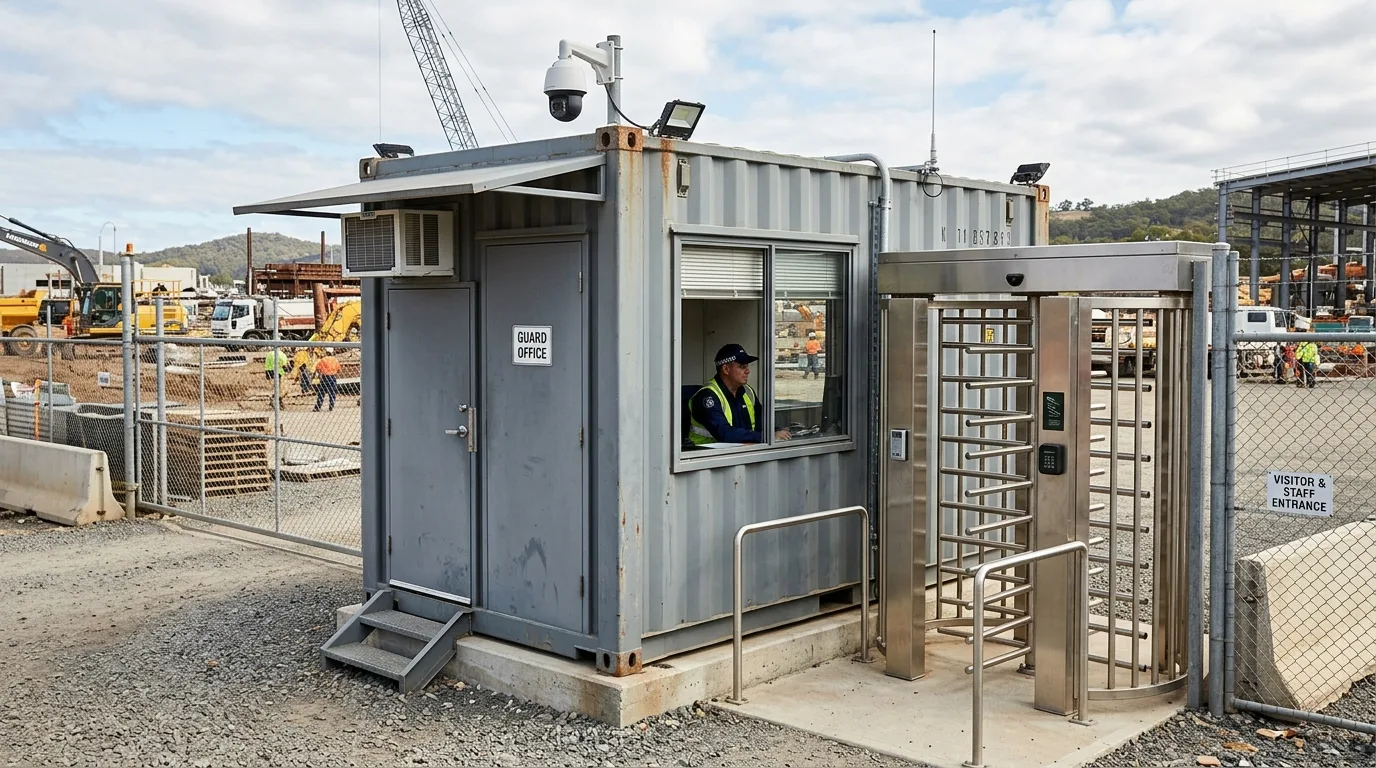
A guard booth is the small structure at a site entrance where security personnel check credentials, log visitors, and control who gets in — sold under a half-dozen names: guard shack, guard house, security booth, gatehouse. Most are prefab steel or fiberglass shells that arrive empty. 2M Technology builds them differently: inside steel CONEX shipping containers, with the access control already installed — turnstile lanes, badge and biometric readers, cameras, HVAC, and power — fabricated at our Grand Prairie, TX facility and working within hours of delivery.
Guard Booth vs. Guard Shack vs. Guard House: What Buyers Actually Mean
The terms are used interchangeably, but they usually signal size and permanence. A guard shack typically means a small single-guard shelter at a gate. A guard booth or security booth is the same idea, often prefabricated and craned into place. A guard house or gatehouse implies something larger — room for multiple officers, monitoring equipment, sometimes restrooms. Whatever the label, every buyer is solving the same problem: putting a weather-protected security presence at an entrance, with some way to control who passes.
That last part — controlling who passes — is where most prefab booths fall short. The booth shelters the guard; the actual access control (gates, turnstiles, readers) is a separate project with separate vendors. A container-built unit collapses that into one delivery.
Prefab Guard Booth vs. Container-Built: Side-by-Side
| Factor | Traditional Prefab Booth (steel/fiberglass shell) | 2M Container-Built Guard Booth |
|---|---|---|
| What arrives on site | An empty shelter — access control is a separate purchase and install | Structure + turnstile lanes + badge/biometric readers + cameras, pre-wired and tested |
| Structure | Panel construction, craned onto a pad | Corten-steel CONEX container — forklift/tilt-bed relocatable, jobsite-tough |
| Personnel flow control | Guard checks people manually, or you add gates later | Full-height or tripod turnstile lanes built into the unit |
| Climate & power | HVAC and electrical often optional add-ons | HVAC, lighting, and power distribution included; solar + battery available for off-grid sites |
| Relocation | Possible but fragile; panels loosen with moves | Designed for it — same container moves site to site for years |
| Best fit | Permanent single-guard posts with existing gate infrastructure | Construction gates, industrial perimeters, events, any site needing guard + screening in one unit |
Configurations: 20-Foot and 40-Foot Units
2M builds guard booths in 20-foot and 40-foot CONEX configurations. The 20-foot unit handles a typical single-gate deployment: guard workspace plus one or two turnstile lanes. The 40-foot configuration adds room for multiple lanes, a separate office or break room, equipment storage, or a monitoring station with camera walls. Every unit is configured to the site: lane count, reader types (badge, PIN, biometric, mobile credential), camera coverage, intercom, and lighting are specified before fabrication, so the unit arrives ready rather than as a shell awaiting trades.
On-site setup takes 2–4 hours from delivery to first badge swipe — the unit needs placement, power connection (or its solar array deployed), and network. No foundation pour, no framing inspection, no multi-week electrical rough-in.
Where Container Guard Booths Earn Their Keep
Construction gates. Job sites lose real money to theft — the National Equipment Register estimates $300 million to $1 billion in equipment stolen from U.S. job sites annually, with under a quarter ever recovered. A guard booth with built-in construction site turnstiles gives the gate both a human presence and a hard record of every worker who badged in — and moves to the next project when this one ends.
Refineries, plants, and utility perimeters. Industrial sites use container guard booths as permanent-duty gate infrastructure — contractor badging during turnarounds, 24/7 workforce entry, integration with existing plant access control. Our industrial container turnstile configurations cover the hazardous-area and high-headcount variants.
Events and venues. A staffed booth plus ticket-scanning turnstile lanes, deployed for the season or the weekend, then hauled away — see event container turnstiles for the ticketing-integration side.
Warehouses and distribution yards. Driver check-in, employee entry at shift change, and after-hours perimeter control from one gate structure, per OSHA’s general jobsite security expectations under 29 CFR 1926 site-control provisions.
Need Full Screening Instead of a Guard Post?
A guard booth controls who enters. If you also need to control what enters — X-ray baggage screening, walk-through metal detection, divestiture tables — that’s a security checkpoint, a bigger build we handle as a separate product line: see custom container security checkpoints. And if you only need the turnstile lanes without the staffed booth, our custom container turnstiles are the lighter-weight answer. Not sure which fits? The container configurator walks through it, or request a quote with your gate layout.
Guard Booth FAQs
-
How much does a container guard booth cost?
Pricing is quote-based by configuration — container size, turnstile lane count, reader types, camera package, and HVAC/power options move the number meaningfully. A configured 20-foot unit with integrated access control typically lands well below the combined cost of a prefab booth plus separately-contracted gates, readers, and electrical work. Request a quote with your site details for a firm number.
-
What’s the difference between a guard booth and a guard shack?
Mostly vocabulary — both mean a small structure sheltering security staff at an entrance. “Shack” tends to imply a basic single-guard shelter; “booth” often means a prefabricated unit. 2M’s container-built units cover both roles, with the difference that access control hardware is integrated rather than added later.
-
Can a guard booth run off-grid?
Yes. Solar panel arrays with battery backup are available for remote sites — the same off-grid power approach we use on remote industrial deployments, sized to the unit’s HVAC, lighting, turnstile, and camera load.
-
How fast can one be deployed?
Fabrication lead time depends on configuration; once delivered, on-site setup runs 2–4 hours from truck to first badge swipe. There’s no civil construction — the unit places on compacted ground or an existing pad.
-
Can it integrate with our existing access control system?
Yes — reader hardware and software integration options are configured per site, so credentials your facility already issues (badges, biometrics, mobile) can work at the booth rather than forcing a parallel system.
-
Is it actually relocatable, or relocatable in theory?
Genuinely relocatable — it’s a CONEX container, engineered to be lifted, trucked, and stacked. Contractors move the same unit project to project; the structure tolerates moves that would work a panel-built booth loose in a season.
Related Project
See how we built and delivered a containerized access control unit for an energy site: Case Study: 10-ft Container Turnstile Checkpoint (Louisiana Energy Site).
BUILT IN TEXAS
Container guard booths are fabricated at 2M Technology’s Grand Prairie, TX facility (Texas Security License B15309) and ship nationwide. Same-day site assessments available across Dallas–Fort Worth.