|
✍ By 2M Technology Engineering Team
|
Screening Infrastructure Engineering Center
Healthcare Facility Security Screening Systems
Weapons detection, visitor screening, and access control for hospitals, emergency departments, psychiatric units, and outpatient clinics. 2M Technology engineers healthcare security systems that protect staff and patients while maintaining the therapeutic environment and care access that defines clinical facilities.
What is Healthcare Facility Security Screening?
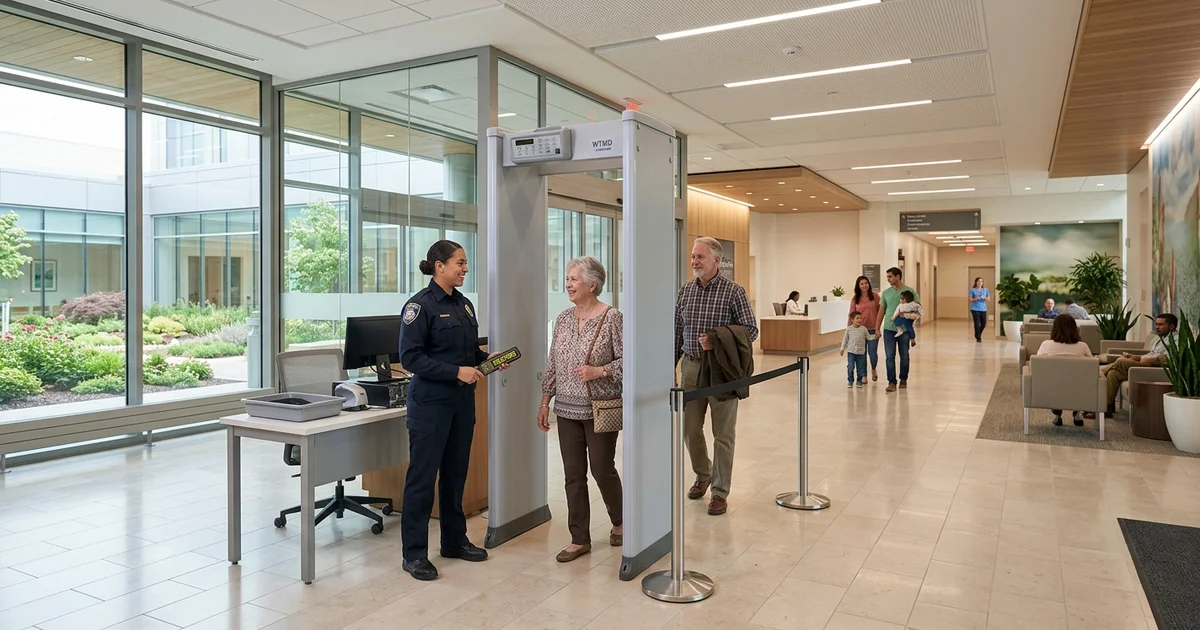
Healthcare facility security screening is the deployment of weapons detection systems, visitor management infrastructure, and access control at hospital entry points and high-risk clinical areas — including emergency departments, psychiatric units, and behavioral health facilities — to prevent the introduction of weapons and reduce workplace violence against healthcare workers and patients. Healthcare screening presents a fundamentally different design problem than institutional security: patients arrive in medical distress, visitors are often emotionally charged, medical equipment triggers standard screening systems, and the clinical environment requires de-escalation protocols that are incompatible with adversarial checkpoint interaction.
Of all workplace violence injuries in the U.S. occur in healthcare settings — emergency departments, psychiatric units, and inpatient facilities report the highest rates of any occupational category (Bureau of Labor Statistics)
Of emergency nurses report being physically assaulted at work (Emergency Nurses Association survey) — the ED is the highest-risk single department for healthcare security incidents
Healthcare facilities operate continuously without the defined entry windows that simplify checkpoint planning at schools and courthouses — security screening must function at 3 AM as effectively as at peak morning hours
Healthcare security systems must be designed to avoid HIPAA violations — visitor management, access logs, and security camera placement must account for patient privacy in clinical areas adjacent to screening checkpoints
Why Healthcare Security Screening Is Different
Healthcare facilities cannot operate security checkpoints the way courts, schools, or stadiums do. The patient population includes people in acute medical distress who cannot be delayed, and the visitor population is often emotionally volatile — managing a family member’s crisis. Standard checkpoint protocols consistently fail in this environment.
Medical Devices and Implants
A significant percentage of hospital visitors and all patients may have pacemakers, ICDs, cochlear implants, insulin pumps, or orthopedic hardware that triggers WTMD alarms. The protocol for handling medical device alarms must be clinical and respectful — not the adversarial secondary screening approach appropriate for security contexts. Staff must be trained to identify and accommodate medical devices without creating delays or humiliation.
Emergency and Trauma Access
Emergency department entry cannot be subject to standard checkpoint screening delays. A patient arriving in cardiac arrest, with a trauma injury, or in obstetric emergency cannot wait in a screening queue. ED security design must provide a bypass protocol for urgent clinical cases that simultaneously maintains weapons detection capability for non-emergent visitors arriving at the same entry point.
Psychiatric and Behavioral Health Units
Psychiatric unit access requires the most rigorous screening of any clinical area — patients and visitors must be screened for all weapons, sharps, ligature risks, and contraband. Security screening for behavioral health must be complete and consistent while being delivered by staff trained in trauma-informed, de-escalation communication rather than enforcement-oriented interaction.
Emotionally Elevated Visitor Population
Visitors arriving at a hospital are frequently in emotional crisis — a family member has been injured, is in surgery, or is dying. This population responds differently to security interactions than the general public. Screening staff must be trained in empathetic communication and de-escalation, and checkpoint design should minimize the transactional, security-focused feel of the interaction without compromising detection capability.
24-Hour Continuous Operation
Healthcare screening must operate continuously without the defined entry windows that allow checkpoint staffing to be concentrated at peak hours. A hospital receiving 200 visitors per hour during peak daytime and 20 visitors per hour at 3 AM cannot staff and operate identical checkpoint configurations around the clock. Screening systems must support both peak-staffed and reduced-staffing configurations without creating security gaps during overnight and weekend hours.
HIPAA Privacy Compliance
Security camera placement, visitor access logging, and checkpoint proximity to clinical areas must account for HIPAA patient privacy requirements. Cameras positioned at screening checkpoints must not capture patient clinical information visible through windows or open doors into treatment areas. Visitor access logs maintained for security purposes must be handled as protected health information when they contain patient association data.
Security Screening by Clinical Area
Different clinical areas within a hospital require distinct screening approaches. A single checkpoint design applied uniformly across all entry points consistently fails to serve either security or clinical objectives.
Emergency Department
The ED is the highest-risk clinical area for weapons incidents. Intoxicated, agitated, and psychiatric patients arrive without appointment, often with companions who may also be in crisis. ED security screening must provide rapid WTMD and X-ray screening for all non-urgent visitors while maintaining an unobstructed clinical bypass for EMS arrivals and acute patient transports. Separate ambulance bay access with camera monitoring and intercommunication is essential.
Psychiatric and Behavioral Health Units
Behavioral health unit access requires complete screening of all persons — patients transferring from other units, family visitors, and clinical staff carrying personal items. The search must detect not only weapons but sharps, ligature materials, and contraband. Equipment selection must support trauma-informed interaction, and security staff must receive behavioral health-specific training. Point-of-care access control must prevent elopement without creating a punitive environment.
Main Hospital Entry and Lobby
Main hospital lobby screening serves the highest daily visitor volume with the most diverse population — patients arriving for scheduled appointments, family visitors, vendors, and delivery personnel. Checkpoint design must handle peak morning and visiting-hour volumes, accommodate mobility aids and medical equipment, and integrate with visitor management systems that issue time-limited access credentials. Staffing models must account for peak hours without abandoning security during overnight operations.
Outpatient Centers and Medical Offices
Outpatient and clinic-level facilities typically present lower security risk than inpatient hospitals but are increasingly deploying WTMD screening following incidents at medical office buildings and specialty clinics. Checkpoint design for outpatient settings often uses a single WTMD lane with a bag X-ray at the reception entry, integrated with visitor check-in rather than positioned as a separate security checkpoint.
Healthcare Screening Throughput Reference
| Facility Type | Peak Hourly Volume | Recommended Config | Installed Cost Range |
|---|---|---|---|
| Community Hospital (under 200 beds) | 50-150 visitors/hr peak | 1-2 WTMD + 1 X-ray | $45,000-$90,000 |
| Regional Hospital (200-500 beds) | 150-400 visitors/hr peak | 2-4 WTMD + 2 X-ray | $90,000-$180,000 |
| Large Medical Center (500+ beds) | 400-1,000 visitors/hr peak | 4-8 WTMD + 3-4 X-ray + multi-entry | $180,000-$420,000 |
| Psychiatric Unit (dedicated access) | Variable controlled access | 1-2 WTMD + X-ray + mantrap | $65,000-$130,000 |
| Emergency Department Entry | 24/7 variable | WTMD + X-ray + clinical bypass + camera | $55,000-$120,000 |
How to Design a Healthcare Security Checkpoint
Related Screening Resources
Frequently Asked Questions: Healthcare Security Screening
Design Your Healthcare Security System
2M Technology engineers hospital security screening systems that protect staff and patients while remaining compatible with clinical operations. Emergency department design, psychiatric unit access control, and 24-hour operational planning across Texas and nationwide.
(214) 988-4302 | sales@2mtechnology.net