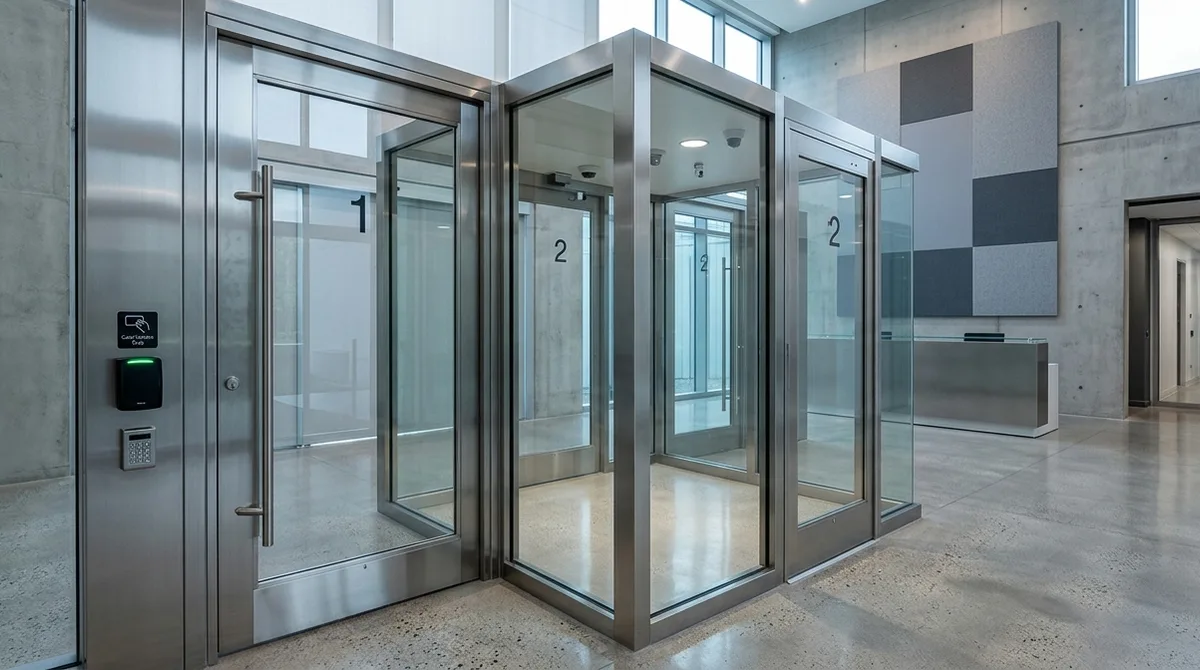
A security vestibule is a two-door entry chamber where the outer door must close and lock before the inner door releases — so no one passes directly from the street into the protected space. When the interlock is enforced for one person at a time with credential checks or screening inside the chamber, the same structure is called a mantrap. Banks, data centers, courthouses, and pharmaceutical facilities use them to kill the two attacks ordinary doors can’t stop: tailgating and forced rush-through. This guide covers how the interlock logic works, what the codes require, and the build options — including the container-built version 2M manufactures.
Vestibule vs. Mantrap: The Interlock Logic
| Configuration | Interlock rule | Throughput | Typical use |
|---|---|---|---|
| Security vestibule | Both doors never open simultaneously | Groups allowed; flow-controlled | School front offices, lobby weather + security control |
| Mantrap (single-person) | One person per cycle; credential or verification inside | 4–10 people/min | Data centers, cash rooms, evidence storage |
| Screening mantrap | Inner door releases only after detection screening passes | 3–6 people/min | Courthouses, corrections, high-threat lobbies |
| Bi-directional sally port | Vehicle or group-scale interlock chamber | Per-vehicle cycle | Jails, cash-in-transit docks, secure loading |
What the Codes Require
The non-negotiable constraint is emergency egress: NFPA 101, the Life Safety Code, requires that occupants can always exit — so every compliant mantrap fails safe outbound on fire alarm or power loss, typically via free-egress hardware on the inner face and alarm-released outer doors. Access control delays inbound, never outbound. ADA also applies: chamber depth must accommodate wheelchair turning, and at least one compliant leaf per direction. Local guidance for entry-hardening lives under CISA’s physical security resources. A mantrap that traps people during an emergency isn’t security — it’s liability; interlock release logic is where amateur installs fail inspection.
Three Ways to Build One
1. Built-in-place (renovation)
Framing a second doorline into an existing lobby: $15,000–$60,000+ depending on glazing rating, door hardware, and how much structure moves. Best when the lobby is already the right shape; worst when columns and egress paths force redesign.
2. Prefabricated booth vestibules
Factory-built glass/steel chambers craned into a lobby — faster, ballistic options available, but interior footprint and aesthetics constrain them.
3. Container-built (2M’s line)
A complete vestibule or screening mantrap built into a delivered container structure — doors, interlocks, access control, cameras, intercom, HVAC, and optionally walk-through detection pre-integrated before it arrives. Deployed as the entry point for plants, yards, events, and facilities that need a hardened entrance without construction. It’s the same platform as our container security checkpoints, configured for interlocked pedestrian entry. On site in hours, not months.
Design Decisions That Matter
Cycle rate vs. peak arrival: a single-person mantrap at 6/min cannot serve a 200-person shift change — count your worst 15 minutes first (the math mirrors lane counts in our security assessment template). Tailgate detection: overhead sensors or weight mats catch the second person the interlock alone can’t see. Glazing: UL 752 ballistic levels where the threat model demands it. Integration: the chamber should ride your existing access control, not a parallel system — one credential, one audit log.
Security Vestibule & Mantrap FAQ
What is the difference between a mantrap and a security vestibule?
Interlock strictness: a vestibule prevents both doors opening at once; a mantrap adds one-person-per-cycle enforcement with verification inside the chamber. Every mantrap is a vestibule; most vestibules are not mantraps.
Are mantraps legal? What about fire code?
Yes, when designed to NFPA 101: free egress outbound at all times, automatic release on fire alarm or power failure, ADA-compliant geometry. The interlock only ever restricts entry. Inspections fail on egress logic more than any other element.
How much does a security vestibule cost?
Renovation builds: $15,000–$60,000+. Prefab booths: $25,000–$80,000 depending on rating. Container-built units with integrated access control and screening: quoted per configuration — typically competitive with renovation once construction disruption is priced in, and redeployable.
How fast can a container-built mantrap be operational?
Fabrication runs in our Grand Prairie facility on a several-week cycle; on-site installation is typically a day — placement, power, network, and commissioning. That’s the core advantage over months of lobby construction.
Can screening equipment go inside the vestibule?
Yes — that’s the screening-mantrap configuration: walk-through detection inside the chamber, inner door gated on a clean pass. It concentrates screening staff at one hardened point instead of an open lobby.
Does 2M design these for existing buildings too?
Yes — 2M Technology (Texas Security License B15309) designs interlocked entries for both new container-built deployments and existing lobbies, integrating doors, access control, cameras, and screening as one system. Request a design consultation with your entry’s floor plan.