Texas Security License B15309 | Licensed, Insured & Bonded | Headquartered in Grand Prairie, TX | Free Site Assessment | (214) 988-4302
|
✍ By 2M Technology Engineering Team
|
Screening Infrastructure Engineering Center
Stadium and Event
Security Screening
Multi-gate checkpoint architecture for stadiums, arenas, amphitheaters, and large-scale event venues. 2M Technology engineers screening systems that move 20,000 to 80,000 attendees through gates in a 90-minute entry window — without the queue backups, missed detections, and staffing failures that define poorly designed event security.
What is Stadium and Event Security Screening?
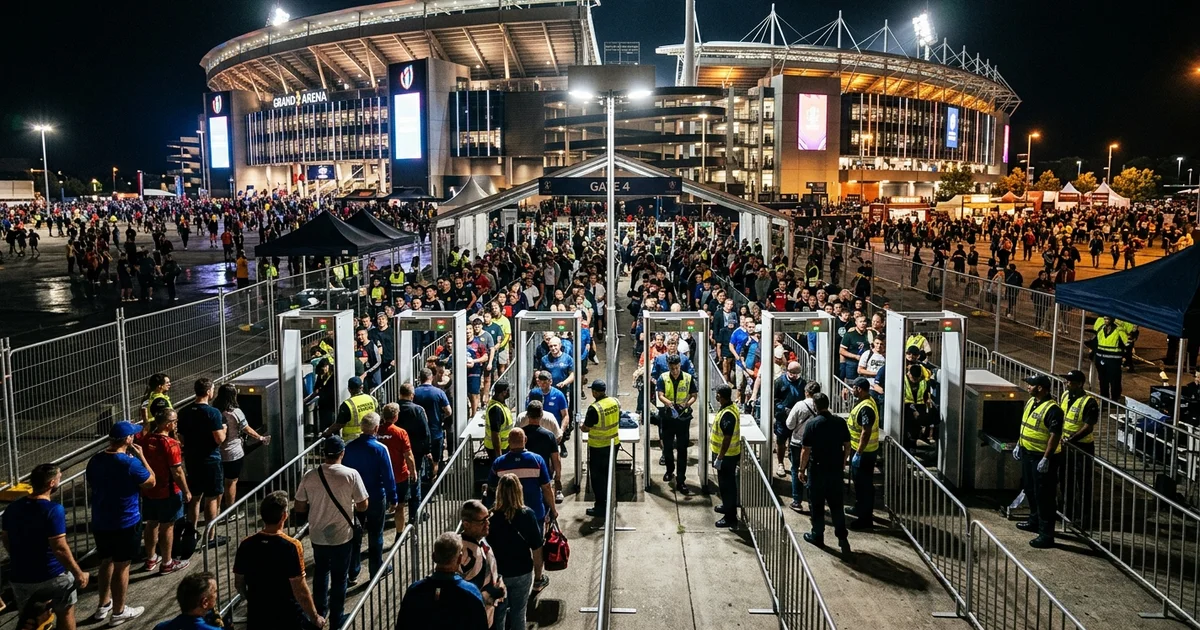
Stadium and event security screening is the deployment of multi-gate checkpoint systems at sports venues, concert arenas, amphitheaters, and large event spaces to screen tens of thousands of attendees for weapons and prohibited items within the compressed entry window before an event begins. Unlike institutional facilities with steady-state traffic, event venue screening must handle its entire daily load in 60-90 minutes, requiring parallel multi-lane architectures at each gate, distributed throughput planning across all active gates, and staffing models that account for both peak surge and rapid post-event demobilization. It represents the highest per-hour throughput demand in the security screening industry.
Typical pre-event entry window for major venue events — the window in which 80-90% of total attendance must clear security, creating peak throughput demands that dwarf any other facility type
Attendees per hour that a well-engineered multi-lane gate checkpoint can process — four WTMDs with two X-ray backup lanes and trained staffing running simultaneously
Throughput planning must be calculated at each individual gate based on that gate’s assigned seating section — not distributed evenly across all gates, which consistently underestimates peak loads at popular entries
DHS SAFETY Act designation and venue certification programs recommend or require structured screening at major public assembly venues — 2M Technology engineers systems that meet federal venue security guidelines
The Event Screening Engineering Problem
Event venue security screening is categorically different from institutional security. The variables that determine checkpoint success at a courthouse or school — steady-state throughput, moderate daily variance, known population — are absent at a stadium. Event venues face:
Uneven Gate Load Distribution
Attendees do not distribute evenly across all gates. Gates near parking structures, transit stops, and VIP entrances receive disproportionately high loads. A gate serving 30% of capacity needs three times the lane count of a gate serving 10% — and the distribution shifts by event type, day of week, and opponent or performer.
Late Arrival Compression
The arrival distribution for events is not uniform across the 90-minute window. 40-60% of attendees typically arrive in the final 20 minutes before kickoff or showtime. This creates a late-arrival surge that is 3-5 times the average arrival rate and must be absorbed by the checkpoint system without queue formation extending onto public streets.
Clear-Bag Policy Throughput Impact
Clear-bag policies, now standard at most major venues, reduce X-ray inspection time but increase WTMD throughput demand. With fewer opaque bags requiring X-ray, the screening bottleneck shifts to the WTMD line — requiring more WTMD lanes relative to X-ray lanes than traditional checkpoint ratios assume.
Seasonal and Weather Variance
Outdoor venues operate year-round in weather that directly affects screening throughput — cold weather means heavier coats with more WTMD alarms and longer secondary inspection, rain creates umbrella and poncho complications, and extreme heat creates health risks for personnel and attendees waiting in outdoor queues.
Staffing Scale and Training Quality
A 50,000-seat stadium requires 300-500 screening personnel per event. The majority are event-day contract workers with minimal training. Checkpoint design must account for staff skill variance by simplifying workflows, using equipment with intuitive alarm resolution, and positioning supervisors for rapid intervention at high-volume lanes.
VIP and Premium Separate Streams
Premium ticket holders, suite guests, and club members expect a screening experience that matches their venue experience. Dedicated VIP checkpoint lanes with faster processing, covered staging, and higher staff-to-attendee ratios must be engineered separately from the general admission checkpoint system.
Multi-Gate Checkpoint Architecture
Stadium security is not a single checkpoint problem — it is a distributed throughput engineering problem. Each gate is an independent checkpoint system that must be designed for its specific load, not a fraction of the venue total.
Each gate is sized based on its assigned seating load and expected arrival distribution. High-load gates near transit need 6-10 WTMD lanes. Low-load service gates may need only 2-3.
Standard ratio for clear-bag venues: 4-6 WTMD lanes per 1 X-ray lane. Traditional bag venues: 2-3 WTMD per X-ray. ADA lane: 1 per gate minimum with 60-inch clear width.
Minimum 50-foot outdoor queue depth per lane with defined barrier channeling. Queue must not extend onto public rights-of-way. Covered staging for outdoor venues in extreme weather markets.
Gate supervisor must have sightlines to all lanes simultaneously. Camera monitoring of each lane feeds to gate command and central operations. Real-time queue depth reporting enables staffing rebalancing during peak arrival.
Event Venue Checkpoint Throughput Reference
Lane count per gate for standard event screening. Assumes clear-bag or limited-bag policy, trained contract staff, and 90-minute entry window with 50% of attendance arriving in the final 30 minutes.
| Venue Capacity | Active Gates | WTMD per High-Load Gate | X-Ray per Gate | Screening Staff (event) |
|---|---|---|---|---|
| 5,000-15,000 | 4-6 gates | 2-4 WTMD | 1 X-ray | 40-80 staff |
| 15,000-30,000 | 6-10 gates | 4-6 WTMD | 1-2 X-ray | 120-200 staff |
| 30,000-50,000 | 8-14 gates | 6-8 WTMD | 2-3 X-ray | 200-350 staff |
| 50,000-80,000+ | 12-20 gates | 8-12 WTMD | 2-4 X-ray | 350-600 staff |
| Festival / Outdoor (variable) | Perimeter zones | Mobile WTMD arrays | Mobile X-ray | Per-zone staffing model |
How to Design Stadium Event Security Screening
Event Venue Screening Cost Reference
| Venue Type | Configuration | Installed System Cost |
|---|---|---|
| Arena (5,000-15,000) | 4-6 gates, 2-4 WTMD per gate, 1 X-ray per gate | $180,000 – $320,000 |
| Mid-Size Stadium (15,000-35,000) | 8-12 gates, 4-6 WTMD per gate, 1-2 X-ray per gate | $380,000 – $650,000 |
| Large Stadium (35,000-65,000) | 12-18 gates, 6-10 WTMD per gate, 2-3 X-ray per gate | $650,000 – $1.4M |
| Festival / Outdoor Venue | Mobile WTMD arrays + mobile X-ray per zone | Per-event rental or custom scope |
Related Screening Resources
Frequently Asked Questions: Stadium and Event Security Screening
Design Your Event Venue Security System
2M Technology engineers multi-gate checkpoint systems for stadiums, arenas, amphitheaters, and outdoor festivals. Gate-level throughput analysis, mobile augmentation, and full event-day support across Texas and nationwide.
(214) 988-4302 | sales@2mtechnology.net
For expert stadium security screening design and installation, 2M Technology provides turnkey solutions from site assessment through commissioning. Call (214) 988-4302 or request a free site assessment.