
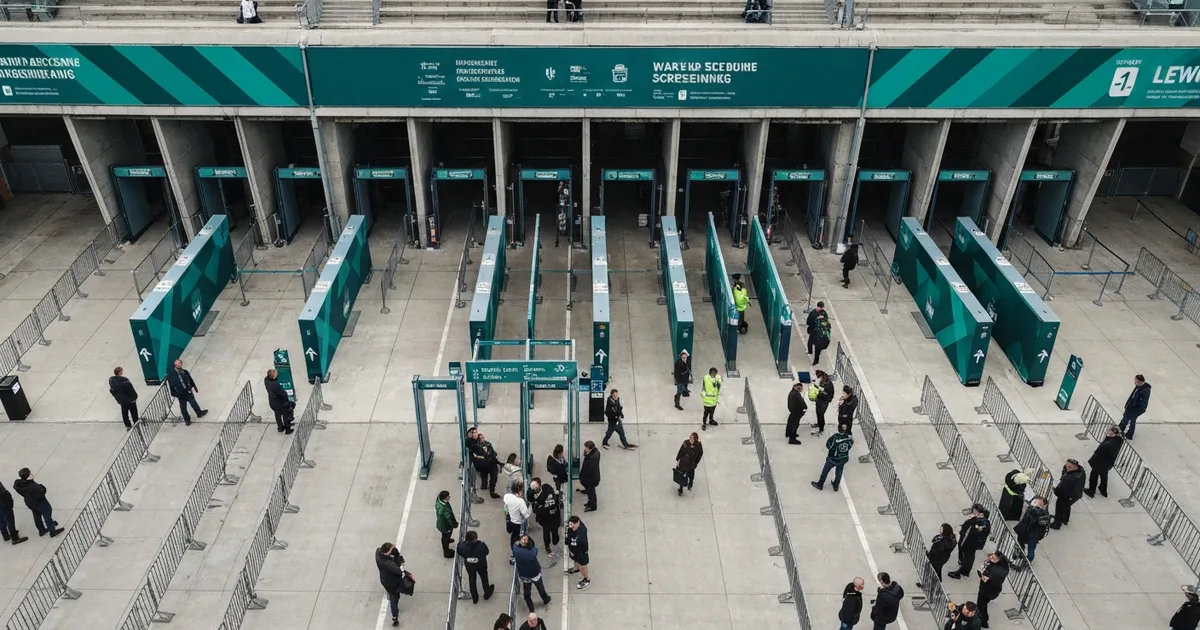
Event Screening Queue Optimization: Throughput Engineering for Stadium and Venue Security
Engineering the security screening queue to maximize throughput at stadium, arena, and large-venue events — achieving 600 to 1,200 people per hour per lane while maintaining detection effectiveness and eliminating the crowd pressure that creates secondary safety hazards.
Event screening queue optimization is the engineering discipline of designing security screening lanes, staffing configurations, and attendee flow patterns to process the expected event attendance before the scheduled start time — without creating crowd density and pressure conditions that become secondary safety hazards. A poorly designed screening queue that backs up onto a public plaza or creates a crowd crush condition is itself a safety failure, regardless of whether the screening equipment is functioning correctly.
The Queue Engineering Problem: Screening Rate vs. Arrival Rate
Effective event screening queue optimization begins with the mathematical relationship between the peak attendee arrival rate and the screening throughput capacity. At most stadium and arena events, 60 to 70 percent of attendance arrives in the 45 minutes before the scheduled start time. For a 60,000-seat stadium with 70 percent pre-game arrival concentration, that represents approximately 56,000 people arriving in 45 minutes — a rate of 1,244 per minute that must be processed through the available screening lanes. If each lane processes 10 people per minute, 125 lanes are required. If actual lane count is 40, wait times will exceed 30 minutes and crowd pressure will build at the entry points. The engineering solution is to reduce arrival concentration through timed entry, pre-screening, and lane count optimization — not to simply increase individual lane speed, which has physical limits.
Throughput Benchmarks by Screening Method
| Screening Method | People/Hour/Lane | Staff Required | Detection Capability |
|---|---|---|---|
| Walk-through metal detector (WTMD) | 400 — 600 | 2 — 3 per lane | Metals only; pat-down required for alerts |
| Advanced imaging technology (AIT) | 150 — 250 | 2 per lane | Metals, non-metals, concealed items |
| Passive millimeter wave (no remove-items) | 800 — 1,200 | 1 — 2 per lane | Metals, dense non-metals, body-worn items |
| Handheld wand (secondary only) | 60 — 100 | 1 per person | Metal; used for secondary screening only |
| Bag X-ray (baggage inspection lane) | 200 — 350 bags | 1 — 2 per lane | Weapons, prohibited items in bags |
Queue Optimization Engineering: The 5 Design Levers
1. Lane Count Calculation
Required lane count = (peak arrival rate per minute) / (lane throughput per minute). For a 20,000-seat arena with 65 percent pre-event arrival concentration over 60 minutes and walk-through metal detection at 8 people per minute per lane: (13,000 / 60) / 8 = 27 lanes minimum. Most venues operate with significantly fewer lanes, which is the root cause of queue buildup. Event screening queue optimization begins with validating this calculation against actual attendance distribution data, not projected averages.
2. Arrival Distribution Engineering
Timed entry ticketing — assigning arrival windows to ticket holders — is the highest-impact single intervention for event screening queue optimization because it directly reduces the peak arrival rate that drives queue buildup. Events that successfully implement 3-window timed entry (60, 45, and 30 minutes pre-event) typically reduce the peak 10-minute arrival rate by 40 to 55 percent, enabling the same lane count to process attendees without queue buildup. Implementation requires ticket system integration and communication to attendees, but delivers throughput improvements that no amount of equipment investment can match.
3. Clear-Bag and Item Reduction Policies
Clear bag policies reduce secondary screening time by 35 to 50 percent by eliminating the need for operators to investigate opaque containers. When operators can see bag contents without opening them, both the X-ray review time and the rate of secondary pat-downs decrease. Venues that pair clear bag policies with a prohibited items list available at ticket purchase see additional throughput improvements because attendees arrive with fewer items requiring confiscation or return-to-vehicle decisions that create non-linear queue delays.
4. Lane Differentiation and Express Processing
Separating attendees into express lanes (no bag, clear bag, credential-holder) and standard lanes (opaque bag, stroller, mobility assistance) reduces the variance in per-person processing time that creates queue clustering. A single person with a stroller who takes 3 minutes to process in a standard lane holds up everyone behind them. Dedicated lanes for complex processing cases protect the throughput rate of standard lanes and maintain predictable queue length management.
5. Crowd Flow Management and Queue Geometry
Queue geometry — the physical layout of stanchions, entry channels, and approach paths — determines whether crowd density builds uniformly across all lanes or concentrates at specific entry points. Serpentine queue designs maintain even load distribution across lanes. Approach path width limits should prevent crowd density from exceeding 2.5 people per square meter in the pre-screening area to prevent crowd pressure conditions. Event screening queue optimization must address approach geometry, not just screening lane configuration.
Queue Failure Indicators and Response Protocols
Related Screening Infrastructure Resources
- Screening Infrastructure Engineering Center
- Stadium and Event Security Screening
- Bad Queue Management at Security Checkpoints
- Screening Infrastructure for Critical Facilities
Is Event screening queue optimization the Right Approach for Your Operation?
Event screening queue optimization from 2M Technology is appropriate when standard security measures cannot address the scale, throughput, or detection requirements of the operation. 2M Technology engineers event screening queue optimization solutions that are calibrated to your specific site, threat profile, and operational workflow — not generic off-the-shelf configurations.
The core advantage of event screening queue optimization from 2M Technology is open architecture and interoperability. Every component integrates with existing credentialing, video management, and access control platforms already in use — there is no proprietary lock-in and no requirement to replace functioning systems.
Key Questions When Evaluating Event screening queue optimization Options
- Does the event screening queue optimization solution deploy without permanent structural changes?
- Can the event screening queue optimization system scale incrementally as operational requirements grow?
- Is the solution cloud-connected for remote oversight and event review?
- Does the event screening queue optimization provider offer site assessment and ongoing support?
- Can the system integrate with your existing access control and VMS platforms?
Contact 2M Technology at (214) 988-4302 for a site-specific event screening queue optimization assessment.
Frequently Asked Questions: Event Screening Queue Optimization
How many screening lanes does a 50,000-seat stadium need?
A 50,000-seat stadium with 65 percent pre-event arrival concentration over 60 minutes generates approximately 540 arrivals per minute at peak. With walk-through metal detection at 8 people per minute per lane, 68 lanes are required to prevent queue buildup. Most stadiums operate with 40 to 50 lanes, which creates predictable queue pressure that can be managed through timed entry ticketing — reducing peak arrival concentration to allow fewer lanes to process the same attendance without buildup.
What is the fastest security screening technology for large events?
Passive millimeter wave screening systems achieve 800 to 1,200 people per hour per lane — roughly double the throughput of walk-through metal detectors — because they do not require attendees to remove items from pockets or stop walking. The tradeoff is higher equipment cost per lane. For venues where lane count is constrained by the physical entry point design, passive millimeter wave systems can double effective throughput capacity without requiring additional lane space.
How does a clear bag policy improve event screening throughput?
Clear bag policies improve event screening throughput by reducing secondary screening time by 35 to 50 percent. When X-ray operators can visually confirm bag contents through transparent material, the number of bags requiring conveyor inspection and secondary pat-downs decreases significantly. Clear bag policies also reduce prohibited item confiscation events — which create non-linear queue delays — because attendees arrive knowing their contents are visible and self-screen before entry.
Optimize Your Event Screening Queue
2M Technology engineers event screening queue configurations for stadiums, arenas, and large venues — calculating required lane counts, throughput projections, and crowd flow geometry to eliminate queue buildup before your next event.
References: DHS Venue Security Planning · NFPA 101 Life Safety Code

