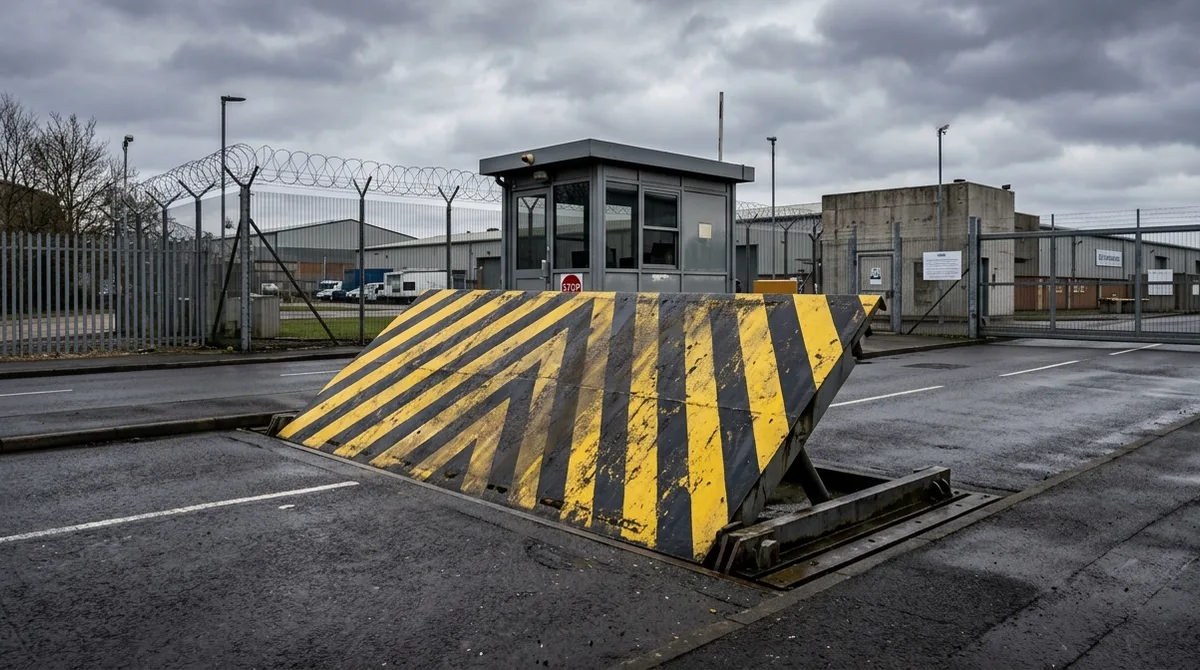
A road blocker is a heavy-duty rising barrier — usually a hydraulic steel wedge installed in or on the roadway — that physically stops a vehicle from forcing entry, including a driver deliberately ramming the gate. Unlike a barrier arm that signals “stop,” a crash-rated road blocker makes stopping non-negotiable: properly specified units arrest a 15,000 lb truck at 50 mph. This guide explains how road blockers work, what the crash ratings actually mean, and how they compare against bollards, tire killers, and barrier arms — all four of which 2M Technology supplies and installs.
How a Road Blocker Works
The common configuration is an in-ground hydraulic wedge: a steel plate sits flush with the pavement, and on command a hydraulic power unit raises it to roughly 3 feet at up to a 45° attack face in 2–6 seconds (faster with an emergency-up circuit). The vehicle’s own momentum works against it — the wedge catches the chassis and engine block rather than the bumper. Surface-mounted versions bolt to the roadway for sites where excavation is impossible, trading some crash performance for install speed. 2M’s 2MRB in-ground hydraulic road blockers are the flush-mount type, sized per lane width and rated per project threat level.
Crash Ratings: What M30, M40, and M50 Mean
Vehicle barriers are rated under ASTM F2656, which replaced the old DoD K-ratings. The number is the speed at which the barrier stopped a standard 15,000 lb (6,800 kg) test truck: M30 = 30 mph (old K4), M40 = 40 mph (K8), M50 = 50 mph (K12). A penetration suffix (P1–P4) records how far the truck bed traveled past the barrier — P1 (under 3.3 ft) is the standard for protecting occupied buildings. The federal Whole Building Design Guide’s vehicle-barrier resource covers the engineering behind the ratings. Rating choice is a site calculation, not a catalog pick: the achievable approach speed on your entry road (straight run vs. forced serpentine) sets the M-level you actually need.
Road Blocker vs. Bollards vs. Tire Killers vs. Barrier Arms
| Barrier | Stop a vehicle ramming? | Traffic Flow | Best Placement | Typical Use |
|---|---|---|---|---|
 Road blocker (hydraulic wedge) | Yes — highest stopping power per lane | Full lane closure, cycles per vehicle | Vehicle checkpoints, final denial line | Government, data centers, plants |
 Security bollards (fixed or hydraulic retractable) | Yes — rated units stop trucks; pedestrians pass freely | Selective — retractables drop for authorized vehicles | Perimeters, storefronts, plazas, crowded-space protection | Ramming prevention, standoff distance |
 Tire killers / traffic spikes | Disables, doesn’t arrest — vehicle rolls on rims | One-way enforcement or on-command | Exit lanes, wrong-way prevention, secondary layer | Parking, dealership exits, base lanes |
 Barrier arms / gates | No — access control only | Fastest throughput | Every managed lane as the first, visible layer | Parking, campuses, HOAs |
The layered design most sites land on: barrier arm for everyday access control, road blocker or rated bollards as the crash layer behind it, tire killers on exits. One device rarely does all three jobs.
Where Road Blockers Are Deployed
Government and courthouse perimeters: the final-denial layer at vehicle sally ports, typically M40–M50/P1. Data centers and critical infrastructure: insurers and federal frameworks increasingly expect rated barriers at truck gates — CISA’s Vehicle Ramming Action Guide outlines the assessment process. Industrial plants and distribution hubs: paired with guard-booth checkpoints so drivers are verified before the wedge drops. Event and pedestrian zones: after the 2025 New Orleans attack, cities re-examined temporary and permanent vehicle mitigation — our analysis of the New Orleans response covers which barrier types cities chose and why.
Specifying a Road Blocker: The 5 Decisions
1. Threat speed: measure the longest straight approach; that speed sets the M-rating. 2. Lane width: blockers are built in 2m–6m widths; wider lanes may take two units. 3. Duty cycle: a truck gate cycling 400 times a day needs a heavier hydraulic power unit than a rarely-used emergency lane. 4. Climate: in-ground units in freeze zones need drainage and heater options — this is where cheap units fail first. 5. Controls integration: the blocker should tie into the same access control that runs your gates and turnstiles — badge readers, LPR, guard-booth push-buttons, and an emergency fast-raise loop. 2M engineers all five into each project quote rather than selling from a size chart.
Road Blockers FAQ
-
What does a road blocker cost installed?
Budget from the low tens of thousands per lane for a mid-rated in-ground hydraulic unit including excavation, hydraulics, and controls — site conditions (utilities, drainage, freeze protection) move the number more than the steel does. Surface-mount units cost less to install but less stopping margin.
-
Road blocker or bollards — which should I choose?
Choose by what must pass: if pedestrians and bicycles should flow freely everywhere except vehicle lanes, rated bollards protect the perimeter and a road blocker guards the vehicle gate. If the site has one controlled truck entrance and the threat is a deliberate ramming, the wedge gives the most stopping power per dollar in that lane.
-
How fast does a road blocker rise?
Standard hydraulic cycles run 2–6 seconds up; emergency-up circuits with accumulators cut that to roughly 1.5 seconds. Speed matters less than placement — a blocker sited behind a serpentine approach never needs to beat a 50 mph truck.
-
Do road blockers work in winter?
Yes, when specified for it: in-ground pits need positive drainage plus heater kits in freeze climates, and hydraulic fluid rated for the low-temperature range. Units that skip these are the ones frozen open in January.
-
What is the difference between K12 and M50?
Same test intent, different standards generations: K12 was the DoD rating for stopping a 15,000 lb truck at 50 mph; ASTM F2656 M50 is its modern equivalent with added penetration reporting (P1–P4). Specify M-ratings for new projects; treat K-ratings on datasheets as legacy equivalents.
-
Can 2M install road blockers with our existing access control?
Yes — 2M Technology (Texas Security License B15309) supplies the 2MRB blocker line and integrates it with badge readers, LPR cameras, turnstiles, and guard-booth controls as one system, nationwide. Request a site assessment.