Home › UniFi Deployment Center › UniFi Industrial Deployment Guide
UniFi Deployment Guide for Industrial Facilities & Manufacturing Plants
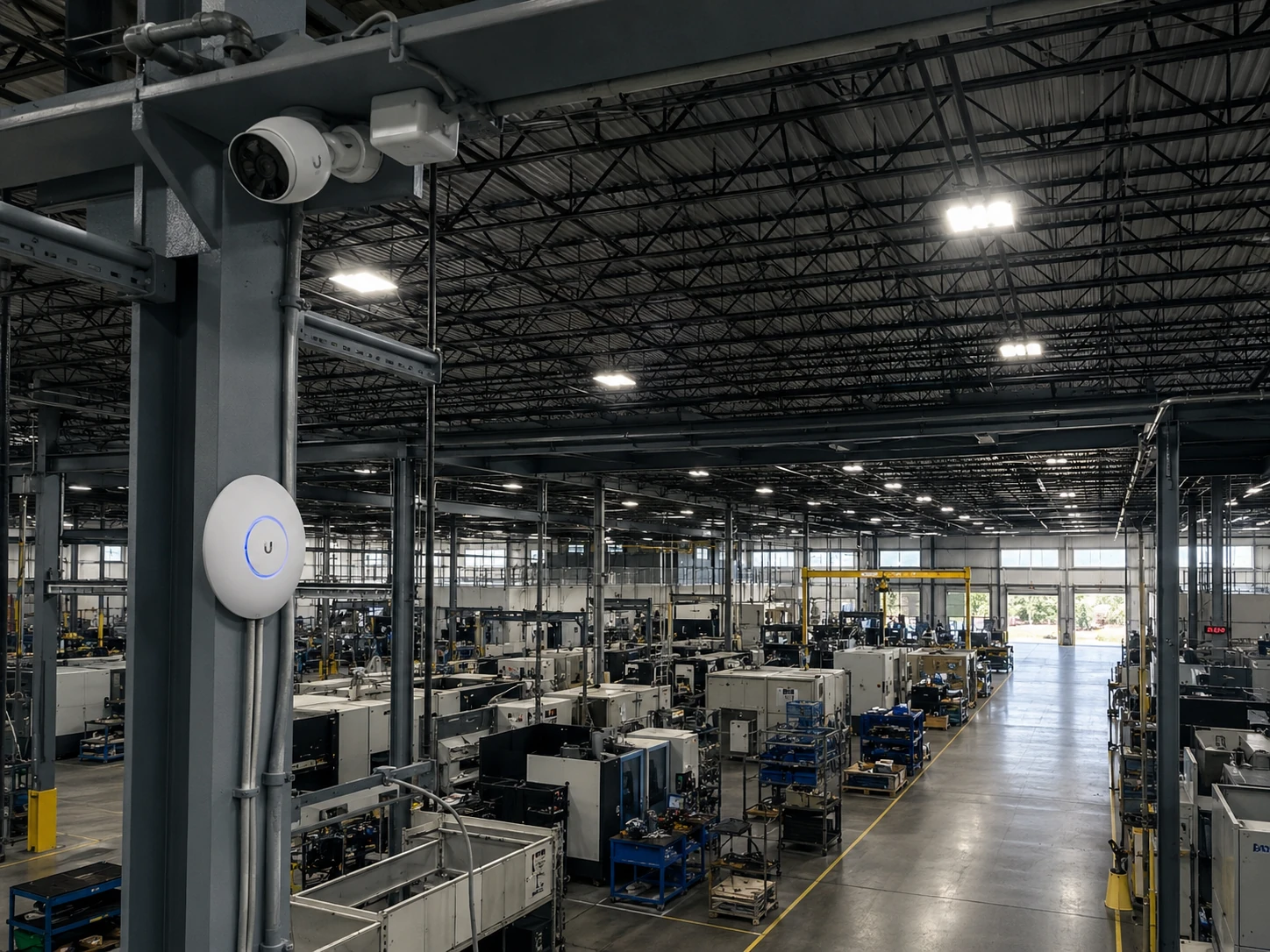
UniFi deployment in industrial facilities and manufacturing plants encounters environmental and operational constraints that standard commercial deployments never face: extreme temperatures, pervasive EMI from motors and variable frequency drives (VFDs), vibration from heavy machinery, large physical footprints requiring distributed fiber infrastructure, and the mandatory separation of OT (operational technology) and IT networks. 2M Technology deploys UniFi surveillance and networking for industrial facilities across Texas — from food processing plants and automotive manufacturing to chemical facilities and heavy industrial sites. This guide covers the engineering decisions specific to harsh environment security infrastructure that standard commercial deployments never address.
1. Industrial Environmental Challenges
UniFi deployment industrial environments require EMI-resistant network design, hazardous area camera selection, OT/IT network isolation, and rugged mounting solutions that standard commercial specifications cannot provide. 2M Technology engineers these systems for Texas manufacturing plants, chemical facilities, and heavy industrial sites where network failure stops production.
UniFi deployment industrial environment classification determines cable selection, housing ratings, and switching topology — decisions that must be locked in before hardware is ordered.
| Challenge | Source | Impact on UniFi Equipment | Mitigation |
|---|---|---|---|
| Extreme heat (Texas summer) | Ambient + process heat | Camera/switch thermal shutdown above operating range | Select cameras rated to 50°C+; shade mounting where possible |
| EMI from VFDs/motors | Variable frequency drives, large motors, welders | Copper Ethernet interference; intermittent link loss | Use fiber for all backbone; maintain 12″+ separation from power conduit |
| Vibration | Presses, compressors, conveyor systems | Loose connectors, camera mount fatigue, structural failure | Anti-vibration mounts; thread-locking compound; rigid conduit |
| Dust / particulate | Grinding, cutting, sanding, granular product | Lens contamination; switch port clogging; cooling failure | IP66 cameras minimum; sealed switch enclosures; filtered cabinets |
| Chemical exposure | Cleaning agents, process chemicals, coatings | Camera housing corrosion; cable jacket degradation | 316 stainless mounting hardware; chemical-resistant cable jacketing |
| Wash-down environments | Food processing, pharmaceutical, chemical plants | Pressure water ingress | IP67 or IP68 enclosures for direct wash-down areas; IP66 minimum elsewhere |
2. Camera Selection & Placement for Industrial Environments
UniFi deployment industrial camera selection must account for explosion-proof ratings, IR illumination under high dust, vibration tolerance, and NEMA enclosure requirements specific to manufacturing zones.
Standard UniFi Cameras in Industrial Settings
Standard UniFi cameras (G5 Bullet, G6 Turret, AI Pro, G6 PTZ) are suitable for unclassified industrial areas where the following conditions are met:
- Ambient operating temperature below 50°C — most UniFi cameras are rated to 50°C; Texas industrial facilities often exceed this in non-climate-controlled areas during summer
- No direct chemical spray or high-pressure wash-down — IP66 protects against water jets but not sustained pressure washing at close range
- No classified (Division 1/2) hazardous atmosphere — see our oil and gas deployment guide for hazardous area camera requirements
Camera Placement for Industrial Floors
| Zone | Camera | Mounting | Key Consideration |
|---|---|---|---|
| Production floor overview | AI 360 (ceiling) or PTZ (elevated) | Structural steel, beam-mount | Anti-vibration mount if near press/stamping equipment |
| Machine-level coverage | G5 Dome or G5 Pro | Structural pillar, 12–16 ft | Verify clear sightlines past machinery |
| Loading dock / shipping | AI Pro (exterior LPR) + G5 Pro (interior) | Above dock door | Same two-camera approach as warehouse |
| Perimeter fence | G5 Bullet or G6 Turret | Fence post or dedicated pole | IP66, -30 to 50°C rating critical for Texas outdoor conditions |
| Office / admin areas | G5 Dome or AI Turret | Standard ceiling/wall | Standard commercial installation |
3. Industrial Mounting Requirements
UniFi deployment industrial mounting decisions determine long-term stability — incorrect hardware in high-vibration environments causes camera drift, misaligned coverage zones, and accelerated hardware failure.
- Structural steel beam mounting: Use beam clamp mounts (Unistrut P1000 or equivalent) on overhead structural steel — never drill into structural beams without structural engineer approval. Beam clamps allow repositioning without re-drilling.
- Anti-vibration mounts: In facilities with significant floor-transmitted vibration (stamping presses, compressors, forging), use anti-vibration rubber grommets between camera mount and structural attachment. Vibration causes connector loosening over 12–18 months without isolation.
- Thread-locking compound: Apply Loctite Medium (blue) to all mounting hardware screws in vibration environments — self-loosening of mounting hardware in vibration environments is a documented failure mode.
- All cable in conduit: Surface-run cable at any height in an active industrial floor is at risk from equipment, forklifts, and maintenance operations — all camera cable in active industrial areas must be in rigid steel conduit, not flexible conduit or cable tray alone.
- 316 stainless mounting hardware: In chemical or food processing environments, zinc-plated hardware corrodes rapidly. Specify 316 stainless steel fasteners for all camera mounts in corrosive environments.
4. EMI-Resistant Network Design
UniFi deployment industrial network architecture requires dedicated VLANs per production zone, redundant uplinks between IDF/MDF panels, and managed switch selection rated for extended temperature ranges. Industrial facilities have pervasive electromagnetic interference sources — VFDs, large AC motors, welders, induction heaters, and high-voltage bus bars. EMI in copper Ethernet causes packet loss, link instability, and intermittent camera dropout. The solution is straightforward:
- Use fiber for all backbone runs: OS2 or OM4 fiber is completely immune to EMI. Any backbone run in or near production areas must be fiber — not copper. See our fiber backbone planning guide.
- Cat6A shielded (S/FTP) for horizontal runs: Where copper horizontal runs are unavoidable (camera to local IDF), use shielded Cat6A (S/FTP) rather than unshielded UTP. Shielded cable requires proper grounding at both ends — consult an electrical engineer for industrial grounding requirements.
- 12″ minimum separation from power conduit: Route data conduit perpendicular to power conduit where they must cross; maintain 12″+ separation on parallel runs. Steel conduit for data provides additional EMI shielding compared to PVC.
- IDF switches in sealed enclosures: Industrial-grade NEMA 12 or NEMA 4 enclosures for IDF switches on the production floor — standard rack-mount switches are not rated for dusty or chemically aggressive industrial environments.
5. OT/IT Network Isolation
UniFi deployment industrial OT/IT segmentation is the most critical network decision — a misconfigured bridge between operational technology and business IT can halt production and expose PLC control systems to cyber threats. Industrial facilities operate OT (Operational Technology) networks — PLC, SCADA, DCS, HMI systems — that must remain completely isolated from IT networks (cameras, Wi-Fi, corporate LAN). OT/IT convergence failures have caused production shutdowns and ransomware propagation from IT to OT in industrial environments (the 2021 Colonial Pipeline incident is the most cited example).
- Physical or logical air gap: OT networks should have no routed path to IT networks. A UniFi gateway firewall can implement logical separation, but many industrial operations managers prefer physical separation — separate switches, separate fiber runs, and a data diode or industrial DMZ between OT and IT where data sharing is required.
- Camera VLAN never touches OT: UniFi cameras on the camera VLAN (VLAN 20) must have no path to OT network segments. Verify with firewall rules and network diagram documentation.
- ISA/IEC 62443 framework: For larger industrial facilities, the ISA/IEC 62443 series provides the standard framework for industrial cybersecurity network design. 2M Technology aligns industrial network designs with this framework.
6. Industrial Wi-Fi Considerations
UniFi deployment industrial Wi-Fi design must overcome metal interference, moving equipment RF scatter, and large open-floor propagation challenges that standard office AP placement cannot resolve. Wi-Fi in industrial environments faces the same EMI challenges as copper Ethernet, plus the metal-dense propagation issues of warehouse environments. Key considerations:
- Use 5 GHz or 6 GHz where possible in open areas: 2.4 GHz is more susceptible to interference from industrial equipment (some VFDs emit in the 2.4 GHz range)
- Non-DFS channels for operational SSIDs: Any Wi-Fi used for production devices (barcode scanners, mobile terminals, PLCs with Wi-Fi) must be on non-DFS channels (36–48)
- AP enclosures in harsh zones: Standard UniFi APs are not rated for dusty or chemically aggressive environments — use AP-rated NEMA 12 enclosures or specify outdoor APs (rated IP67) for production floor mounting
- OT devices never on IT Wi-Fi: PLCs and SCADA-connected devices with Wi-Fi must be on an isolated OT Wi-Fi SSID, not the same SSID as employee devices
7. Access Control for Production Areas
UniFi deployment industrial access control requires glove-compatible readers, explosion-proof housings in Class I Div II zones, and fail-secure locking integrated with the facility fire panel.
- Production floor entry: NFC card or badge access for all entrances to active production areas — restricts entry to authorized personnel and creates shift log records useful for incident investigation
- Tool cribs and supply rooms: Controlled access for high-value tooling, calibration equipment, and maintenance supplies — prevents unauthorized access and supports inventory accountability
- Electrical rooms and MCC (Motor Control Center): Access-controlled with logging — electrical room access in industrial facilities is both a safety and a sabotage risk
- Server room / SCADA workstation areas: Two-factor access for any area with OT network access — physical access to SCADA terminals is as significant a risk as network access
- Hazardous area readers: Standard UniFi Access readers are not rated for classified (Division 1/2) areas — coordinate with area classification drawings and specify appropriate rated readers where required
8. Large-Footprint Campus Design
UniFi deployment industrial large-footprint sites introduce multi-building fiber backbone requirements, IDF/MDF architecture decisions, and network capacity planning that single-building guides do not address. Texas industrial facilities often span large footprints — a manufacturing campus may include main production building, warehousing, maintenance shops, guard shack, truck scales, and parking — each requiring network infrastructure. 2M Technology’s approach:
- One MDF at the primary building (production or admin): Central NVR, core switch, and gateway at the MDF. All other buildings connect via OS2 fiber in armored underground conduit.
- One IDF per building: Each building has its own IDF closet with an access switch, fiber patch panel, and UPS. Cameras, APs, and readers in that building connect to the local IDF.
- Guard shack / gatehouse: A small IDF in the guard shack with a PoE switch for gate cameras (AI Pro LPR) and a PTZ for yard overview. Connect to main facility via fiber — never via copper between buildings.
- Truck scale / weigh station: Camera at scale approach (LPR) + scale position camera for documentation. PoE extender from nearest IDF if scale run exceeds 100m.
See our IDF/MDF architecture guide and fiber backbone planning guide for detailed multi-building infrastructure design methodology.
UniFi Industrial Deployment — Environmental Rating Selection Reference
| Condition | Required Rating | UniFi Camera Suitable | Alternative Required | Notes |
|---|---|---|---|---|
| Outdoor — rain and dust | IP66 | Yes — G5 Bullet, G6 Turret, AI Pro | — | Standard outdoor-rated cameras sufficient |
| Wash-down / pressure cleaning | IP67 | Limited (IP66 cameras with caution) | IP67 camera or enclosure | Sustained pressure wash requires IP67 minimum |
| Particulate / grinding dust | IP65+ | Yes with sealed enclosure on IDF switches | NEMA 12 switch enclosure | Camera OK; switches need sealed cabinet |
| Corrosive atmosphere | IP66 + 316SS mounting hardware | Yes with correct hardware | 316 stainless mounting only | Zinc-plated hardware corrodes rapidly |
| Vibration (presses, compressors) | Anti-vibration mounts | Yes with anti-vibration mount | Thread-locking compound required | Vibration loosens standard mounting hardware |
| Division 2 / Zone 2 classified area | ATEX/UL Division 2 enclosure | Camera in rated enclosure only | Explosion-proof enclosure required | See oil and gas deployment guide |
| Division 1 / Zone 1 classified area | ATEX/IECEx Zone 1 IS certified | NOT suitable | Intrinsically safe cameras only | Standard cameras NOT permissible in any enclosure |
⚠ Critical Warnings — UniFi Industrial Deployments
9. Common Industrial Deployment Mistakes
UniFi deployment industrial mistakes are expensive — misrated camera housings, copper runs past 100m limits, or OT/IT bridge misconfiguration causes downtime measured in production shifts, not minutes.
- Copper Ethernet backbone near VFDs or large motors: Unshielded copper in high-EMI industrial environments causes intermittent packet loss that is difficult to diagnose — all backbone in industrial areas must be fiber
- Standard rack-mount switches on production floor: Open-frame rack switches accumulate dust and conductive particles — use NEMA 12 sealed enclosures for any switch on or near the production floor
- No anti-vibration mounts near heavy presses: Camera mount screws loosen under sustained vibration over months — use thread-locking compound and anti-vibration mounts near vibration sources
- OT and IT on same VLAN: Any routed path between SCADA/PLC networks and camera or corporate VLANs creates the attack surface that industrial ransomware exploits — full OT/IT isolation is non-negotiable
- Surface-run cable on active production floor: Surface cables in any active production area will be damaged by forklifts, maintenance equipment, or moving machinery — all cable in production areas in rigid steel conduit minimum
Frequently Asked Questions
UniFi deployment industrial questions from plant engineers center on hazardous area ratings, PoE budget for rugged cameras, OT network isolation, and warranty coverage in harsh environments — addressed directly below.
Can standard UniFi cameras handle industrial outdoor environments in Texas?
Yes, for most outdoor unclassified industrial areas. UniFi cameras rated to 50°C (G5 Bullet, G6 Turret, AI Turret, G5/G6 PTZ) handle Texas outdoor conditions including summer heat. The IP66 weather rating covers dust and water jet exposure. The main limitation is operating temperature — in areas where ambient temperature exceeds 50°C (near process equipment or in unventilated hot areas), shade mounting or enclosures with thermal management are required. For classified (Division 1/2) hazardous areas, explosion-proof enclosures are required — see our oil and gas deployment guide.
How does EMI from VFDs affect UniFi cameras and switches?
VFDs (variable frequency drives) generate conducted and radiated EMI that can cause packet loss, link instability, and intermittent connectivity on copper Ethernet runs in proximity. Symptoms include cameras dropping offline for seconds at a time, high packet loss on camera streams during motor start/stop events, and unexplained NVR recording gaps. The solution is to use fiber for all backbone runs in or near VFD areas, and shielded Cat6A (S/FTP) for horizontal copper runs where fiber is not practical.
Does 2M Technology install UniFi in manufacturing plants and industrial facilities in Texas?
Yes. 2M Technology designs and installs UniFi surveillance and networking for industrial facilities, manufacturing plants, and industrial campuses across Texas. Our industrial scope includes EMI-resistant network design, fiber backbone planning, IDF placement in NEMA enclosures, camera placement for production floors and perimeter, OT/IT network isolation design, and access control for production and restricted areas. Contact us for a free facility assessment.
Related Deployment Guides — Plan the Full System
Industrial UniFi deployment requires EMI-resistant design, harsh environment hardware, and OT/IT isolation. These guides cover each dependent layer:
Plan Your Industrial UniFi Deployment
- Texas Private Security License B15309
- (214) 988-4302
- sales@2mtechnology.net