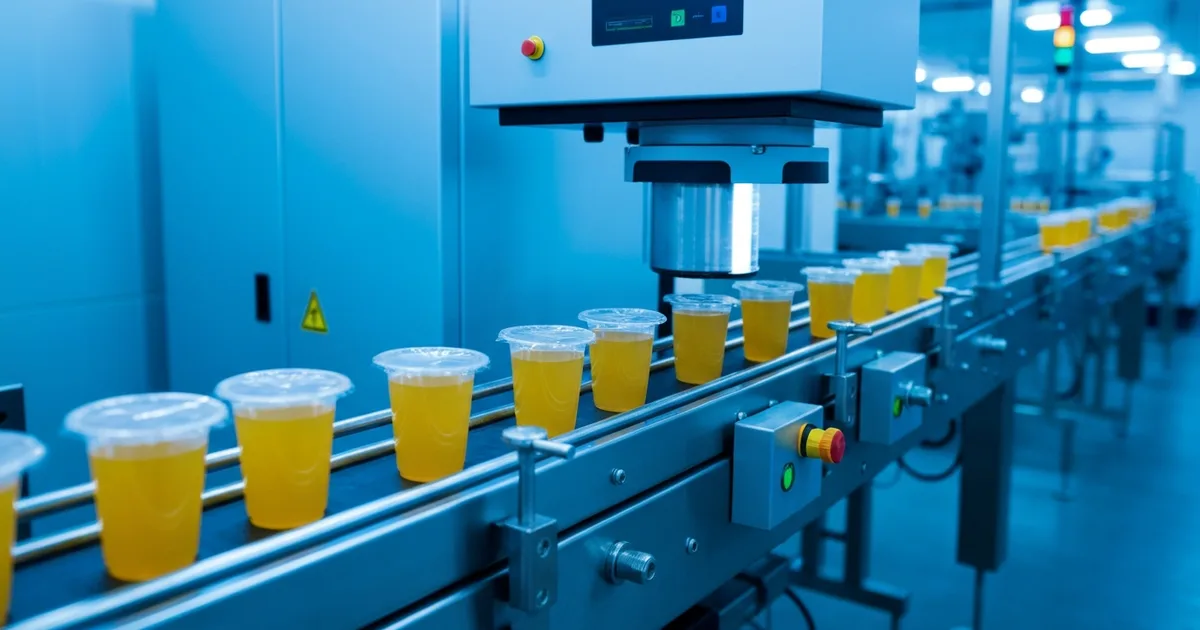
X-Ray Contaminant Detection Juice Cups: Complete Guide
Complete operational guide to inline X-ray inspection for juice cups, yogurt cups, dairy pouches, and RTD beverage packaging — covering production workflow integration, contaminant-specific detection parameters, HACCP compliance, AI reject analytics, and false reject reduction engineering.
X-ray contaminant detection juice cups and liquid food packaging requires a technically distinct approach compared to solid product inspection from solid product inspection because the liquid fill attenuates X-rays at a density approaching glass — compressing the contrast window that the detection algorithm relies on. This guide covers the full operational engineering stack: production line placement, contaminant-specific detection parameters, reject-lane architecture, HACCP CCP compliance workflows, AI-powered reject analytics, and false reject reduction — for juice, dairy, yogurt, and RTD beverage packaging operations.
What X-Ray Contaminant Detection Juice Cups Involves
X-ray contaminant detection juice cups applications require calibration for the specific cup geometry, fill volume, and target contaminant density. Glass at 0.5mm and metal at 0.3mm are detectable by most modern x-ray contaminant detection juice cups systems. Low-density contaminants in x-ray contaminant detection juice cups inspection — insects, organic matter, thin plastics — require higher-resolution imaging and appropriate algorithm sensitivity tuning. 2M Technology configures every x-ray contaminant detection juice cups system to the client’s specific product and compliance requirements. Request a system quote.
Optimizing x-ray contaminant detection juice cups lines starts with defining the minimum detectable contaminant size for your product. Most x-ray contaminant detection juice cups deployments target glass at ≥1.0mm and metal at ≥0.5mm. Dense contaminants in x-ray contaminant detection juice cups inspection are straightforward; the challenge lies in low-density materials. Bone, rubber, and certain plastics require higher kV settings for reliable x-ray contaminant detection juice cups detection. 2M Technology configures sensitivity thresholds during commissioning and validates performance against a defined set of test pieces specific to your x-ray contaminant detection juice cups product line. Annual re-validation of x-ray contaminant detection juice cups systems is recommended to maintain detection accuracy as product formulations change. Request a system assessment.
When validating a x-ray contaminant detection juice cups line, use certified reference test pieces at the minimum detectable size. Run each test piece through the x-ray contaminant detection juice cups system at production speed to confirm detection rates meet your specification. 2M Technology recommends quarterly validation runs for all x-ray contaminant detection juice cups installations. Maintain a validation log documenting each run — this record satisfies HACCP and GFSI audit requirements for x-ray contaminant detection juice cups inspection systems. If detection rates degrade between validation runs, recalibrate the x-ray contaminant detection juice cups system immediately. Contact 2M for calibration support.
For questions about commissioning or validation of your x-ray contaminant detection juice cups line, contact 2M Technology. We support x-ray contaminant detection juice cups systems nationwide.
Validate X-Ray Detection Limits for Your Liquid Product Line
Juice Cup Production Line Workflow: X-Ray Contaminant Detection Architecture
Inline x-ray contaminant detection juice cups equipment must be positioned at the correct point in the production workflow to intercept all contamination risk vectors — including filling equipment wear, sealing mechanism debris, and upstream ingredient contamination. The diagram below maps the standard juice cup filling line topology with inspection placement and reject-lane architecture.
Contaminant-Specific Detection Parameters for Liquid Cup Products
Metal Fragment Detection: X-Ray Contaminant Detection Juice Cups Performance
Metal fragments in juice cup lines originate primarily from filling nozzle wear, valve seat erosion, and sealing jaw fatigue. Stainless steel 304/316 is the dominant metal in food filling equipment and has an X-ray attenuation coefficient 8-10 times higher than juice fill — providing reliable detection at 1.5-2.5mm sphere equivalent. Ferrous metal is even more detectable (1-2mm). Unlike metal detectors, X-ray performance is not degraded by the high-moisture, high-conductivity juice fill. Minimum detectable metal size is validated using calibrated test wands embedded in sealed production cups at full line speed.
Glass Fragments: The Hardest X-Ray Contaminant Detection Juice Cups Challenge
Glass in liquid cup products can originate from breakage in the ingredient handling area, glass process equipment, laboratory glassware, or building fixtures above the production line. Soda-lime glass has an attenuation coefficient only 1.5-2x higher than typical juice fill — the smallest contrast differential of any common contaminant. Minimum detectable glass size is typically 3-5mm sphere equivalent in standard juice cups. High-Brix products (above 12 Brix) reduce this margin further. Dual-energy X-ray systems improve glass discrimination by generating a material composition layer alongside the density image, separating glass density signatures from product density variation.
Dense Plastic Fragments in X-Ray Contaminant Detection Juice Cups Applications
Dense engineering plastics used in filling and sealing equipment — nylon, acetal (Delrin), HDPE components — have X-ray attenuation coefficients close to the juice fill density, making them the most difficult contaminant category to detect in liquid packaging. Minimum detectable dense plastic size in juice cups is typically 5-8mm depending on plastic type, with some low-density formulations near the boundary of detection capability for standard single-energy systems. Dual-energy X-ray with material discrimination algorithms is required for reliable detection of dense plastic fragments below 6mm in liquid cup products.
Packaging Defects and Sealing Anomalies in X-Ray Contaminant Detection Juice Cups
Beyond foreign body detection, X-ray inspection simultaneously identifies packaging integrity failures in sealed cups: incomplete seals that allow air ingress, underfill conditions where fill weight falls outside specification, overfill that may cause seal failure, and missing or misaligned foil lids. Sealing anomaly detection through X-ray uses density distribution analysis — a properly sealed, correctly filled cup has a consistent density profile; a partially sealed cup shows air gap density patterns at the seal interface. This simultaneous quality inspection adds significant value beyond contamination detection alone and requires no additional inspection equipment or line space.
Detection Limit Reference Table
| Contaminant | Density vs. Juice | Min. Detectable (typical) | Single-Energy | Dual-Energy |
|---|---|---|---|---|
| Ferrous steel | 10-12x | 1.0-2.0mm | ✓ Excellent | ✓ Excellent |
| Stainless steel 304/316 | 8-10x | 1.5-2.5mm | ✓ High | ✓ High |
| Aluminum | 3-4x | 2.0-3.5mm | ✓ Medium-High | ✓ High |
| Soda-lime glass | 1.5-2x | 3.0-5.0mm | ⚠ Medium | ✓ Medium-High |
| Ceramic / porcelain | 2-3x | 2.5-4.0mm | ✓ Medium | ✓ Medium-High |
| Dense plastic (nylon/POM) | 1.1-1.3x | 5.0-8.0mm | ⚠ Low-Med | ✓ Medium |
| Underfill / sealing defect | N/A (void) | >5% fill variance | ✓ Detected | ✓ Detected |
False Reject Reduction for Liquid Cup X-Ray Inspection
False rejects in x-ray contaminant detection juice cups operations are primarily driven by density variation in the fill itself — Brix variation batch-to-batch, temperature differentials between cups early and late in a production run, and air bubble distribution from filling turbulence. Each of these creates localized density anomalies in the X-ray image that a poorly tuned algorithm misclassifies as foreign body signatures. On juice cup lines, false reject rates without optimization commonly run 0.5-2%; with product-specific AI model training and fill temperature compensation, achievable rates fall below 0.2%.
0.5-2%
Typical FRR without optimization on juice cup lines
<0.2%
Achievable FRR with AI model training and fill compensation
$80K+
Annual waste cost of 1% FRR on a 300-cup/min juice line
3 mo
Typical payback for AI model retraining on high-volume lines
The most effective intervention for juice cup false reject reduction is AI model retraining on 500-2,000 representative production cups sampled across the full Brix variation range, temperature range, and fill turbulence profile of the actual line. This allows the model to establish a product-specific density baseline rather than relying on the factory default model calibrated against water-filled test cups. See the full engineering guide: False Reject Reduction in Food X-Ray Inspection.
False Reject Reduction for Liquid Cup X-Ray Inspection
1
Hazard ID
Document physical hazards: metal, glass, dense plastic by source
2
Critical Limits
Set detection threshold = smallest validated test piece size per material
3
Monitoring
Shift startup check with test pieces; continuous automated logging
4
Corrective Action
CCP failure: hold all product since last passing check; investigate root cause
5
Verification
Supervisor sign-off; annual re-validation at full line speed
6
Records
90-day minimum retention: validation studies, shift logs, corrective actions
X-ray contaminant detection juice cups programs must meet FDA FSMA Preventive Controls (21 CFR Part 117) requirements — the HACCP plan for a juice cup operation identify physical hazards, document that the CCP technology is capable of detecting those hazards, and maintain records for the required retention period. The critical limit for X-ray inspection must be the smallest contaminant size that was reliably detected during the validation study — not the system’s nominal specification. An inspection system validated on water-filled cups at slow speed but deployed on high-Brix juice at full production speed has a documentation gap that an FDA investigator will identify. Consult the FDA FSMA guidance directly for applicable recordkeeping requirements.
AI Inspection Layer: Reject Analytics and Operational Intelligence
Modern X-ray inspection systems log every rejection event with the associated density image, position within the production run, and detection parameters. This data stream is the foundation for AI-powered operational intelligence that goes beyond individual reject decisions to identify systemic production quality trends.
Reject Pattern Analytics
Identifies whether reject events cluster at production run start (cold fill), during a specific shift, or after specific upstream equipment events — pointing to root cause before a recall event occurs.
Equipment Wear Detection
A gradual increase in metal rejection events correlated with production volume is a reliable indicator of nozzle or valve wear before the component generates a catastrophic failure. AI trend analysis triggers maintenance before contamination escalates.
Sealing Anomaly Trending
Sealing defect rates trending upward across consecutive production runs indicate seal jaw wear, temperature controller drift, or foil feed tension issues — all diagnosable from X-ray density data before they cause production-scale failures.
QA Escalation Triggers
Automated escalation when reject rate exceeds a statistical control limit — e.g., 3x normal rate in any 15-minute window — notifies QA supervisors before the condition affects an entire batch. Integrates with MES and CAPA systems via OPC-UA or REST API.
See full implementation guide: AI Anomaly Detection for Industrial Inspection and Operational QA Workflows
Liquid Packaging Inspection Applications: Cluster Hub
The x-ray contaminant detection juice cups detection principles and workflow architecture on this page apply across liquid and semi-liquid food packaging formats. Each application has specific density, fill viscosity, and sealing variables that affect detection parameters:
Yogurt Cup Inspection
Higher fill density than juice; fruit piece inclusions create detection noise. Glass and metal detection at similar limits; false reject from fruit pit density overlap requires specialized model training.
Dairy Packaging Inspection
Milk, cream, and flavored dairy in cups and cartons. Fat content variation affects density baseline; UHT and aseptic carton formats require high-penetration X-ray to inspect through laminated wall materials.
Beverage Bottling Inspection
Carbonated and still beverages in PET and glass. Glass-in-glass contamination in glass-bottled products is the highest-risk application; dual-energy X-ray required for reliable glass shard discrimination against glass bottle walls.
RTD Beverage QA
Ready-to-drink protein shakes, meal replacement drinks, and functional beverages. Protein and mineral content creates elevated baseline density; fill level verification important for premium unit pricing integrity.
Foil-Seal Inspection
Single-serve and portion pack products with foil lids. Metal detectors cannot inspect through foil; X-ray is the only inline technology that simultaneously checks fill level and foreign bodies through metallic seals.
Inline Cup Inspection Systems
High-speed cup inspection for pudding, gelatin, applesauce, and sauce portions. Variable fill density by product requires per-SKU model validation. Conveyor synchronization with the filling carousel is critical for accurate reject timing.
Real Project Examples
City of Thornton: Courthouse X-Ray Security Screening Scanners
Proviso Township High School District 209: X-Ray Machines
Why Metal Detectors Cannot Replace X-Ray Contaminant Detection Juice Cups Systems
For x-ray contaminant detection juice cups applications, juice, dairy, and beverage products present high-moisture, high-conductivity fills that generate significant product effect in metal detectors — reducing stainless steel sensitivity by 30-50% and making non-metallic contaminant detection impossible. Foil-lidded cups cannot be inspected by metal detection at all. The combination of product effect, foil packaging, and glass/ceramic contamination risk makes X-ray inspection the only viable inline solution for most liquid cup formats. See the full analysis: Why Metal Detectors Miss Low-Density Contaminants.
Frequently Asked Questions: X-Ray Contaminant Detection Juice Cups and Liquid Packaging
What is the minimum glass size detectable by X-ray in a sealed juice cup?
For x-ray contaminant detection in juice cups, minimum detectable glass size typically ranges from 3 to 5mm sphere equivalent under standard inspection conditions. Glass is significantly harder to detect than metal in liquid packaging because juice and glass have similar X-ray attenuation values, compressing the density contrast that detection relies on. Dual-energy X-ray systems improve glass discrimination and can reduce the minimum detectable size by 20-30%. Formal validation testing with actual production cups and calibrated glass test pieces is required to establish site-specific critical limits — not nominal manufacturer specifications.
Where should X-ray inspection be placed in a juice cup filling line?
Optimal placement for inline X-ray inspection in a juice cup filling line is post-sealing, pre-labeling. This position intercepts contamination from all upstream risk points — ingredient handling, blending, filling nozzle wear, and seal jaw debris — while still allowing contaminated cups to be rejected before labeling and coding costs are applied. The reject mechanism must be positioned 200-400ms after the aperture exit based on conveyor speed, with a confirmation sensor that verifies rejected cups appear in the reject bin.
Can X-ray inspect foil-lidded juice cups and dairy portions?
Yes. X-ray inspection penetrates foil lids and aluminum-laminated packaging without interference, making it the only practical inline contamination detection technology for sealed foil-lid cups. Metal detectors cannot inspect through foil because the packaging material generates an overwhelming electromagnetic signal. X-ray simultaneously detects foreign bodies, verifies fill level, and checks for sealing anomalies — three quality checks in one pass through the inspection aperture.
Related Food X-Ray Inspection Resources
- Food X-Ray Inspection System Cost and Configuration Guide
- X-Ray Inspection Machine for Packaged Food — CPG Applications
- False Reject Reduction in Food X-Ray Inspection
- Why Metal Detectors Miss Low-Density Contaminants — Foreign Body Detection in Liquid Products
- Why Food Inspection Systems Fail — 8 Root Causes
- Hidden Costs of Food Recalls — Complete Financial Impact
- AI Anomaly Detection for Industrial Inspection
Validate X-Ray Detection for Your Juice, Dairy, or Beverage Cup Line
- Texas Private Security License B15309
- (214) 988-4302
- sales@2mtechnology.net