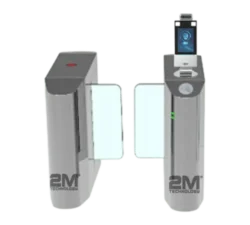
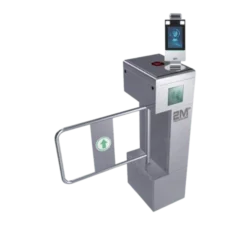
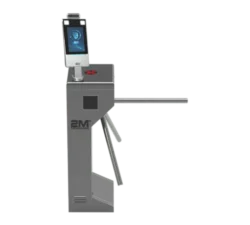
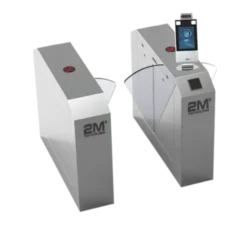
Access Control Turnstiles allow only one authenticated person to pass at a time, requiring card, biometric, or PIN verification. Used to enforce access policies and create complete entry audit trails at offices, campuses, warehouses, and stadiums.
Key benefits of our access control turnstiles include:
Upgrade your entrance management with advanced access control turnstiles designed for security, efficiency, and reliability.
Premium for corporate lobbies. ADA compliant, fast throughput.
Maximum security for outdoor perimeters and stadiums. Cannot be bypassed.
Access control turnstiles range from basic tripod units for gym entry to high-security optical barriers for corporate headquarters. The right choice depends on three variables: required throughput, security level (can someone bypass the gate?), and ADA compliance requirements.
| Type | Physical Barrier | Throughput (pph) | ADA Compliant | Best Application |
|---|---|---|---|---|
| Tripod turnstile | Low (3 rotating arms) | 800–1,200 | No (requires separate ADA gate) | Gyms, offices, transit, recreation facilities |
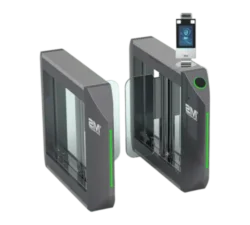
| Optical / flap barrier | Medium (retractable flaps) | 2,000–3,000 | Yes (wide-lane models) | Corporate lobbies, airport terminals, banks |
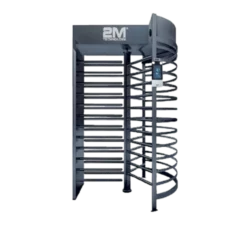
| Full-height turnstile | High (floor to 7ft ceiling) | 400–600 | No (requires separate ADA gate) | Stadiums, utilities, industrial plants |
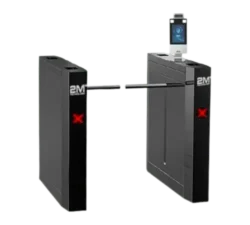
| Drop arm / speed gate | Low (horizontal drop arm) | 1,500–2,500 | No | High-volume transit, bus stations, events |
| Swing barrier gate | Medium (full-panel swing) | 1,500–2,000 | Yes (designed for ADA) | ADA lanes, emergency egress points |
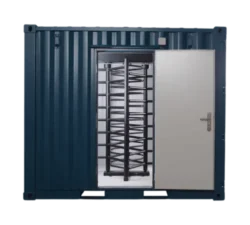
| Container turnstile | High (shipping container unit) | 300–500 | No | Construction sites, events, oil and gas |
An access control turnstile does not operate in isolation. It connects to a broader access control system via a standard electronic interface. Understanding the integration layer helps you select compatible hardware from the start.
| Credential Type | Security Level | User Experience | Cost | Best For |
|---|---|---|---|---|
| Proximity card (125 kHz HID) | Low (cloneable) | Tap and go | Low | Low-risk applications being phased out |
| Smart card (13.56 MHz) | High (encrypted) | Tap and go | Medium | Corporate, government, education |
| Mobile credential (BLE/NFC) | High (device auth) | Phone tap or wave | Medium | Modern corporate, multi-site operations |
| Biometric (fingerprint) | Very high | Touch sensor | High | Construction workforce, high-security zones |
| Face recognition | Very high | Walk-up, hands-free | High | High-traffic corporate, healthcare, schools |
| QR / barcode | Low (screenshot risk) | Scan phone/badge | Low | Visitor management, events |
A professional services firm with a 450-employee corporate campus in Plano, Texas needed to replace an aging proximity card turnstile system in its three-building campus. The existing system used 125 kHz HID proximity cards with no encryption — a known vulnerability for a company handling client financial data.
2M Technology designed and installed a comprehensive upgrade: six optical turnstile lanes across the three lobbies, upgraded to OSDP-connected smart card readers (13.56 MHz iCLASS SE) with mobile credential support via HID Origo. The project included full access control panel replacement, reader rewiring to OSDP, and integration with the firm existing visitor management system. Migration from old proximity cards to new smart cards was staged over 30 days with dual-technology readers (legacy and new cards both accepted during transition). The firm eliminated a key credential cloning vulnerability and gained detailed audit trails showing entry/exit by employee and time across all three buildings.
ADA Standards for Accessible Design (Section 404) require accessible entry and exit paths for individuals with disabilities. For access control turnstile installations, this means:
For high-traffic commercial installations, 2M Technology recommends designing at least 20% of lanes as ADA-accessible swing barriers to prevent bottlenecks at the accessible gate. Reference: ADA Standards for Accessible Design (DOJ 2010)
Access control turnstiles enforce one-person-per-credential entry, eliminating tailgating that card-reader-only systems cannot prevent. 2M Technology supplies and installs access control turnstiles for corporate lobbies, stadiums, transit hubs, and industrial facilities across Texas. Our access control turnstiles integrate with HID, MIFARE/DESFire, Mercury OSDP 2.0, Brivo, Genetec, and Ubiquiti UniFi Access credential platforms — no proprietary lock-in. Call (214) 988-4302 for a site assessment.
Related: Full Height Turnstile Systems | Container Turnstile Systems | Access Control Systems Dallas TX
A turnstile uses a rotating mechanism (tripod arms or full-height cage) that physically blocks passage until a credential is presented. A speed gate (drop arm) uses a horizontal arm that drops to block passage or retracts to allow it. Speed gates offer higher throughput (up to 2,500 pph) with a lower physical barrier. Turnstiles provide more physical resistance to determined bypass attempts. For security-critical applications, full-height turnstiles provide the highest barrier; for high-volume corporate lobbies, optical turnstiles balance throughput with aesthetics.
Yes, with IP65-rated outdoor-specific models. Standard indoor optical turnstiles are not weatherproof. Full-height turnstiles from 2M Technology are available with IP65-rated stainless steel enclosures suitable for outdoor perimeters at stadiums, utilities, and industrial plants. Container turnstile units are purpose-built for outdoor deployment with no permanent building required.
A single tripod or optical turnstile installs in 2-4 hours once conduit and power are pre-run. A three-lobby corporate campus installation with six optical turnstile lanes and full access control integration typically takes 5-7 business days including panel installation, reader wiring, software configuration, and testing. Container turnstile deployment at a job site takes 3-4 hours per unit with no facility preparation beyond a level pad and 20A power.
Yes, with proper specification. Turnstiles are configured as either fail-safe (power loss = lanes open, allowing free egress — required for life safety compliance) or fail-secure (power loss = lanes locked — for high-security applications). Battery backup or UPS is recommended to keep the access control system operational during brief power outages. Most commercial installations use fail-safe configuration with UPS backup to meet both life safety and security requirements.
2M Technology turnstiles support Wiegand and OSDP protocols, making them compatible with the most widely deployed access control platforms including Lenel S2, Software House, Genetec, Honeywell Pro-Watch, Brivo, Verkada Access, and HID Access. For specific integration requirements including cloud platforms and mobile credentials, contact 2M Technology for a compatibility assessment before specifying hardware.


Texas Security License B15309
2M TECHNOLOGY Inc. © 2026 | Company based in TEXAS USA – All Rights Reserved