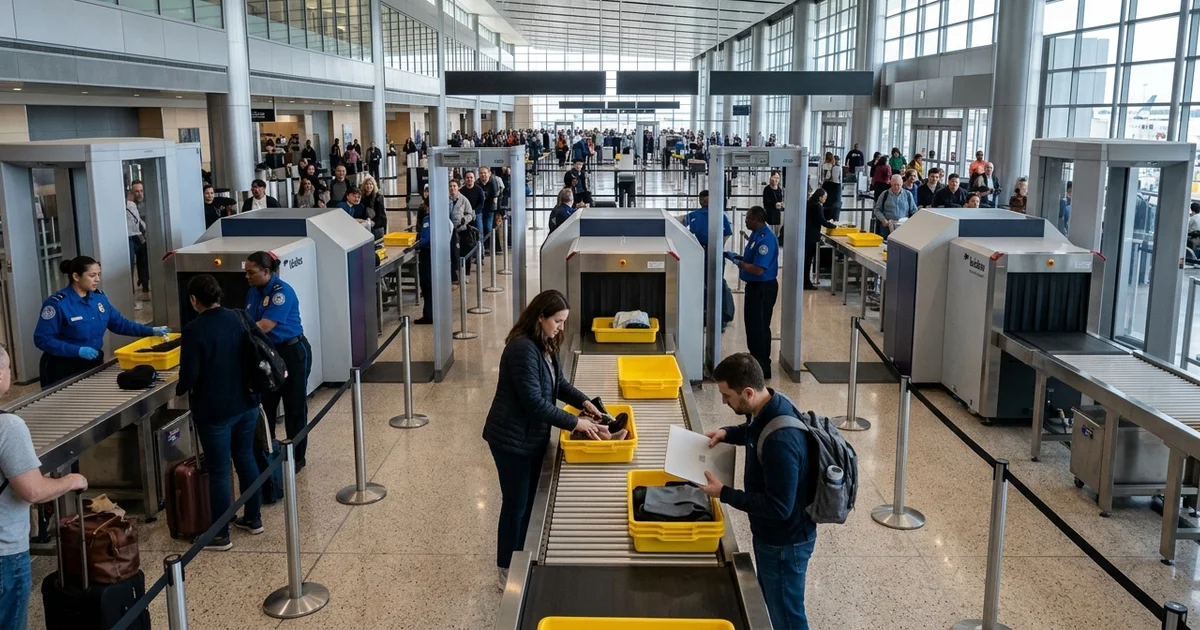
Airport Security Checkpoint Infrastructure
Engineering frameworks, throughput models, and deployment architecture for aviation security checkpoints — and the commercial screening systems that apply the same principles at schools, courthouses, stadiums, and critical facilities. 2M Technology brings aviation-grade screening engineering discipline to every high-volume checkpoint environment.
What is Airport Security Checkpoint Infrastructure?
Airport security checkpoint infrastructure is the integrated system of X-ray inspection equipment, advanced imaging technology (AIT), walkthrough metal detectors (WTMD), automated tray return systems (ATRS), divestiture staging areas, remote image analysis platforms, and passenger flow management systems deployed at Transportation Security Administration (TSA) screening checkpoints in commercial airports. Airport security checkpoint infrastructure operates under the most rigorous regulatory framework of any civilian screening environment and has produced the most thoroughly validated throughput engineering models in the industry — models that directly inform the design of high-volume non-aviation checkpoints at schools, courthouses, stadiums, and public assembly venues.
Passengers screened daily through U.S. TSA checkpoints — the largest sustained-throughput security screening operation in the world, producing the most comprehensive real-world checkpoint performance data available
Passengers per hour throughput for a well-configured standard X-ray checkpoint lane at a busy domestic airport — the benchmark against which all commercial facility checkpoint designs are calibrated
Computed tomography X-ray is replacing 2D X-ray as the TSA standard for checkpoint bag screening — CT provides 3D volumetric imaging that allows liquids to remain in bags, dramatically improving throughput per lane
Automated Tray Return Systems eliminate tray starvation — the single most common throughput bottleneck in high-volume checkpoints — and reduce the staffing required for tray logistics by 2-3 officers per lane
Airport Security Checkpoint Infrastructure Architecture
Modern airport security checkpoint infrastructure is a multi-zone flow system, not simply a row of X-ray machines and metal detectors. Each zone performs a specific function in the passenger processing sequence, and the sizing of each zone determines the throughput of the entire checkpoint.
Zone 1: Divestiture Area
The divestiture area is where passengers remove shoes, belts, laptops, and liquids before reaching the X-ray conveyor. Undersizing the divestiture area creates a backup that blocks the X-ray lane entrance even when the lane itself is clear. Standard airport divestiture areas provide 8-12 feet of staging per lane with 30-50 trays available at any time.
Zone 2: X-Ray Inspection
The X-ray tunnel inspects bags, carry-on items, and removed personal effects. Modern CT X-ray systems provide 3D volumetric imaging that enables liquids screening without removal, significantly improving throughput. Remote image analysis allows TSA officers to review images at a dedicated workstation rather than standing at the tunnel exit.
Zone 3: WTMD / AIT
Walkthrough metal detectors and Advanced Imaging Technology (millimeter wave) scanners screen the passenger simultaneously with X-ray bag inspection. Parallel passenger and bag processing is the key to maintaining high throughput — if one runs faster than the other, the slower element becomes the bottleneck for the entire lane.
Zone 4: Secondary Inspection
Secondary inspection areas handle AIT and WTMD alarm resolution, ETD (explosive trace detection) swabbing, and bag checks for X-ray anomalies. Standard airport secondary areas are sized to absorb 5-8% alarm rates without blocking the primary lane exit. Undersized secondary areas are the primary cause of lane stoppage at busy checkpoints.
Zone 5: Collection and Exit
The post-screening collection area is where passengers reassemble items removed during divestiture. Automated Tray Return Systems (ATRS) continuously return trays from the exit end to the divestiture area, eliminating tray starvation. Collection area length must accommodate the reassembly time for the heaviest-divested passenger type at peak lane throughput.
Zone 6: Remote Image Analysis
Remote Image Analysis (RIA) allows X-ray images to be reviewed by trained officers at a centralized workstation rather than by an officer standing at each individual lane exit. This enables one highly trained image analyst to service multiple lanes simultaneously, concentrating detection expertise while freeing lane officers for passenger management functions.
Airport Security Checkpoint Infrastructure Throughput Reference
TSA-validated throughput benchmarks for standard checkpoint configurations. These figures inform the design of commercial facility checkpoints applying the same engineering principles.
| Configuration | Throughput | Key Enablers |
|---|---|---|
| Standard 2D X-ray + WTMD lane | 150-250 passengers/hr | Baseline; liquid removal required |
| CT X-ray + AIT lane | 250-400 passengers/hr | No liquid removal; 3D imaging; TSA PreCheck compatible |
| CT X-ray + AIT + ATRS | 350-500 passengers/hr | Automated tray return eliminates starvation; highest sustained throughput |
| TSA PreCheck dedicated lane | 400-600 passengers/hr | No shoe removal, no liquid removal, trusted traveler population |
| Remote Image Analysis (1 analyst, 3-4 lanes) | Multiplies per-lane throughput | Centralizes image expertise; frees lane officers for passenger management |
Airport Security Checkpoint Infrastructure Principles Applied to Commercial Facilities
The TSA has invested billions of dollars validating checkpoint engineering principles over 20+ years of high-volume operations. These validated principles — not vendor spec sheets — are the correct foundation for commercial facility checkpoint design.
Divestiture area sizing
Aviation: 8-12 ft per lane with 30-50 trays. Schools and courthouses: adapt to backpack and briefcase density with equivalent staging depth and tray count.
Parallel bag and passenger screening
Aviation: X-ray and WTMD run simultaneously. Every commercial checkpoint: bag screening and personnel screening must run in parallel, never sequentially.
Secondary area absorption rate
Aviation: sized for 5-8% alarm rate. Commercial: sized for 3-5% alarm rate. In both cases: must not block primary lane exit under any alarm scenario.
Operator rotation intervals
Aviation: 20-30 minute X-ray monitor rotation is TSA SOP. Commercial: the same rotation interval applies — detection rates degrade significantly beyond 30 minutes of continuous operation.
How Airport Security Checkpoint Infrastructure Design Principles Apply to Your Facility
Airport vs. Commercial Checkpoint Equipment Comparison
| Component | Aviation (TSA) | Commercial Facility |
|---|---|---|
| X-Ray system | CT (3D volumetric) — TSA QPL required | 2D dual-view; CT for high-security applications |
| Personnel screening | AIT (millimeter wave) + WTMD backup | WTMD; AIT for high-security or courthouse applications |
| Tray return | Automated Tray Return System (ATRS) | Manual return standard; ATRS for high-volume installations |
| Image analysis | Remote Image Analysis (RIA) with dedicated workstations | On-lane operator; remote monitoring for multi-site operations |
| Explosive detection | ETD (Explosive Trace Detection) mandatory | Optional; recommended for courthouse and government facilities |
| Throughput per lane | 150-500 passengers/hour (config-dependent) | 150-250 persons/hour (standard commercial) |
Need a Portable Container Screening Checkpoint?
For general aviation terminals, remote apron checkpoints, or temporary screening capacity, 2M Technology builds custom container security checkpoints — self-contained units with X-ray screening, walk-through metal detectors, turnstiles, cameras, and access control. Delivered ready to operate.
View Custom Container Security Checkpoints →Aviation Screening Standards
Airport checkpoint infrastructure operates inside the most codified screening environment in the U.S.: passenger and baggage screening follows TSA screening procedures, airside construction and safety phasing follows FAA airport safety programs, and cabinet X-ray equipment is regulated under FDA 21 CFR 1020.40. For GA terminals, FBOs, and employee screening points outside TSA-staffed checkpoints, 2M configures the same class of equipment — dual-view X-ray at 160 kV and NIJ-benchmarked metal detection — matched to the facility’s security program.
Related Screening Infrastructure Resources
Frequently Asked Questions: Airport Security Checkpoint Infrastructure
Apply Aviation-Grade Screening Engineering to Your Facility
2M Technology brings the throughput models, zone architecture, and operational frameworks of airport security checkpoint infrastructure to schools, courthouses, stadiums, religious facilities, healthcare campuses, and warehouses — without the regulatory complexity or procurement requirements of TSA-regulated aviation checkpoints.