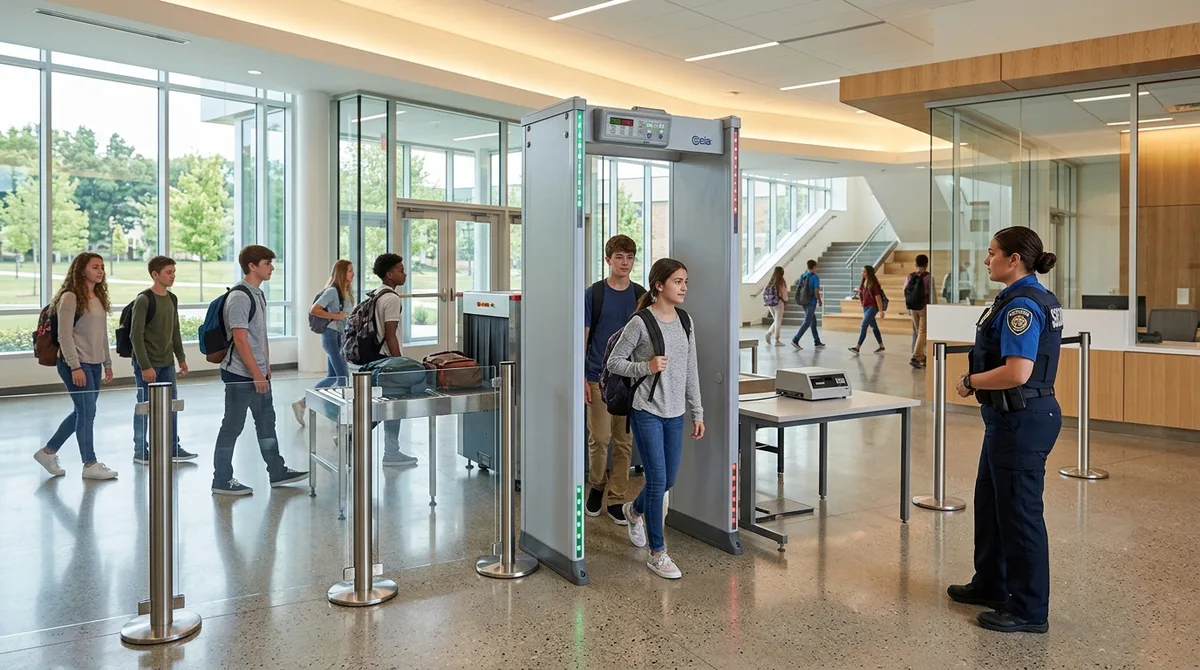
Evolv Technology sells AI-based concealed-weapons screening portals — free-flow gateways that scan visitors as they walk through without emptying pockets. They dominate the category’s marketing, but buyers researching alternatives usually have three concerns: subscription cost, detection accuracy claims, and whether a simpler proven technology does the job. This guide compares every serious alternative, including the one most schools and courthouses ultimately choose.
Why Buyers Look for Evolv Alternatives
Three reasons come up in nearly every evaluation.
- Cost model: AI screening portals are typically sold as multi-year subscriptions per lane — school-district budget documents have put annual costs in the tens of thousands of dollars per lane — while conventional multi-zone metal detectors are a one-time purchase, typically under $10,000 per lane.
- Accuracy scrutiny: in November 2024 the FTC took action against Evolv Technologies over marketing claims about what its AI-powered screening could reliably detect.
- Fit: free-flow screening trades thoroughness for speed — the right call for a 20,000-seat stadium, often the wrong one for a courthouse door.
The 5 Alternatives Compared
1. Multi-Zone Walk-Through Metal Detectors (the proven default)
Modern multi-zone units are not the airport archways of the 1990s. 2M Technology’s walk-through line spans 6 to 90 detection zones — pinpointing where on the body an item sits — with throughput of 30–60 people per minute per lane and programmable sensitivity profiles for schools, courthouses, and venues. Detection performance is benchmarked against NIJ Standard 0601.02 from the National Institute of Justice — a published federal standard, not a proprietary marketing claim. One-time purchase, no per-lane subscription, and any technician can service them.
2. AI Concealed-Weapons Portals (Evolv’s direct peers)
If free-flow screening is a hard requirement, Evolv is not the only vendor: CEIA’s OPENGATE, Xtract One’s SmartGateway, and Metrasens Ultra compete in the same category, each with different sensor approaches and pricing. Evaluate all of them on the same two questions — what does the subscription actually cost over 5 years, and what does independent (not vendor) testing say about detection rates for the threat items you care about.
3. X-Ray + Metal Detector Checkpoints (the courthouse standard)
Where the mandate is “nothing gets through” rather than “keep the line moving,” the proven answer is a staffed checkpoint: X-ray baggage screening for what people carry, a walk-through detector for what they wear. This is the configuration courts, government buildings, and correctional facilities standardize on. 2M builds these as complete checkpoint systems — including container-built units that deploy in hours.
4. AI Video Gun Detection (a different layer, not a replacement)
ZeroEyes, Omnilert, and similar platforms analyze existing camera feeds to detect a drawn, visible firearm and alert staff — see our full gun detection systems comparison for how this layer fits. That is a response-acceleration tool, not entry screening — it cannot find a concealed weapon. Some campuses run both layers; neither substitutes for the other.
5. Handheld Screening (the budget tier)
Handheld wands paired with trained staff cost hundreds, not thousands, and work for low-volume or secondary screening. Throughput is the limit: expect 3–5 people per minute per officer, which is why wands are almost always the backup to a walk-through lane rather than the primary.
Side-by-Side Comparison
| Option | Detects | Throughput/Lane | Cost Model | Benchmark |
|---|---|---|---|---|
| Multi-zone walk-through (2M) | Concealed metal weapons, zone-located | 30–60/min | One-time purchase | NIJ 0601.02 |
| AI portals (Evolv, CEIA, Xtract One) | Concealed weapons per vendor AI | Up to free-flow | Multi-year subscription per lane | Vendor claims; FTC scrutiny |
| X-ray + WTMD checkpoint | Carried and worn threats | Depends on staffing | One-time purchase | NIJ 0601.02 + FDA 21 CFR 1020.40 |
| AI video gun detection | Visible drawn firearms only | Passive (camera-based) | SaaS subscription | Vendor claims |
| Handheld wands | Concealed metal, manual sweep | 3–5/min per officer | One-time purchase | NIJ 0602.02 |
A Real Deployment Instead of a Demo
When Proviso Township High Schools (Illinois) needed entry screening across multiple buildings, the district deployed 2M X-ray scanners with walk-through detection lanes — conventional, certified equipment their own staff operate daily. Read the Proviso Township case study for scope and outcome, or see how the same stack works in courts in our courthouse checkpoint design guide.
Evolv Alternatives FAQ
-
Is a multi-zone metal detector as effective as Evolv?
For concealed metal weapons — guns, knives — a modern multi-zone detector benchmarked to NIJ 0601.02 is the technology with a published federal standard behind it. AI portals optimize for speed and lower divestiture; their detection claims are vendor-published, which is precisely what the FTC action concerned. Match the tool to your threat model and traffic volume.
-
What does an Evolv-style system cost versus a metal detector?
AI screening portals are subscription products — school-district budget filings have shown annual per-lane costs in the tens of thousands. A 2M multi-zone walk-through is a one-time purchase typically under $10,000 per lane, with no recurring license. Over a 5-year horizon the difference per lane commonly exceeds $100,000.
-
Can I get free-flow screening without Evolv?
Yes — CEIA OPENGATE, Xtract One SmartGateway, and Metrasens Ultra compete directly in the free-flow category. Compare their 5-year subscription totals and independent test results side by side with Evolv before committing.
-
What do schools actually deploy?
Both. Districts with high daily throughput and large budgets have adopted AI portals; districts prioritizing certified detection and predictable cost deploy multi-zone walk-through units — see our guide to metal detectors for schools, including Texas grant funding paths.
-
Do I still need staff with any of these?
Yes. Every screening technology — AI portal or conventional — needs a trained officer for secondary screening of alarms. Budget the staffing identically across options; it is the subscription line that differs.
-
Can 2M help us compare options for our facility?
Yes — 2M Technology (Texas Security License B15309) designs screening checkpoints for schools, courts, venues, and industrial sites nationwide, and will spec conventional detection honestly against AI portals for your throughput and threat model. Request a free assessment.