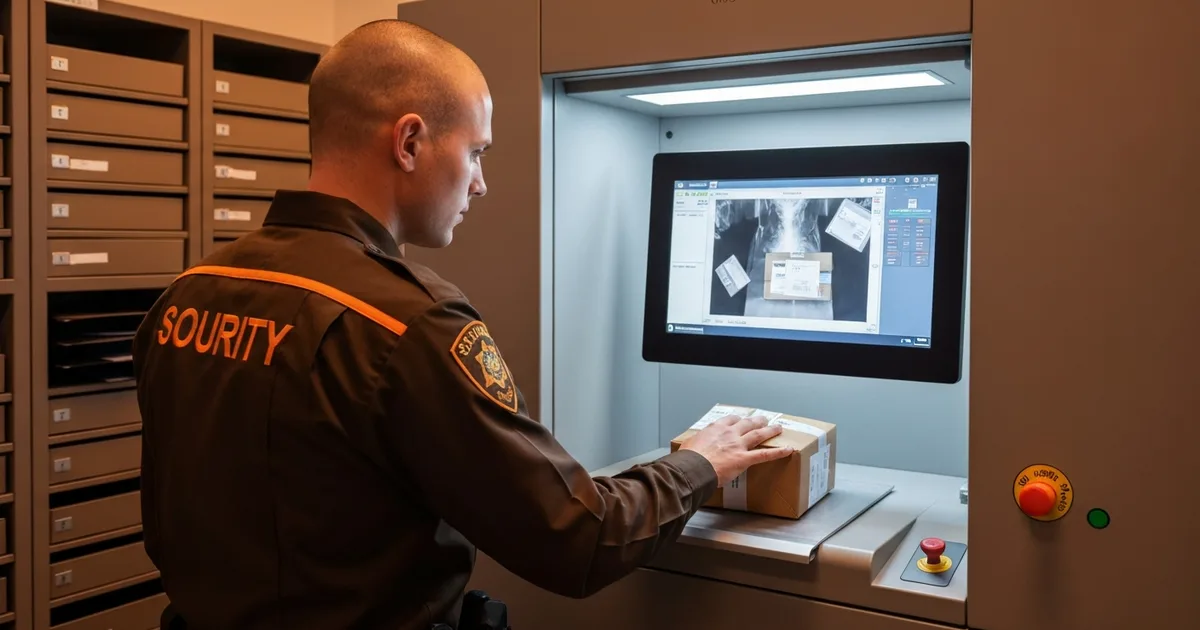
Mailroom Threat Inspection Workflow: X-Ray Screening for Packages and Correspondence
A complete mailroom threat inspection workflow covering X-ray screening protocols, suspicious item identification, isolation procedures, and escalation chains for government, corporate, and high-profile organizational mailrooms.
A mailroom threat inspection workflow integrates X-ray screening equipment, operator training, suspicious item identification criteria, and documented escalation procedures into a consistent process that intercepts threatening mail and packages before they reach their intended recipients. Organizations targeted by mail-based threats — government agencies, political offices, financial institutions, law firms, and high-profile corporations — require more than a screening machine: they require an engineered workflow that delivers reliable threat interception without creating operational bottlenecks that cause mail to bypass inspection entirely.
Mail Threat Categories and X-Ray Screening Targets
| Threat Category | X-Ray Indicators | Response Level |
|---|---|---|
| Improvised explosive device (IED) | Wiring, battery, dense mass, asymmetric density | Immediate evacuation, law enforcement |
| Suspicious powder / biological agent | Low-density bulk material, unusual packaging pattern | Isolation, HAZMAT notification |
| Bladed weapon / sharp object | High-density linear profile, knife or blade shape | Hold and notify security |
| Firearm or components | High-density mechanical shape, spring components | Immediate law enforcement |
| Contraband / unauthorized electronics | Circuit board profile, battery, hidden cavities | Hold, notify security supervisor |
The Complete Mailroom Threat Inspection Workflow
X-Ray System Requirements for Mailroom Threat Inspection
Image Quality
Minimum 0.4mm wire resolution. High-penetration dual-energy imaging to distinguish organic from inorganic materials. Color-coded density display enabling operators to rapidly distinguish wiring, batteries, and dense metallic components from paper and clothing.
Throughput Capacity
Conveyor aperture sized for standard envelope through large parcel (typically 40cm x 30cm minimum). Speed calibrated to allow adequate operator review time — typically 0.2 to 0.3 m/s for mailroom applications, lower than baggage screening to allow careful image review.
Image Archive
Minimum 90-day image retention with item tracking by barcode or RFID. Law enforcement investigations following a mail threat incident require image retrieval capability. Tamper-evident logging of all operator actions, threshold changes, and system access events.
Operator Certification
Mailroom X-ray operators require periodic image interpretation training using test image libraries that include IED components, weapons, and threat materials. Certification programs typically require 16 to 24 hours of initial training and annual recertification with performance testing against a standard threat image library.
Suspicious Item Indicators: Training Standards for Mailroom Operators
Mailroom X-ray operator training must cover both technical image interpretation and non-X-ray indicators that flag items for additional scrutiny before they reach the machine. External indicators include excessive postage, no return address or fictitious return address, misspelled recipient information, unusual odor, staining or oily residue, uneven weight distribution, and protruding wires or strings. X-ray image indicators include batteries with wiring attached, asymmetric dense components in soft packaging, shielded cavities, metallic components inconsistent with the stated package contents, and powder or granular material in unusual container forms. Operators should be trained to treat external and X-ray indicators as complementary — an item with suspicious external indicators warrants more careful X-ray review even if the initial image appears unremarkable.
Related Screening Infrastructure Resources
- Screening Infrastructure Engineering Center
- Screening Infrastructure for Critical Facilities
- Warehouse Security Screening
- Courthouse Security Checkpoint Design
Is Mailroom threat inspection the Right Approach for Your Operation?
Mailroom threat inspection from 2M Technology is appropriate when standard security measures cannot address the scale, throughput, or detection requirements of the operation. 2M Technology engineers mailroom threat inspection solutions that are calibrated to your specific site, threat profile, and operational workflow — not generic off-the-shelf configurations.
The core advantage of mailroom threat inspection from 2M Technology is open architecture and interoperability. Every component integrates with existing credentialing, video management, and access control platforms already in use — there is no proprietary lock-in and no requirement to replace functioning systems.
Key Questions When Evaluating Mailroom threat inspection Options
- Does the mailroom threat inspection solution deploy without permanent structural changes?
- Can the mailroom threat inspection system scale incrementally as operational requirements grow?
- Is the solution cloud-connected for remote oversight and event review?
- Does the mailroom threat inspection provider offer site assessment and ongoing support?
- Can the system integrate with your existing access control and VMS platforms?
Contact 2M Technology at (214) 988-4302 for a site-specific mailroom threat inspection assessment.
Frequently Asked Questions: Mailroom Threat Inspection
What X-ray resolution is required for effective mailroom threat detection?
Effective mailroom X-ray inspection requires a minimum of 0.4mm wire resolution to reliably detect the wiring and battery components associated with IEDs. High-penetration dual-energy imaging is recommended to distinguish organic materials (such as explosive compounds) from metallic components. Systems with lower resolution may miss fine wiring details that are critical for threat identification.
How often should mailroom X-ray operators be retrained?
Annual recertification with performance testing against a standard threat image library is industry standard for mailroom X-ray operators. Initial certification requires 16 to 24 hours of training covering image interpretation, threat indicators, and escalation procedures. High-volume or high-risk mailrooms may require semi-annual refreshers and monthly performance testing.
What should a mailroom operator do when they see a suspicious X-ray image?
The operator should immediately stop the conveyor, not move or open the item, and notify the security supervisor using the documented escalation procedure. The item should remain in the X-ray machine or be isolated in a designated hold area depending on the threat classification. Law enforcement should be contacted for any item that cannot be immediately classified as non-threatening by trained personnel.
Design Your Mailroom Threat Inspection Program
2M Technology engineers mailroom X-ray screening systems and inspection workflows for government, corporate, and high-profile organization mailrooms — including operator training protocols and escalation procedure documentation.
References: CISA Physical Security Guidelines · FBI Bomb Data Center Resources