Precision is everything when operating cranes across offshore energy platforms, port facilities, and onshore industrial sites. Whether your crew is manning a pedestal crane on a floating vessel or handling heavy materials on land, clear visibility is critical for safety and efficiency. The problem is that standard surveillance equipment simply cannot survive these demanding conditions, making explosion proof crane cameras necessary. Between the constant saltwater spray, intense boom vibrations, and the persistent threat of explosive gases, you need hardware that is engineered for these exact conditions.
At 2M Technology, our explosion proof crane cameras are built for offshore and onshore deployments. These explosion proof crane cameras meet strict ATEX and IECEx standards. They provide reliable monitoring that helps maintain compliance with API RP 2D inspection protocols while keeping your lifting operations safe and minimizing down-time.
Four Critical Requirements for Explosion Proof Crane Cameras
When outfitting an offshore crane, the operating environment dictates strict technical requirements. If you are upgrading your equipment to meet OEM specifications, your explosion proof crane cameras must excel in four key areas:
- IECEx / ATEX Zone 1 or Class I, Div 1 Certification: Offshore platforms and Floating Production, Storage, and Offloading vessels (FPSOs) process highly volatile substances. Cameras mounted near the topside, winch areas, or boom must be fully certified to operate safely in environments where explosive gases are continuously or intermittently present.
- 316L Stainless Steel Housing: Marine environments are brutal on equipment. To prevent rapid saltwater corrosion and ensure a long lifecycle, a marine-grade 316L stainless steel enclosure is absolutely critical for any offshore installation.
- High-Vibration Resistance: Pedestal cranes experience intense dynamic forces. Your camera must feature robust shock absorption and high-vibration resistance to withstand continuous boom and pedestal vibration without losing image stability.
- Long-Range PTZ Zoom or Thermal Imaging: Operators need clear load monitoring directly from the cab. A camera with long-range Pan-Tilt-Zoom (PTZ) capabilities or thermal imaging ensures the operator has perfect visibility of the hook and load, regardless of weather conditions or distance.
Recommended Explosion Proof Crane Cameras from 2M Technology
For corrosive offshore environments, we highly recommend our SS316L stainless steel solutions. Here are the top performers when selecting explosion proof crane cameras for continuous load monitoring and operator visibility.
Best Overall for Offshore Crane Monitoring
These models are built to handle the physical abuse of lifting operations while maintaining crystal-clear visibility.

2MEB16-T5M
A 5MP 4-in-1 Mini Explosion-Proof Camera with a fixed lens and a compact 316L stainless steel housing.
Product Specifications2MEB16-IP4M
A rugged 4MP Fixed Explosion-Proof Camera designed for continuous reliability.
Product Specifications
2MEPIR16-T2M33X
A 2MP Analog Explosion-Proof PTZ Camera with 33X zoom for excellent detail at a distance.
Product Specifications2MEPIR16-IP4M22X
A 4MP Explosion-Proof PTZ Camera featuring 22X optical zoom for precise maneuvering.
Product Specifications
2MEP16-IP5M32X
A 4MP 32X Starlight Network Explosion-Proof PTZ Speed Dome Camera built specifically for low-light operations.
Product Specifications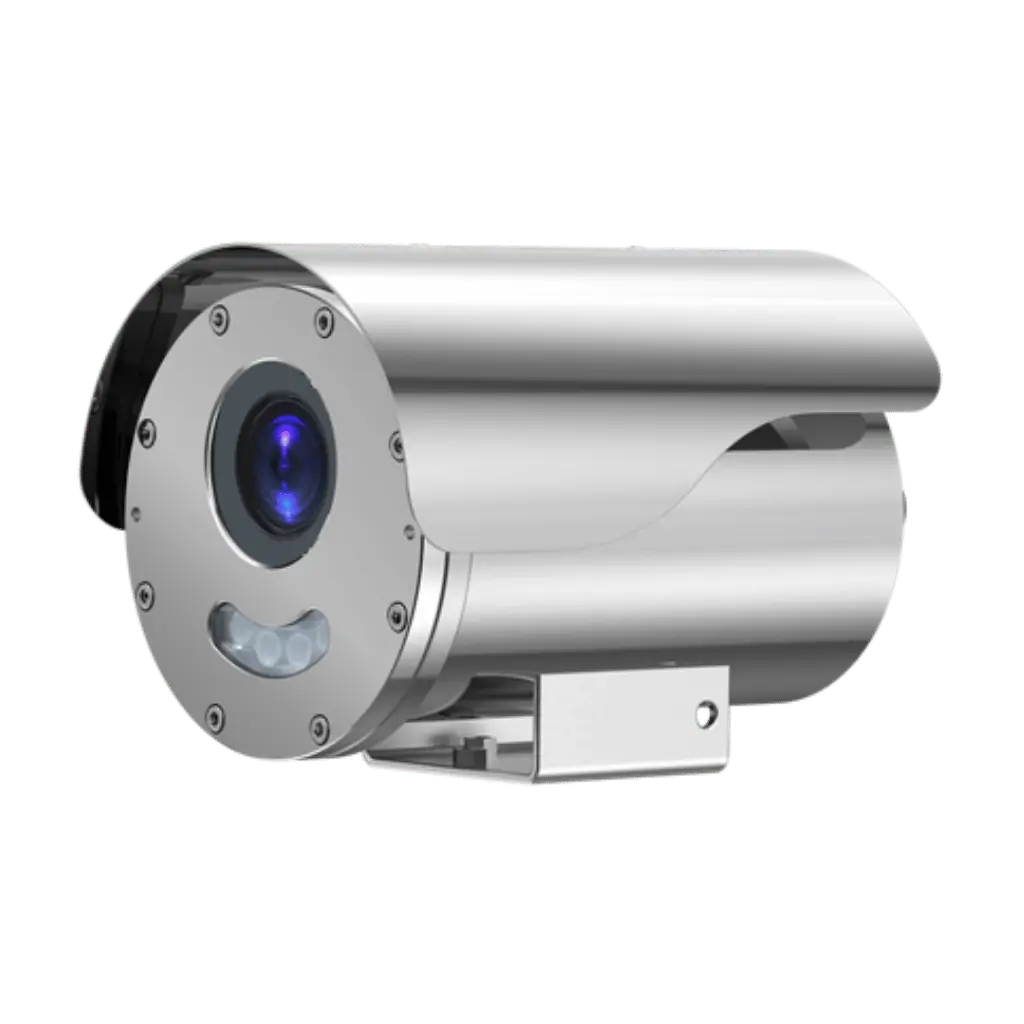
Best for Long-Distance Load Monitoring

2MEPT04-4M37X
This model features a powerful 37X optical zoom. It allows operators to monitor hooks, loads, and lifting operations from significant distances without sacrificing image quality or situational awareness.
Product SpecificationsBest Thermal and Visible Imaging Solution
2MEPT16-TH6450MM
An Explosion-Proof Thermal PTZ Camera equipped with a 50mm thermal lens and an integrated visible camera. This dual-sensor design ensures all-weather monitoring and unmatched visibility through fog, heavy rain, or total darkness.
Product SpecificationsComplete Purpose-Built Explosion Proof Crane Camera System
To get the most out of your setup, you need more than just a single camera. A fully functioning system using explosion proof crane cameras requires seamless integration that stretches from the crane boom all the way into the operator cab.

We round out our complete systems by including a 17-inch explosion-proof monitor equipped with a 4-channel built-in NVR. This advanced setup makes it incredibly easy for operators to view multiple explosion proof crane cameras at the exact same time directly from their seat. Furthermore, our explosion-proof RS485 controller serves as the ideal tool for remotely operating PTZ cameras, ensuring you maintain total situational awareness throughout both offshore and onshore drilling operations. To tie everything together, we supply heavy-duty explosion-proof armored cables that are designed to withstand the physical abuse, extreme loads, and constant movement of daily crane operations while staying compliant with API Spec 2C, API RP 2D, and API Q1 standards.
Why Choose 2M Technology’s Explosion Proof Crane Cameras?
Finding reliable suppliers for explosion proof crane cameras is surprisingly difficult. Even when you do locate a capable vendor, you are often forced to deal with lead times of six to seven weeks just to get your equipment on site. We know that many offshore operators are already familiar with the HERNIS CT40 system, which has long been considered an industry benchmark for topside monitoring. Even though the HERNIS platform is undoubtedly a proven solution, it usually comes with exceptionally high acquisition costs, frustratingly long wait times, and very limited flexibility for customization.
2M Technology offers a much more practical and cost-effective alternative. Our explosion proof crane cameras deliver the exact same rugged, ATEX-certified performance required for hazardous environments but with far better pricing and significantly faster availability. We build our systems specifically to keep your projects on schedule and your crews completely safe, all without draining your entire equipment budget.
Brand Comparison: 2M Technology vs. The Competition
When upgrading your offshore or onshore lifting equipment, you need to know exactly how your investment stacks up against traditional options and industry benchmarks. Although standard retrofits or legacy brands might seem like the default choice, breaking down the specific technical and operational details reveals a different story.
Here is a detailed look at how 2M Technology’s explosion proof crane cameras compare to legacy industry standards like the HERNIS CT40 and retrofitted standard cameras.
| Feature | 2M Technology Explosion-Proof Crane Cameras | Legacy Industry Standards (e.g., HERNIS CT40) | Retrofitted Standard Cameras (Camera + Ex-Housing) |
|---|---|---|---|
| Overall Price Point | Highly cost-effective; no hidden ecosystem fees | Premium acquisition cost; often requires expensive proprietary add-ons | Moderate to high (must buy the camera and specialized housing separately) |
| Typical Lead Times | Readily available with fast turnarounds | Lengthy wait times (often 6 to 7 weeks) | Moderate to slow (depends on sourcing components from multiple vendors) |
| Hazardous Certifications | ATEX and IECEx | ATEX and IECEx | Varies depending on vendor |
| Flexibility & Customization | Highly customizable options, including cable lengths, thermal imaging, and PTZ configurations | Rigid product lines with limited room for customizations | Varies depending on vendor |
| Housing Material | 316L Stainless Steel | 316L Stainless Steel | Lesser grade 304 Stainless Steel or heavy cast aluminum |
| Vibration & Shock Tolerance | Engineered for the extreme dynamic forces of crane booms and pedestals | Excellent vibration resistance | Poor (commercial cameras often vibrate loose inside enclosures) |
| VMS Integration | Fully ONVIF compliant for seamless VMS or NVR integration | Proprietary protocols that lock you into their specific ecosystem | ONVIF compliant, depending on the internal camera brand |
| Complete System Ecosystem | Full suite of accessories including Ex-proof monitors, controllers, and armored cables. | Full suite of ecosystem accessories | Housing only, requiring you to source cables and monitors separately |
| Maintenance & Support | Plug-and-play design with accessible, US-based technical support | Reliable, but requires expensive specialized technicians for repairs | Difficult to maintain (opening the housing compromises the seal) |
Upgrading your lifting operations is a critical investment in both personnel safety and daily efficiency. When your crew is operating in highly volatile and corrosive environments, there is absolutely no room for equipment failure or compromised visibility. At the same time, securing top-tier monitoring equipment should not mean exhausting your project budget or waiting several months for a delivery.
2M Technology offers the perfect balance of rugged durability and modern adaptability. Our explosion proof crane cameras deliver the 316L marine-grade build quality and strict safety certifications expected from legacy brands, but without the prohibitive price tags and restrictive proprietary ecosystems. Combined with fast shipping times and open-platform flexibility, we make it easier than ever to meet the demands of modern offshore or onshore projects.
Frequently Asked Questions (FAQs)
-
What makes a crane camera truly explosion-proof?
To be classified as explosion-proof, the camera must be enclosed in a heavy-duty, flame-proof housing (usually made of 316L stainless steel) engineered to contain any internal spark, flash, or explosion. This ensures that even if an internal electrical fault occurs, the camera enclosure prevents any flame or heat from escaping and igniting the volatile gases or combustible dust present in the surrounding offshore or onshore atmosphere.
-
Why is 316L stainless steel mandatory for offshore crane cameras?
Standard camera enclosures, even those made of aluminum or 304-grade stainless steel, quickly pit, rust, and fail when subjected to constant saltwater spray and harsh marine winds. 316L marine-grade stainless steel contains molybdenum, an alloy element that drastically increases resistance to chloride pitting and galvanic corrosion. This material is a non-negotiable requirement for reducing down-time and maximizing the lifecycle of your hardware on an offshore pedestal crane or drilling platform.
-
How do explosion-proof crane cameras handle high boom vibration?
Crane booms and winches experience intense structural shock and continuous dynamic vibration during lifting operations. Standard security cameras will quickly suffer from loose internal components, sensor drift, and shaky, unusable footage. Purpose-built explosion proof crane cameras feature internal heavy-duty shock absorption mounts and specialized pan-tilt motor gears designed to isolate the lens sensor from physical impact, delivering smooth video feed back to the operator cab.
-
Are thermal imaging cameras necessary for offshore crane operations?
While standard visible lenses are great for clear daylight operations, thermal imaging adds an entirely new layer of safety and visibility. Offshore environments are notorious for heavy fog, driving rain, and pitch-black nights. In these conditions, standard optics often fail. By integrating thermal explosion proof crane cameras, operators can clearly see load outlines, safely detect deck personnel, and monitor equipment heat signatures regardless of the weather or time of day. We offer dual-sensor models, like the 2MEPT16-TH6450MM, that combine both visible and thermal lenses in one robust housing for true all-weather performance.
-
Do operators need a specialized monitor inside the crane cab?
Yes, the environment inside the operator cab can still fall under hazardous area classifications depending on the specific layout of your platform. To ensure total compliance and safety, we recommend pairing your explosion proof crane cameras with our 17-inch explosion-proof monitor. This specialized display features a 4-channel built-in NVR. It allows the operator to view multiple live camera feeds from the boom, winch, and pedestal all on one screen, completely eliminating the need for bulky extra equipment inside a tight cab space.
-
What is the typical lead time when ordering these explosion proof crane cameras?
One of the biggest frustrations in the offshore industry is waiting months for replacement hardware. While legacy brands often quote lead times of six to eight weeks for topside monitoring equipment, 2M Technology does things differently. We maintain much better stock levels and can fulfill critical orders significantly faster. By choosing our explosion proof crane cameras, you experience far less operational downtime and keep your facility upgrades perfectly on schedule.
Get Explosion Proof Crane Cameras for Your Offshore/Onshore Operations
Do not let poor visibility or outdated surveillance gear put your operations at risk. Contact our team at 2M Technology today to discuss your specific operational requirements, and discover how our purpose-built monitoring solutions can keep your projects running safely and on schedule.
Quotes returned within 24 hours • (214) 988-4302 • sales@2mtechnology.net
Related Resources
- Understanding ATEX and IECEx Certifications: A deep dive into hazardous area classifications, helping you understand the exact differences between Zone 1, Zone 2, and Class I Division 1 environments so you can specify the right hardware.
- Explosion-Proof PTZ Cameras: Browse our complete catalog of pan-tilt-zoom solutions built exclusively for volatile environments, featuring marine-grade 316L stainless steel housings and heavy-duty wiper systems.
- Hazardous Area Monitors and Accessories: Complete your cab setup with our specialized 17-inch explosion-proof monitors, dedicated RS485 controllers, and API-compliant heavy-duty armored cables.
- Surveillance Solutions for the Oil and Gas Industry: Discover how 2M Technology secures upstream, midstream, and downstream operations with ruggedized, weather-proof camera systems.