Shop commercial network IP cameras with AI motion detection, night vision, PoE, and remote access. Dome, bullet, PTZ, fisheye, and 4K models. Expert installation in Dallas-Fort Worth.
Network IP security cameras transmit video over ethernet or WiFi — offering resolutions from 2MP to 4K+, AI-powered analytics, remote access from any device, and Power over Ethernet (PoE). Available in dome, bullet, turret, PTZ, fisheye, and panoramic form factors for commercial, industrial, and institutional facilities.
Commercial network IP cameras (Internet Protocol cameras) are digital security cameras that transmit video over an ethernet or Wi-Fi network rather than a coaxial cable. Unlike legacy analog cameras, each IP camera has its own network address and can send compressed HD video directly to a network video recorder (NVR), cloud platform, or video management software (VMS) over standard IT infrastructure.
The shift from analog CCTV to network IP cameras has changed commercial security installation. An IP camera system requires no separate video cable — only a Cat5e or Cat6 ethernet cable carrying both data and power (PoE). This eliminates the coaxial cable and separate power cable run required for analog, reducing installation labor by 40-60% on large projects.
| Type | Coverage Pattern | Best For | Indoor / Outdoor | Resolution Range |
|---|---|---|---|---|
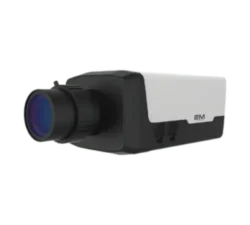
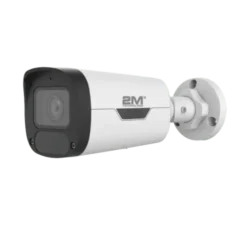
| Fixed bullet camera | Narrow cone, 1 direction | Perimeter, parking lots, entry points | Both (IP66 outdoor) | 2MP to 8MP (4K) |
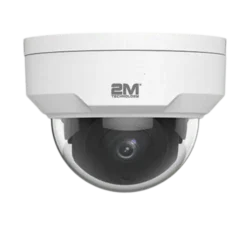
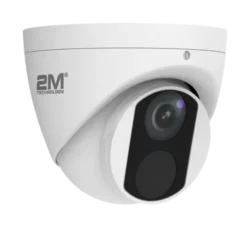
| Fixed dome camera | Wide cone, 1 direction | Interior areas, lobbies, corridors | Both (vandal-resistant dome) | 2MP to 8MP (4K) |
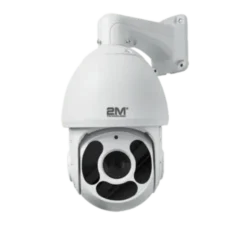
| PTZ (pan/tilt/zoom) | 360 pan, 90 tilt, optical zoom 20-40x | Wide-area perimeter, parking, stadiums | Both (outdoor IP66) | 2MP to 4MP with optical zoom |
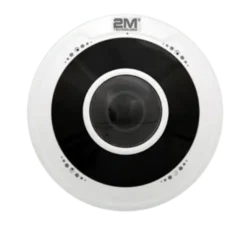
| Fisheye / 360 | Full 180 or 360 degree | Open-plan interiors, lobbies, large rooms | Primarily indoor | 5MP to 12MP (dewarped) |
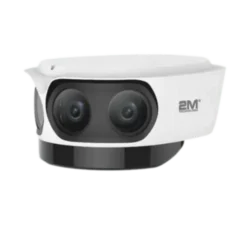
| Multi-sensor panoramic | 4 sensors, 90 degrees each = 360 | Parking lots, large retail floors | Both | 8MP to 32MP combined |
| License plate recognition (LPR) | Narrow, high contrast | Vehicle entry/exit lanes, parking gates | Outdoor | 2MP to 4MP with IR |
Most commercial network IP camera installations use Power over Ethernet (PoE). A single Cat5e/Cat6 cable to each camera location provides both network data and power — no separate power cable, no local transformer. PoE cameras are more reliable than wireless and are the standard for any installation where cable runs are feasible.
Wireless IP cameras are appropriate for existing structures where cable installation is too invasive (historic buildings, temporary installations) and sites where a wired network already exists but cable runs are impractical. Wireless cameras require battery power or a local power outlet and are susceptible to RF interference in industrial environments. 2M Technology recommends wired PoE for all permanent commercial installations.
| Resolution | Pixels | Use Case | Storage per Camera per Day (H.265) |
|---|---|---|---|
| 2MP (1080p) | 1920 x 1080 | Interior areas, employee access, non-critical zones | 6-10 GB/day at 15 fps continuous |
| 4MP (1440p) | 2560 x 1440 | High-value interiors, retail, cashier areas | 12-18 GB/day at 15 fps continuous |
| 4K / 8MP | 3840 x 2160 | Wide-area exterior, large parking lots, stadiums | 20-30 GB/day at 15 fps continuous |
| LPR-optimized | 2MP with narrow FOV | License plate capture at 20-40 feet | 8-12 GB/day |
Rule of thumb: 4MP is the minimum for facial identification at distances over 15 feet. For license plate capture at a vehicle gate, use an LPR-optimized camera with a 6-12mm lens, not a standard 2MP wide-angle dome.
A manufacturing facility in Grand Prairie, Texas operating with a 16-camera analog CCTV system from 2009 contacted 2M Technology following an equipment theft incident in the shipping dock area. The existing analog system produced 480-line resolution footage that was too low to identify the individuals involved.
2M Technology replaced the system with 24 network IP cameras: 18 x 4MP fixed cameras covering interior production areas and corridors, 4 x 4K bullet cameras on the perimeter and parking lot, and 2 x LPR cameras at the main vehicle gate. The new system was connected via an existing Cat6 infrastructure to a 32-channel NVR with 60-day retention. Total labor time was 2 days. The facility now has facial-identification-quality footage at all critical areas and license plate records for all vehicles entering the lot.
Network-connected cameras are endpoints that can be targeted by attackers if not properly hardened. Key risks: default passwords never changed, no firmware updates, cameras accessible from the public internet without authentication. Best practices per NIST Cybersecurity Framework: change all default passwords before installation, keep camera firmware current, place cameras on a dedicated VLAN separated from business IT systems, disable public internet access or secure with VPN.
Commercial network IP cameras transmit compressed HD video over standard Ethernet or fiber, eliminating the distance limits and signal degradation of analog CCTV. 2M Technology designs and installs commercial network IP cameras for warehouses, corporate campuses, retail chains, and industrial facilities throughout the Dallas–Fort Worth metroplex.
When specifying commercial network IP cameras, key parameters include: sensor resolution (2MP to 8MP/4K), low-light sensitivity (starlight or ColorVu rated), lens focal length (fixed vs varifocal), compression codec (H.265+ for 50–70% bandwidth savings over H.264), and PoE class (802.3af or 802.3at). Commercial network IP cameras with onboard AI analytics detect motion, count occupancy, and send push alerts without a dedicated server.
Our commercial network IP cameras integrate with Hikvision, Dahua, Axis, and Ubiquiti UniFi Video Management Systems (VMS) and support ONVIF Profile S and T for cross-brand compatibility. Storage options range from onboard SD card (32–512GB) to NVR, NAS, or cloud — most commercial network IP cameras support simultaneous local + cloud recording for redundancy.
For a commercial network IP camera system in Dallas-Fort Worth, call 2M Technology at (214) 988-4302 for a free on-site assessment and itemized quote.
2M Technology stocks commercial network IP cameras from 2MP fixed domes to 8K multi-sensor panoramic units. Every commercial network IP camera we install includes a 3-year on-site warranty, remote commissioning support, and integration with your existing VMS or access control platform. Reach out at (214) 988-4302 to discuss which commercial network IP cameras fit your budget and security objectives.
Not sure which commercial network IP cameras fit your facility? Our Dallas team has installed commercial network IP cameras at 200+ sites. Compare commercial network IP cameras by resolution, IR range, and AI capability — or request a commercial network IP camera quote at (214) 988-4302. All commercial network IP cameras include a 3-year warranty and on-site installation.
Analog CCTV cameras send a continuous video signal over coaxial cable to a DVR (digital video recorder), which converts it to digital and records it. IP cameras send already-digitized, compressed video over ethernet cable or Wi-Fi to an NVR or cloud platform. IP cameras offer significantly higher resolution (2MP to 4K vs analog maximum of ~1MP), easier installation using existing network infrastructure, and remote access over any network-connected device. They also support on-camera analytics, motion zones, and audio.
Yes. Network IP cameras record to an NVR (Network Video Recorder) on a local network, not to the internet. The internet connection is only required if you want remote viewing on a phone or laptop when off-site. Local recording and playback work fully on a closed local area network (LAN) with no internet connection. This is important for facilities with strict cybersecurity policies.
Coverage depends on building size, floor plan, and risk profile. A rule of thumb for interior coverage is one camera per 1,000-1,500 square feet of open-plan space. Key areas always requiring dedicated coverage: all access doors, main corridors, cash handling, server rooms, and loading docks. 2M Technology provides a free camera placement review for commercial projects based on facility drawings. Most office buildings in the 5,000-20,000 sq ft range require 8-24 cameras.
ONVIF (Open Network Video Interface Forum) is an interoperability standard for network IP cameras and NVRs. Most commercial IP cameras and NVRs support ONVIF Profile S or G, allowing cameras from different manufacturers to work together on the same NVR. However, advanced features (AI analytics, smart motion zones, automatic firmware updates) are usually only fully supported when cameras and NVR are from the same brand ecosystem (Hikvision, Dahua, Hanwha, Axis). For multi-vendor environments, verify ONVIF compatibility before purchase.
Storage duration depends on camera count, resolution, frame rate, compression (H.264 vs H.265), and motion-based recording settings. As a reference: 8 cameras at 4MP resolution, H.265, continuous at 15fps require approximately 100-144 GB/day. A 10TB NVR provides roughly 70-100 days of retention for this configuration. H.265 compression (current standard) uses about 50% less storage than H.264 at equal quality. 2M Technology calculates storage requirements for every installation and sizes the NVR accordingly.


Texas Security License B15309
2M TECHNOLOGY Inc. © 2026 | Company based in TEXAS USA – All Rights Reserved